
A hardwired smoke detector is the standard in most newer homes, and for good reason. It runs on household power, keeps a battery as backup, and usually connects to every other alarm in the house so that a fire in the basement sets off the alarm outside your bedroom too.
If you are replacing old units, building, remodeling, or just wondering what that wire behind your ceiling alarm is for, this guide covers it all: how hardwired smoke detectors work, the different sensor types, current models worth considering, how replacement works, and the common problems homeowners run into.
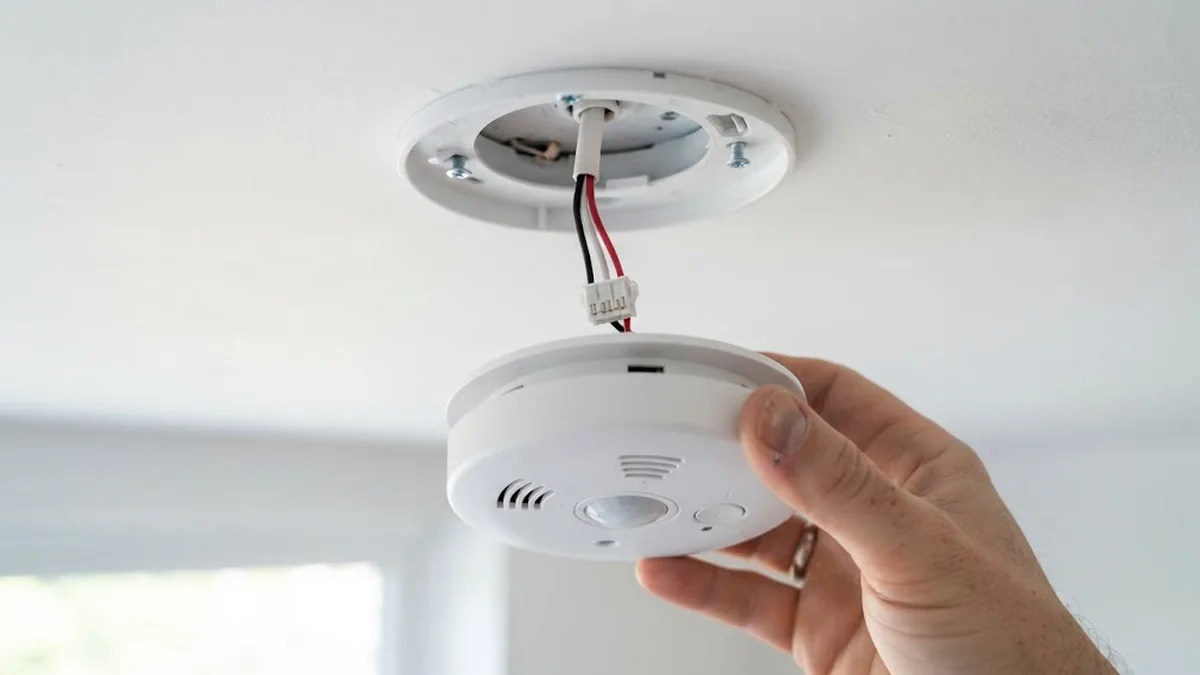
Table of Contents
- What Is a Hardwired Smoke Detector?
- Hardwired vs Battery Smoke Detectors
- Sensor Types: Ionization, Photoelectric or Dual
- Hardwired Smoke Detector Options Worth Considering
- How to Replace a Hardwired Smoke Detector
- Common Hardwired Smoke Detector Problems
- How Often to Maintain Hardwired Alarms
- How Interconnected Hardwired Alarms Work
- Replacing Old Alarms: Adapter Plugs and Same-Brand Upgrades
- Building Code Requirements
- What Does Hardwired Installation Cost?
- Where to Install Hardwired Smoke Alarms
- Smart Options for Hardwired Systems
- Frequently Asked Questions
- Final Thoughts
What Is a Hardwired Smoke Detector?
A hardwired smoke detector connects to your home’s 120V electrical circuit through a small wiring harness in a ceiling or wall box. It has three key parts:
- Main power from your home’s electrical system, so it does not depend on a battery day to day.
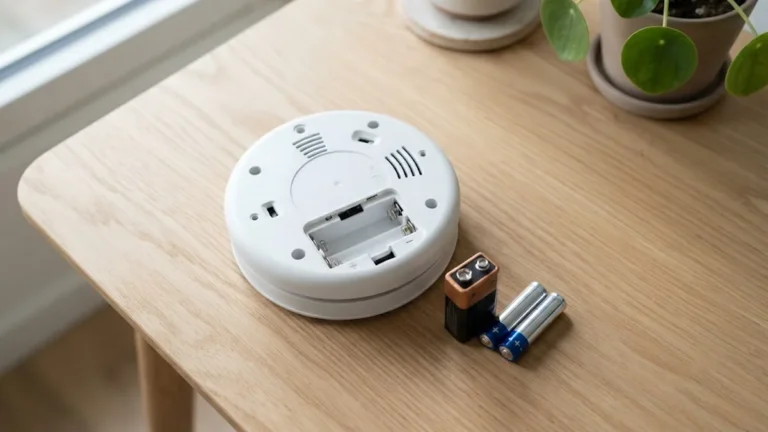
- Backup battery (9V, AA or a sealed 10-year lithium cell) that keeps it working during power cuts.
- Interconnect wire, usually red or orange, that links alarms so they all sound together.
Building codes in much of the US require hardwired, interconnected alarms in new construction. The US Fire Administration recommends interconnected alarms in every home, with alarms inside and outside each sleeping area and on every level, and notes that only a qualified electrician should install new hardwired alarms.
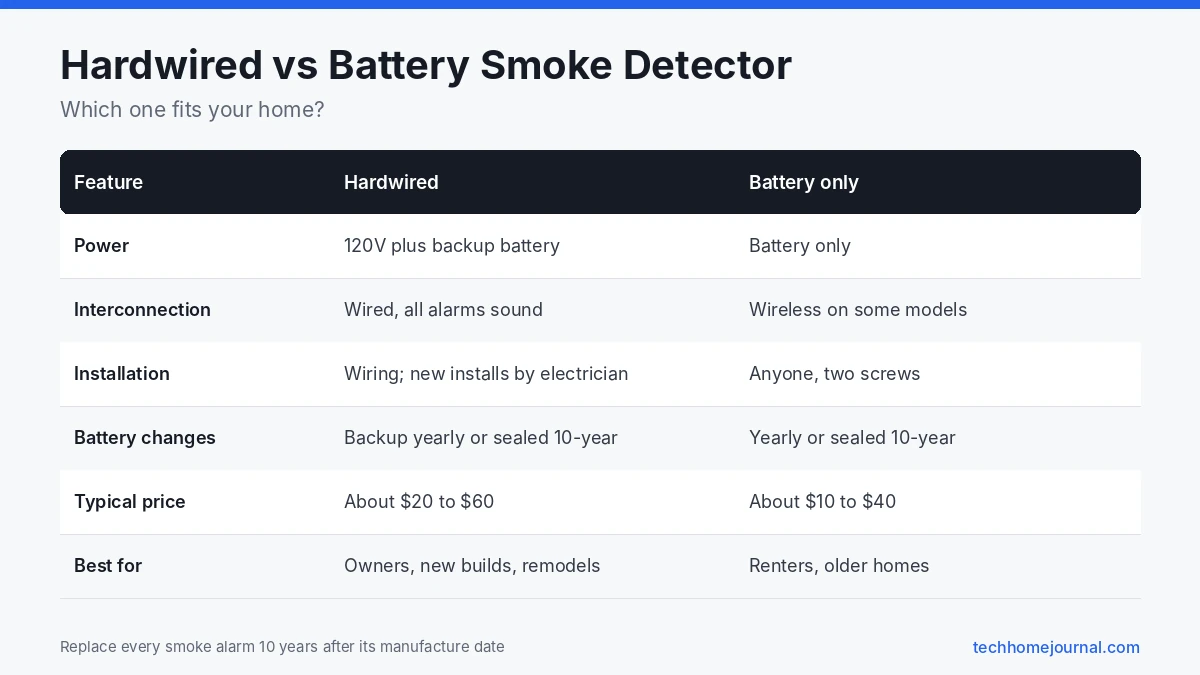
Hardwired vs Battery Smoke Detectors
| Hardwired | Battery only | |
|---|---|---|
| Power | Household power plus backup battery | Battery only |
| Interconnection | Wired, very reliable | Wireless on some models |
| Installation | Needs wiring (new installs by an electrician) | Screw to ceiling, anyone can do it |
| Battery changes | Backup only, or none with sealed models | Yearly, or none with sealed models |
| Typical cost per alarm | About $20 to $60 for standard models | About $10 to $40 for standard models |
| Best for | Homeowners, new builds, remodels | Renters, older homes without wiring |
The biggest advantage of hardwired alarms is the wired interconnect. When one detects smoke, every alarm sounds, which gives people in distant bedrooms precious extra seconds. The NFPA’s smoke alarm guidance notes that working smoke alarms cut the risk of dying in a home fire in half.
Sensor Types: Ionization, Photoelectric or Dual
Smoke alarms use one of two main sensing methods:
- Ionization alarms respond quickly to fast, flaming fires. They are also more prone to nuisance alarms from cooking.
- Photoelectric alarms respond faster to slow, smoldering fires, such as a cigarette in a sofa, and are less likely to go off from toast.
- Dual sensor alarms combine both.
Many fire safety groups recommend photoelectric or dual sensor alarms for most rooms, especially near kitchens. Newer alarms certified to the latest UL 217 standard are also tested for better cooking nuisance resistance. When you shop, check the box for the sensor type and the UL listing.
Hardwired Smoke Detector Options Worth Considering
We have not tested these alarms; this is a research based overview of current, widely available hardwired models. Prices change often, so check current listings.
First Alert SM300-AC (dual sensor)
A hardwired alarm with both photoelectric and ionization sensors and an AA battery backup. First Alert lists it as the replacement for its older 3120B, and it can interconnect with other compatible First Alert/BRK alarms. See First Alert’s SM300-AC product page for details.
- Good for: a straightforward upgrade from an older First Alert/BRK system.
- Watch for: confirm the plug fits your existing harness or use the included adapter.
Kidde 20SA10 (photoelectric, sealed 10-year battery)
A Kidde hardwired photoelectric alarm with a sealed 10-year backup battery, so you never change a battery. It suits homeowners who want the lowest maintenance option.
- Good for: set and forget households.
- Watch for: replace the whole alarm when it signals end of life.
Smoke and CO combination models
Combination alarms such as the First Alert SMICO100-AC or Kidde 30CUAR add carbon monoxide detection, which is required in many areas near bedrooms if you have gas appliances or an attached garage. Our smart carbon monoxide detector guide explains where CO alarms belong.
First Alert SC5 (smart, smoke and CO)
Google stopped making the Nest Protect in 2025 and partnered with First Alert. The First Alert SC5, sold on the Google Store, comes in battery and hardwired versions, detects smoke and CO, sends phone alerts, works in the Google Home app and fits the Nest Protect base plate. It is a natural choice if you are replacing Nest Protects, and our Google Home tips cover how to get more from the app. Our list of the best smart smoke detectors covers more connected options.

How to Replace a Hardwired Smoke Detector
Replacing an existing hardwired alarm with a compatible model is a common DIY job, because the wiring is already in place. Installing new circuits is a job for a licensed electrician.
- Turn off the breaker for the smoke alarm circuit. Many alarms share a circuit with bedroom lights.
- Twist the old alarm off its mounting plate and unplug the wiring harness from the back.
- Check the harness. If the new alarm is the same brand, its plug often fits the old harness. If not, you will need to replace the harness and mounting plate using the wire nuts in the box: black to black (hot), white to white (neutral), red or orange to the interconnect wire.
- Install the new mounting plate to the electrical box.
- Insert the backup battery or activate the sealed battery as the instructions describe.
- Plug in the harness, twist the alarm onto the plate, and turn the breaker back on.
- Press Test on each alarm and confirm all interconnected alarms sound.
Always replace interconnected alarms with models the manufacturer lists as compatible. Mixing brands on one interconnect wire may not work and can stop alarms from sounding together.
Common Hardwired Smoke Detector Problems
- Chirping: usually a low backup battery or an alarm at end of life. Our guide to smoke detector beeping covers every chirp pattern.
- All alarms going off at once with no smoke: find the initiating unit (it often has a different flashing light), then clean or replace it.
- Green power light off: check the breaker and the harness connection.
- False alarms near kitchens or bathrooms: move alarms at least 10 feet from cooking appliances where codes allow, or use photoelectric models.
- Alarm older than 10 years: replace it, even if it still tests fine.
How Often to Maintain Hardwired Alarms
- Test monthly with the Test button.
- Replace backup batteries yearly unless they are sealed 10-year units.
- Vacuum the vents every six months.
- Replace all alarms every 10 years from the manufacture date on the back.
If you are building a broader safety setup, our guides to home automation for safety and the best home alarm systems show how smoke alarms fit alongside sensors, cameras and monitoring.
How Interconnected Hardwired Alarms Work
The big advantage of a hardwired system is interconnection. When one alarm detects smoke, every alarm in the home sounds, so a fire in the basement wakes people in upstairs bedrooms.
- Three wires: most hardwired alarms use a black (live), white (neutral) and a third interconnect wire, often red or orange. The interconnect wire carries the alarm signal between units.
- Same brand family: interconnected alarms usually need to be from the same brand, and often from compatible product lines. Mixing brands on one interconnect wire can cause false alarms or no alarm at all.
- Limits: each brand sets a maximum number of interconnected devices. Check the manual before adding more.
- Wireless interconnect: some hardwired alarms can also link wirelessly to battery alarms in rooms without wiring, such as a loft conversion.
When testing, press the test button on one alarm and walk the house to make sure every unit sounds. Ask someone to stay in each bedroom with the door closed to check the alarm is loud enough there.
Replacing Old Alarms: Adapter Plugs and Same-Brand Upgrades
Hardwired alarms connect to a wiring harness, a small plug on the end of the house wires. Each brand uses its own plug shape, which affects how easy an upgrade is:
- Same brand: replacing a Kidde with a Kidde, or a First Alert with a First Alert, often lets you reuse the existing harness or swap it quickly. Check that the new model lists your old one as compatible.
- Different brand: you’ll need to replace the harness on every alarm in the interconnected group, or use an adapter plug where the maker offers one.
- All at once: since alarms should be replaced every 10 years, it’s usually best to replace every unit in the home on the same day. This keeps interconnection reliable and resets the 10-year clock for all of them.
Always turn off the circuit at the breaker before unplugging the harness, even though the plug is designed to be handled.
Building Code Requirements
In the US, building codes for new homes and major renovations generally require smoke alarms that are hardwired, interconnected and fitted with battery backup. Requirements are based on standards like NFPA 72 and the International Residential Code, but local rules vary. Many areas also require carbon monoxide alarms in homes with fuel-burning appliances or attached garages.
If you’re renovating or selling, check with your local building department or fire service. Inspectors often check alarm age, placement and interconnection.
What Does Hardwired Installation Cost?
Costs depend mostly on whether wiring is already in place:
- Replacing existing hardwired alarms: the cheapest job. Many homeowners do it themselves, and an electrician can usually swap several in one visit.
- Adding new hardwired alarms: needs new cable runs through walls and ceilings, which takes more time and adds plaster repair.
- Wireless interconnected alternatives: sealed 10-year battery alarms that link wirelessly avoid new wiring entirely and are a good option where local rules allow them.
Get a written quote that lists the number of alarms, the model and whether old units will be taken away. For more on battery choices, see our smoke detector beeping guide.
Where to Install Hardwired Smoke Alarms
Hardwired alarms are harder to move later, so placement matters even more than with battery units. Follow the usual NFPA guidance:
- One inside each bedroom, one outside each sleeping area, and one on every level, including the basement.
- On the ceiling, or high on a wall within the distance the manual allows.
- At least about 3 m (10 ft) from cooking appliances, and away from bathroom doors where steam escapes.
- Away from ceiling fans, supply vents and windows that create drafts.
- At the top of open staircases, where smoke collects.
In open-plan homes with high or sloped ceilings, follow the manual’s guidance for peaked ceilings rather than mounting right at the apex, where trapped hot air can delay detection.
Smart Options for Hardwired Systems
You don’t have to give up phone alerts with a hardwired system. Options include:
- Smart hardwired alarms that connect to Wi-Fi and send alerts to an app.
- Smart listeners that hear the alarm sound and notify your phone, without replacing the alarms.
- Security system integration: some alarm systems, such as Ring Alarm, offer listeners or compatible smoke sensors that link alarms into professional monitoring.
Check that any smart device keeps the hardwired interconnection working. The alarms themselves should still sound together even if Wi-Fi is down.
Frequently Asked Questions
Do hardwired smoke detectors need batteries?
Most do, as a backup during power cuts. Some newer models use a sealed 10-year battery that never needs replacing.
Can I replace a hardwired smoke detector with a battery one?
You can, but you lose the wired interconnection and may break local code requirements. It is usually better to replace like for like.
Can I mix brands of hardwired smoke detectors?
Generally no on the same interconnect wire. Use alarms the manufacturer lists as compatible so they all sound together.
How long do hardwired smoke detectors last?
About 10 years. Replace them by the manufacture date, even if they still seem to work.
Do I need an electrician to replace a hardwired smoke detector?
Swapping an alarm on existing wiring is a common DIY task with the power off. Running new wiring or adding new alarm locations should be done by a licensed electrician.
Why do all my hardwired smoke alarms go off at once?
They are interconnected, which is a safety feature. If it happens with no smoke, one unit is likely faulty, dirty or at end of life.
Can I add a battery smoke alarm to a hardwired system?
Not with a wire, but some brands sell wireless alarms that link to compatible hardwired units. Check that both models list wireless interconnection with each other.
What is the red wire on a hardwired smoke detector?
It’s usually the interconnect wire. It carries the alarm signal between alarms so they all sound together. It doesn’t carry mains power in normal use, but always treat every wire as live and switch off the breaker first.
Should I choose photoelectric or dual-sensor hardwired alarms?
Photoelectric sensors respond faster to slow, smouldering fires and give fewer cooking false alarms. Dual-sensor models combine photoelectric and ionisation sensing. Either is a good choice; many fire services recommend photoelectric near kitchens.
How do I find which hardwired alarm triggered first?
Many interconnected alarms flash their light faster on the unit that started the alarm, or remember it after the alarm stops. Check the manual for your model’s “initiating unit” or “alarm memory” pattern.
Why does my hardwired smoke alarm chirp after a power cut?
The backup battery may have drained while the power was off. Replace the battery, then hold the test button for 15 to 20 seconds to clear any stored warning.
Do hardwired smoke detectors work during a power outage?
Yes, as long as the backup battery is charged. That’s why the backup battery matters even on a hardwired system.
Can I install hardwired smoke alarms myself?
Replacing an existing hardwired alarm with a compatible model is a common DIY job if you’re comfortable switching off a circuit and handling a plug-in harness. Running new cable or adding circuits is a job for a qualified electrician, and some areas require one by law.
Final Thoughts
A hardwired smoke detector gives you constant power, a battery backup and, most importantly, interconnection that alerts the whole house at once. Choose photoelectric or dual sensor models, add CO detection where needed, and replace every alarm after 10 years. If you want phone alerts and app control, a smart hardwired model like the First Alert SC5 adds those on top of the same reliable wiring.