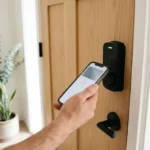

Your living room probably has more CO risk than you think. A gas fireplace, a wood stove or even an attached garage wall can push carbon monoxide into the room where your family spends the most time. A smart carbon monoxide detector catches what your nose can’t, since CO has no smell, no color and no warning signs until someone already feels sick.
This guide walks through what actually matters when picking one: sensor tech, alarm levels, placement, app behavior and the current models worth a look, plus how to find a unit that won’t clash with a clean Scandinavian living room.
Table of Contents
- Quick Answer: What to Look For
- Why the Living Room Needs Its Own CO Sensor
- Electrochemical vs. Metal Oxide Sensors
- CO Alarm Levels: When Does It Go Off?
- Key Features That Separate Good Units From Junk
- Placement Rules Most People Get Wrong
- App Alerts and Smart Home Integration
- Smart CO Detectors Worth Considering in 2026
- Design That Fits a Scandinavian Living Room
- Combo Units vs. Standalone Detectors
- Budget Tiers: What You Get at Each Price
- Buying Checklist
- Frequently Asked Questions
- Final Verdict
Quick Answer: What to Look For
- An electrochemical sensor with a 7 to 10 year rated life
- UL 2034 listing in the US (EN 50291 in the UK/EU)
- A digital PPM readout or app history, so you can see low readings before the alarm sounds
- Push alerts to your phone, plus a loud local alarm that works even if Wi-Fi drops
- Battery backup (or a sealed 10-year battery) and an end-of-life warning
- Compatibility with the ecosystem you already use: Google Home, Alexa or Apple Home
Why the Living Room Needs Its Own CO Sensor
Most homes have one CO alarm, usually stuck in a hallway near the bedrooms. That’s fine for catching a leak while you sleep. It does much less for the hours you spend in the living room.
Gas fireplaces are a common culprit. A cracked heat exchanger or a blocked flue can leak CO slowly, and you won’t notice until you’re dizzy or nauseous. Attached garages share a wall with plenty of living rooms too, and a car left running for even a few minutes can push CO through gaps in drywall and framing. (Our garage security ideas guide covers other smart upgrades for that space.)
The CDC says more than 400 Americans die each year from unintentional CO poisoning not linked to fires, and symptoms like headache, dizziness, weakness and confusion are often mistaken for the flu. That overlap is exactly why people miss it. A dedicated smart carbon monoxide detector in the living room closes the gap, especially in homes with any combustion source nearby.
Electrochemical vs. Metal Oxide Sensors
There are two sensor types worth knowing before you shop. Electrochemical sensors use a chemical reaction to measure CO molecules, and they’re the standard for accuracy in home alarms. Most mid-range and premium smart detectors use this tech.
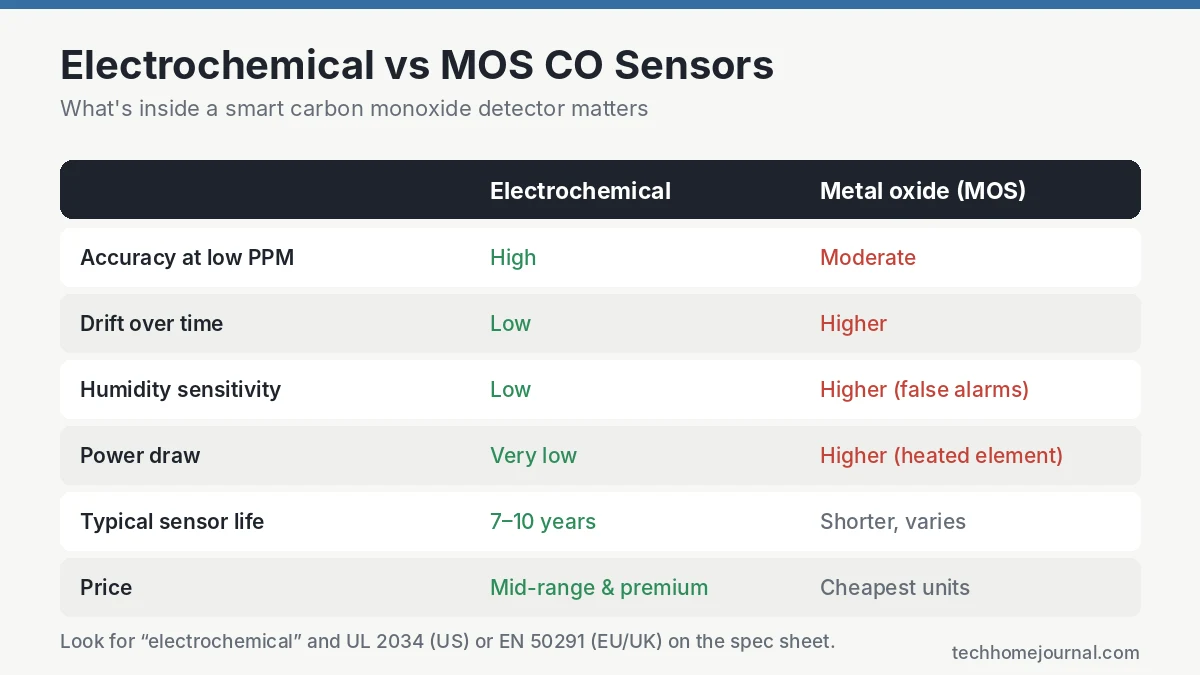
Metal oxide semiconductor (MOS) sensors are cheaper to make. They work, but they’re more prone to drift over time, use more power because of their heated element, and can give false readings in humid rooms. If your living room sits next to an open kitchen or has poor ventilation, that drift matters.
In practical terms: check the spec sheet for “electrochemical sensor” before buying. If a listing doesn’t mention the sensor type at all, ask the seller or pick a model that does.
- Electrochemical: more accurate, longer lifespan, usually a 7 to 10 year sensor rating
- MOS: cheaper upfront, shorter reliable lifespan, more prone to false alarms in humid air
- Certification: look for UL 2034 (US) or EN 50291 (UK/EU) whatever the sensor type
CO Alarm Levels: When Does It Go Off?
Home CO alarms don’t sound the instant they see any carbon monoxide. Under UL 2034, an alarm must go off within a time window that shrinks as the concentration rises. BRK/First Alert lists the thresholds as:
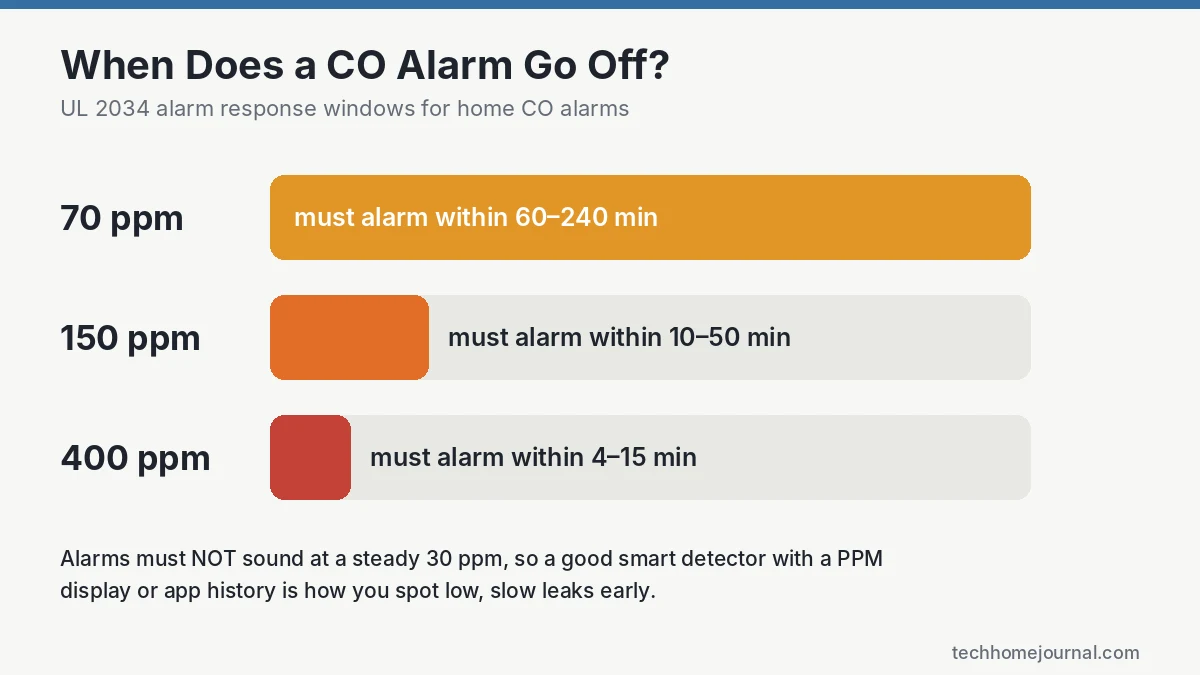
- 70 ppm: must alarm within 60 to 240 minutes
- 150 ppm: must alarm within 10 to 50 minutes
- 400 ppm: must alarm within 4 to 15 minutes
The standard also says an alarm should not sound at a steady 30 ppm, to avoid nuisance alarms. That’s the real case for a smart model: a PPM display or app history lets you notice low, persistent readings from a fireplace or furnace long before the siren goes off.
Key Features That Separate Good Units From Junk
Not every “smart” CO detector is actually smart. Some just bolt Wi-Fi onto an old sensor design. Here’s what separates a useful unit from a badge-slapped one:
- Digital PPM display, not just a pass/fail light
- 10-year sealed battery, or plug-in/hardwired with battery backup, since power cuts don’t pause CO risk
- Automatic self-test, so you know the sensor is alive without pressing a button
- End-of-life alert telling you when to replace the whole unit, not just the batteries
- Voice alert that says “carbon monoxide” instead of a generic beep, which matters for kids or guests unfamiliar with alarm patterns
- Interconnect, so one alarm triggers the others in the house
Skip anything that doesn’t list a sensor lifespan. If a company won’t say how long the sensor lasts, assume it’s short and budget for early replacement.
Placement Rules Most People Get Wrong
The U.S. Consumer Product Safety Commission recommends a CO alarm on every level of the home and outside sleeping areas. CO mixes with air rather than sinking or rising sharply, so the high-vs-low debate that applies to smoke alarms matters less here. Follow the manufacturer’s height instructions, since they vary by model.
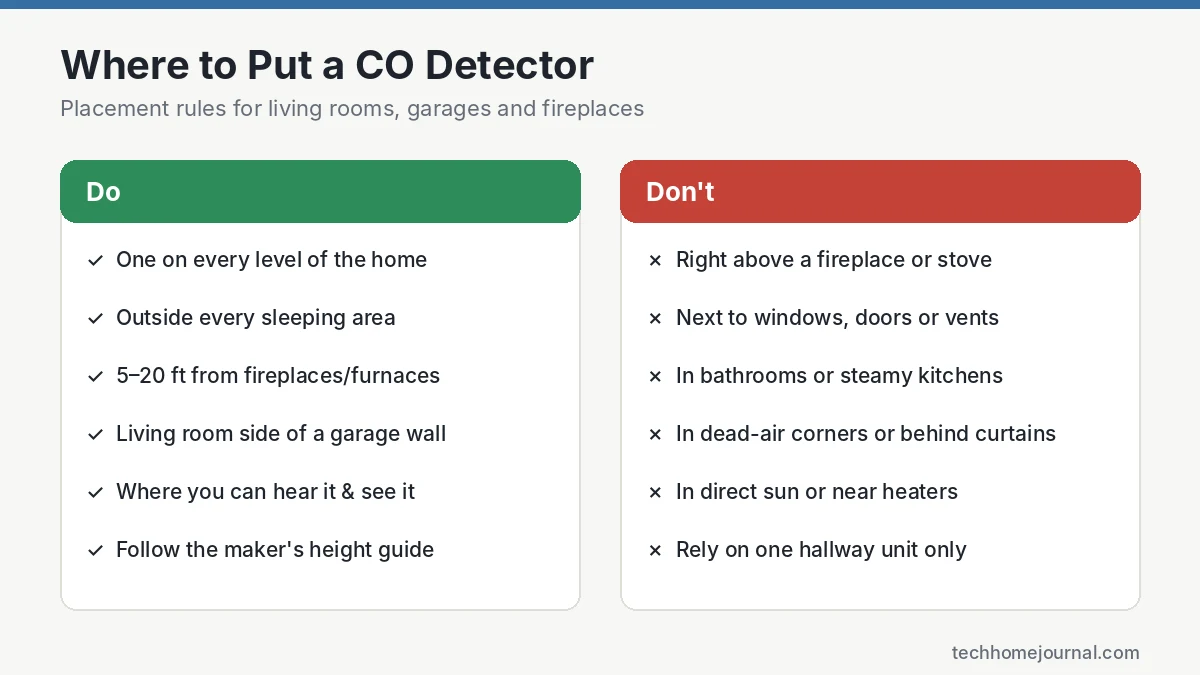
Don’t put a unit directly above or beside a fireplace. Heat and combustion byproducts right at the source can trigger nuisance alarms and shorten sensor life. Kidde’s placement guide suggests keeping alarms 5 to 20 feet from fuel-burning sources like furnaces, water heaters and fireplaces, and away from windows, doors and dead-air spaces.
Pro tip: if your living room has a vaulted ceiling, mount the detector on a lower wall section rather than the highest peak, where air can sit still. For an attached garage, put a detector on the living room side of the shared wall. That’s the fastest way to catch a leak before it spreads through the house. The same “put the sensor where the risk starts” logic applies to water leak sensor placement.
App Alerts and Smart Home Integration
This is where “smart” earns the name. A good app sends a push notification the moment the alarm sounds, so you know about a problem at home even when you’re out, and the better ones also show rising PPM readings before the alarm threshold.
Look for integration with your existing ecosystem. Detectors that work with Google Home, Amazon Alexa or Apple Home let you build useful automations:
- Shut off the furnace fan through a smart thermostat (see our Nest vs. Ecobee comparison)
- Turn on all the lights so everyone can find their way out
- Send alerts to every family member, not just the account owner
Battery and connection status should be visible in the app at all times. A detector that goes offline silently defeats the point of going smart. For more ideas, see our guides to home automation for safety and the best home monitoring apps.
Smart CO Detectors Worth Considering in 2026
One big change to know about: Google discontinued the Nest Protect in March 2025. Existing units keep working until their expiry date, but you’re buying old stock if you find one now. Google’s recommended successor is a First Alert model that works in the Google Home app.
| Model | Type | Power | Smart features | Approx. price |
|---|---|---|---|---|
| First Alert SC5 | Smoke + CO | Hardwired or battery versions | Wi-Fi, First Alert app, Google Home, voice warnings, interconnects with Nest Protect | ~$130 |
| Kidde Smart CO + Indoor Air Quality | CO + TVOC | Plug-in (Wi-Fi needs AC power) | Kidde app, PPM display, voice alerts, Alexa and Google Home | Mid-range |
| X-Sense XC04-WX | CO only | Replaceable CR123A battery | Wi-Fi, X-Sense app, LCD PPM display, no hub needed | ~$40 |
First Alert SC5: the most natural pick for Google Home households and anyone replacing Nest Protects, since it interconnects with them. As a combo unit, it covers smoke and CO in one spot.
Kidde Smart CO with Indoor Air Quality Monitor: a good fit for a living room outlet near a fireplace. It shows CO in PPM and adds a TVOC (volatile organic compounds) reading, which is handy if you also care about general air quality.
X-Sense XC04-WX: a budget, CO-only Wi-Fi alarm with a large LCD readout. It doesn’t connect to Alexa, Google Home or HomeKit, so it’s best for people who just want phone alerts.
Design That Fits a Scandinavian Living Room
Scandinavian design leans on clean lines, muted tones and function that doesn’t shout for attention. Many CO detectors are stark, glossy plastic boxes, which stick out against a room built around warm neutrals and natural materials.
- Choose matte white or soft gray finishes over glossy plastic
- Disc or puck shapes blend into ceilings better than tall rectangular units
- Plug-in units can sit low behind a sofa end or console, as long as vents stay clear
- Avoid always-lit screens if you dim the room at night; look for displays that light up on demand
Never paint over a detector or hide it behind curtains or shelves, since that blocks the sensor vents. For other ways to keep tech discreet, see our smart devices for a Scandinavian living room roundup.
Combo Units vs. Standalone Detectors
Combination smoke and CO detectors are everywhere now, and the convenience is real: one unit, one mounting point, one app. But the two hazards want slightly different spots. Smoke alarms belong on the ceiling and inside bedrooms, while a CO alarm should sit near the risk zone, like a fireplace wall or garage wall.
For a living room with a fireplace or a shared garage wall, a standalone CO detector placed for that specific risk, alongside your existing smart smoke detectors, usually makes more sense than relying on one combo unit to cover both jobs from a single spot.
Budget Tiers: What You Get at Each Price
Entry-level (under ~$50): basic app alerts and a display, but often battery-only and with few smart home integrations. Fine as an extra unit near a specific risk.
Mid-range (~$50 to 100): typically electrochemical sensors, digital PPM readouts, voice alerts and broader ecosystem support. This is where most buyers land and a sensible pick for a primary living room unit.
Premium (~$100 to 150): smoke + CO combos with polished design, voice alerts that name the room, interconnect and tight ecosystem integration. Worth it if you’re building out a full smart home. Prices shift with sales and bundles, so check the manufacturer’s current listing.
Buying Checklist
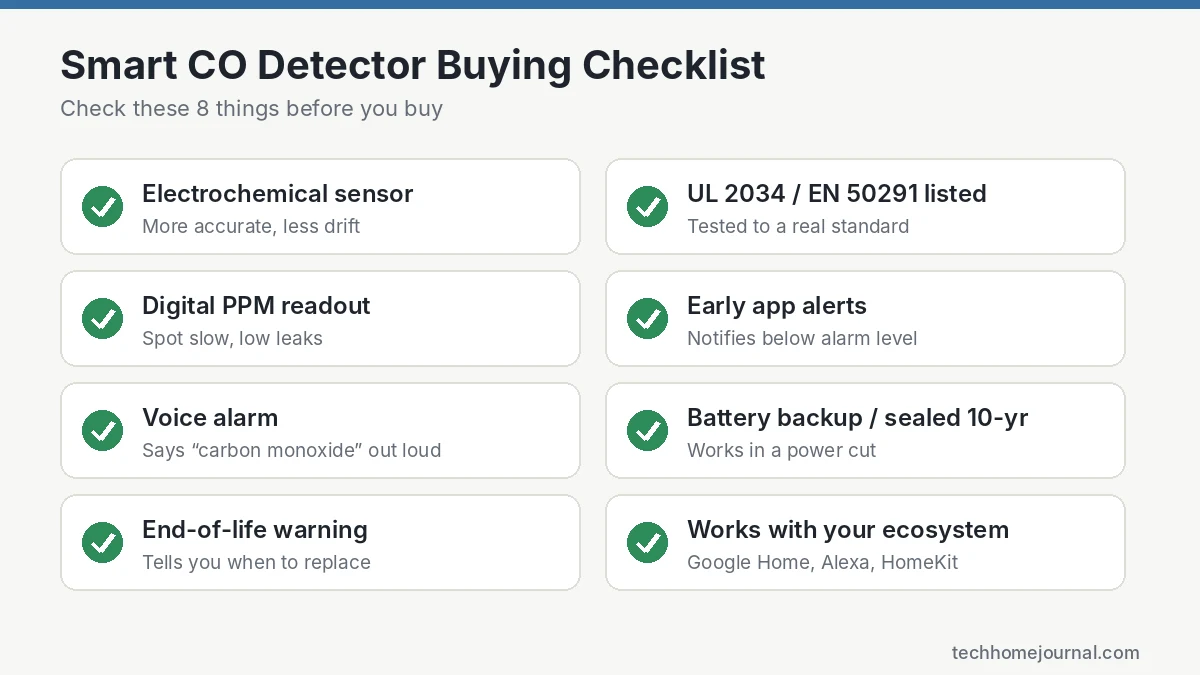
Start with placement: figure out your actual risk zones (fireplace, garage wall, gas appliance), then buy the unit that fits that spot rather than grabbing whatever’s cheapest. If a model can’t tick at least six of the eight boxes above, keep looking. And remember a CO alarm is one layer of a wider living room safety and security setup.
Frequently Asked Questions
How often should I replace a smart carbon monoxide detector?
Most units last 7 to 10 years, based on the sensor’s rated life rather than the housing. Check the manufacture date on the back and set a calendar reminder, though most smart models also send an end-of-life alert.
Can a smart carbon monoxide detector work without Wi-Fi?
Yes. Listed CO alarms still sound a local alarm and most still show readings if Wi-Fi drops. You just lose remote push notifications and app history until the connection returns.
Do I need one detector per room or just one for the whole house?
The minimum is one on every level and outside sleeping areas. Add extra units near fuel-burning appliances and next to an attached garage, since a single hallway alarm may react slowly to a leak in another part of the house.
Is a combo smoke and CO detector good enough for the living room?
It works for basic coverage, but a standalone CO detector placed near your specific risk zone, like a fireplace wall, usually covers it better. Combo units are a reasonable compromise if budget or mounting space is tight.
What PPM level should worry me?
UL 2034 alarms must sound within 60 to 240 minutes at 70 ppm, and much faster at higher levels. Even so, a steady reading above zero on your app or display is worth investigating. Check fireplaces, furnaces and the garage, and call a qualified technician if it persists.
What should I do if my CO alarm goes off?
Get everyone, including pets, outside into fresh air right away, then call 911 or your local emergency number. Don’t go back in until emergency services say it’s safe, even if the alarm stops.
Is the Google Nest Protect still worth buying?
Google discontinued it in March 2025. Units already installed are supported until they expire, but for a new purchase the First Alert SC5 is the intended successor and works with the Google Home app.
Final Verdict
A smart carbon monoxide detector isn’t a nice-to-have if your living room shares a wall with a garage or sits near a gas fireplace. It’s the difference between catching a slow leak early and not catching it until someone feels sick.
Prioritize an electrochemical sensor, UL 2034 listing, a real PPM display and app alerts you’ll actually see. From there, design is fair game. Scandinavian rooms don’t have to compromise on safety hardware just because most detectors look like they belong in a server closet.