
Most people install a smoke detector and forget about it for years. A smart smoke detector changes that: it sends alerts to your phone when you’re away, tells you which room has a problem, warns you before the battery dies and can link into the rest of your smart home.
The market also changed a lot recently. Google discontinued the Nest Protect in 2025, some older connected alarms have been retired, and Kidde and Ring launched new jointly developed alarms. This guide covers the smart smoke detectors that are actually worth buying in 2026 and how to choose between them.
Table of Contents
- Quick Picks
- Comparison Table
- First Alert SC5: Best for Google Home
- Kidde Smart Alarms with Ring: Best for Ring Homes
- Kidde Smoke + CO + Air Quality: Best All-in-One
- X-Sense Wireless Interconnect Kit: Best for Large Homes
- Aqara Smoke Detector: Best for Zigbee and Apple Home
- Ring Smoke & CO Listener: Best Add-On for Existing Alarms
- Discontinued Models to Avoid Buying New
- Photoelectric vs. Ionization Sensors
- Where to Install Smoke Alarms
- How to Choose
- Frequently Asked Questions
- Final Verdict
Quick Picks
- Best for Google Home: First Alert SC5 Smart Smoke & CO Alarm
- Best for Ring homes: Kidde Smart Smoke / Smoke + CO Alarms with Ring
- Best all-in-one: Kidde Smart Smoke + CO Alarm with Indoor Air Quality Monitor
- Best for large homes: X-Sense XS01-M alarms with SBS50 base station
- Best for Zigbee / Apple Home: Aqara Smoke Detector
- Best add-on: Ring Alarm Smoke & CO Listener
Comparison Table
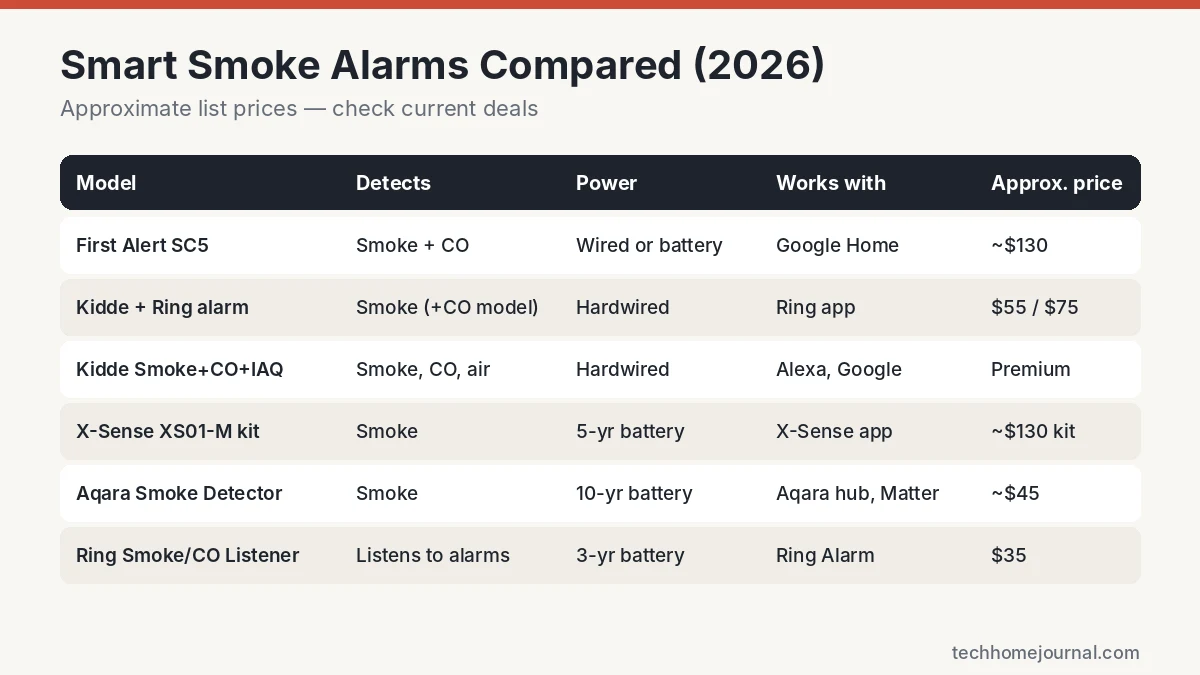
| Model | Detects | Power | Works with | Approx. price |
|---|---|---|---|---|
| First Alert SC5 | Smoke + CO | Hardwired or battery versions | First Alert app, Google Home | ~$130 |
| Kidde Smart Alarm with Ring | Smoke, or smoke + CO | Hardwired with battery backup | Ring app (optional monitoring) | ~$55 smoke / ~$75 combo |
| Kidde Smoke + CO + IAQ | Smoke, CO, air quality | Hardwired | Kidde app, Alexa, Google Home | Premium |
| X-Sense XS01-M + SBS50 | Smoke | Replaceable 5-year battery | X-Sense app | ~$130 to 140 per kit |
| Aqara Smoke Detector | Smoke | Battery (up to 10 years) | Aqara Zigbee hub, Matter via hub | ~$45 |
| Ring Smoke & CO Listener | Listens for existing alarms | 3V battery (up to 3 years) | Ring Alarm / Alarm Pro | ~$35 |
First Alert SC5: Best for Google Home
When Google retired the Nest Protect, it pointed buyers to the First Alert SC5. It detects both smoke and carbon monoxide, sends mobile alerts through the First Alert app, works in the Google Home app and speaks voice warnings. It comes in hardwired and battery-powered versions and can interconnect with compatible First Alert/BRK alarms and existing Nest Protects, which makes it the easiest upgrade path if you already have a few Nest units.
Key specs: smoke + CO, Wi-Fi, voice warnings, Google Home support, hardwired or battery versions, approx. $130.
- Pros: official Nest Protect successor, smoke and CO in one, works with existing Nest Protects
- Cons: pricier than most rivals; Google Home is the main ecosystem
Kidde Smart Alarms with Ring: Best for Ring Homes
Kidde and Ring launched jointly developed smart smoke and smoke + CO alarms in 2025. They send real-time alerts through the Ring app, warn you seven days before the battery runs low, and are designed to cut nuisance alarms from cooking. Launch prices were $54.97 for the smoke alarm and $74.97 for the smoke + CO combo, with optional professional monitoring for around $5 a month.
Key specs: smoke or smoke + CO, Ring app alerts, optional 24/7 monitoring, hardwired with battery backup.
- Pros: affordable, built into the Ring app you may already use, optional monitoring
- Cons: best value only if you’re already in the Ring ecosystem; hardwired install
Kidde Smoke + CO + Air Quality: Best All-in-One
The Kidde P4010ACSCOAQ-WF combines smoke detection, CO detection and indoor air quality (IAQ) monitoring in one hardwired unit. The Kidde app sends alerts, lets you run tests remotely and includes Smart Hush for silencing a false alarm while you’re home. It works with Alexa and Google Home and links to existing Kidde hardwired interconnected alarms. For CO in particular, see our smart carbon monoxide detector guide.
- Pros: three sensors in one, Alexa and Google support, works with existing Kidde wiring
- Cons: hardwired only; costs more than a basic smart alarm
X-Sense Wireless Interconnect Kit: Best for Large Homes
X-Sense’s XS01-M smoke alarms connect to an SBS50 base station and link up to 24 wireless units, so when one alarm sounds, the rest follow. Each uses a photoelectric sensor, an 85 dB siren and a replaceable CR123A battery rated for about five years, with a 10-year product life. The X-Sense app shows which alarm triggered and lets you test or silence alarms remotely. Kits sell for roughly $130 to 140.
- Pros: no wiring, wide interconnect, good value per room
- Cons: smoke only (add CO alarms separately); reviewers note you should place the base station carefully for a stable signal
Aqara Smoke Detector: Best for Zigbee and Apple Home
The Aqara Smoke Detector (SD-S01D) is a photoelectric alarm with an 85 dB siren and a battery rated for up to 10 years. It uses Zigbee 3.0, so it needs an Aqara hub, which can also bring it into Apple Home, Google Home or Alexa through Matter. It’s a good fit if you already run Aqara sensors, and it can trigger automations like turning on lights. Read our Apple HomeKit guide or home automation hub guide if you’re setting up a hub for the first time.
- Pros: long battery life, strong automation options, affordable
- Cons: requires an Aqara hub; smoke only
Ring Smoke & CO Listener: Best Add-On for Existing Alarms
If your current alarms are less than 10 years old and working, you don’t have to replace them. The Ring Alarm Smoke & CO Listener ($34.99) mounts within a few inches of an existing alarm and sends a phone alert when it hears the siren. It runs on a 3V battery rated for up to three years. The catch: it requires a Ring Alarm or Alarm Pro system and does not detect smoke or CO itself.
- Pros: cheap way to make old alarms “smart,” quick install
- Cons: needs Ring Alarm; only as good as the alarm it listens to
Building a full system? Our wireless home security system guide explains how alarms, sensors and cameras fit together.
Discontinued Models to Avoid Buying New
- Google Nest Protect: discontinued in 2025. Existing units keep working until their expiry date, but don’t buy leftover stock for a new install.
- Roost Smart 9V Battery: discontinued by Roost; new setups are no longer possible.
- Leeo Smart Alert: the service was shut down, so the device no longer works as intended.
- Older First Alert Onelink alarms: some, like the Onelink DC10-500, are discontinued. Check that any Onelink model you find is still supported.
Photoelectric vs. Ionization Sensors
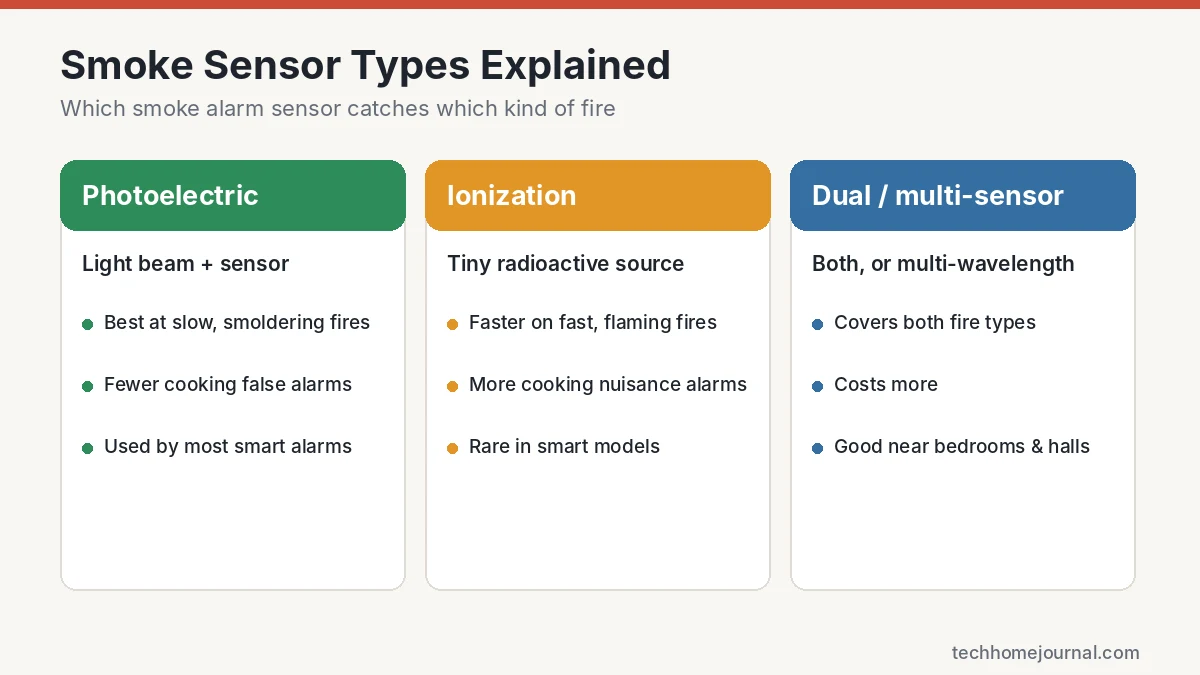
Photoelectric alarms use a light beam and sensor; they respond well to slow, smoldering fires and tend to give fewer nuisance alarms from cooking. Ionization alarms respond faster to fast, flaming fires but are more prone to kitchen false alarms. Dual-sensor and multi-sensor alarms cover both. The NFPA notes that working smoke alarms cut the risk of dying in a home fire in half, so whichever type you choose, the most important thing is that every alarm works and is in the right place.
Where to Install Smoke Alarms
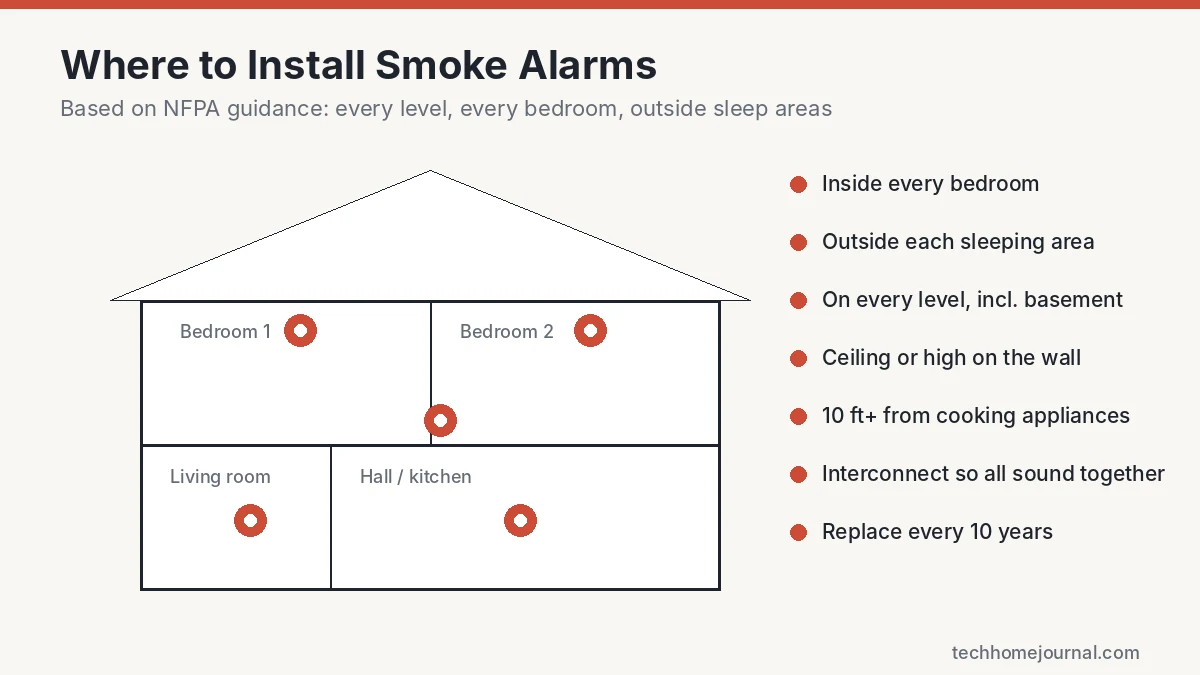
- Inside every bedroom and outside each sleeping area
- On every level of the home, including the basement
- On the ceiling or high on a wall, following the manufacturer’s instructions
- About 10 feet or more from cooking appliances to reduce nuisance alarms
- Interconnected, so when one sounds they all sound
- Replaced every 10 years, and tested monthly
The same “put the sensor where the risk is” logic applies to leaks; see our water leak sensor placement guide.
How to Choose
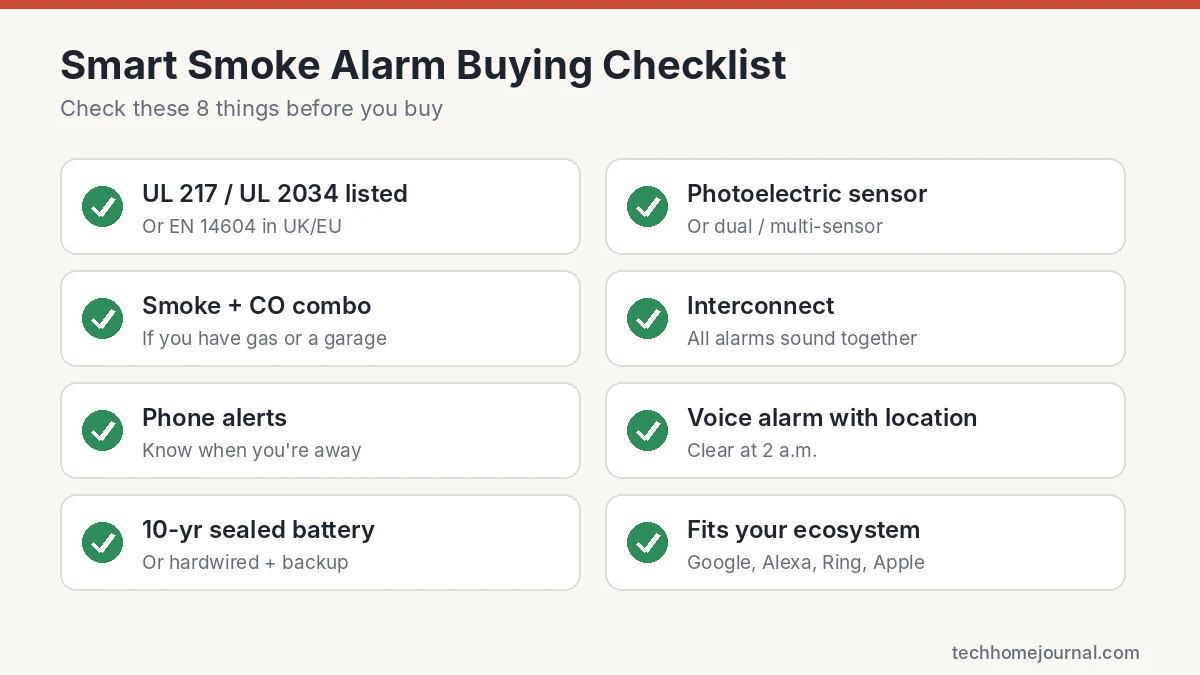
- Start with your ecosystem. Google Home → First Alert SC5. Ring → Kidde with Ring or the Ring Listener. Aqara/Apple Home → Aqara. No ecosystem → X-Sense.
- Decide on CO. If you have gas appliances, a fireplace or an attached garage, choose a smoke + CO combo or add separate CO alarms.
- Hardwired or battery? If your home already has hardwired alarms, replace like for like. Renters and older homes usually need battery models.
- Check certification. Look for UL 217 (smoke) and UL 2034 (CO) in the US, or EN 14604 in the UK/EU.
- Plan for every room. Six cheaper interconnected alarms protect a home better than one premium alarm in the hallway.
For automations that react to an alarm, like turning on all the lights or sending alerts to the whole family, see home automation for safety and our best home monitoring apps.
Related guides on Tech Home Journal:
- Smoke Detector Beeping? 9 Causes & How to Stop It
- Home Monitoring System 2026: Costs, Plans & Best Options
- Smart Water Shut-Off Valve Guide
Frequently Asked Questions
What is the difference between a smart smoke detector and a regular one?
A smart smoke detector connects to Wi-Fi or a hub and sends alerts to your phone, even when you’re away. Regular detectors only sound a local alarm. Smart models also add remote testing, battery warnings and links to Google Home, Alexa, Ring or Apple Home.
Is the Google Nest Protect still worth buying?
Not for a new install. Google discontinued it in 2025. Existing units are supported until they expire, and the First Alert SC5 is the recommended replacement.
How many smoke detectors does a home need?
One inside every bedroom, one outside each sleeping area and at least one on every level, including the basement. A typical two-story, three-bedroom home usually needs five or six alarms.
Do smart smoke detectors work without Wi-Fi?
Yes. Listed smart alarms still sound locally without internet. You lose phone alerts and app features until the connection returns. Add-ons like the Ring Listener depend on your Ring Alarm system being online to send alerts.
How often should smoke detectors be replaced?
Every 10 years from the manufacture date printed on the back. Many smart alarms also send an end-of-life alert. Test them monthly using the button or the app.
Can I mix different brands of smart smoke alarms?
You can, but wireless interconnect usually only works within one brand’s system. If you want every alarm to sound when one goes off, stick to one brand, or use hardwired interconnect.
Final Verdict
For most Google Home users, the First Alert SC5 is the natural pick now that Nest Protect is gone. Ring households get the best value from the Kidde alarms with Ring, or the Ring Listener if their current alarms are still in date. Large homes without wiring are well served by the X-Sense kit, and Aqara suits anyone with an existing Zigbee setup.
Whatever you choose, prioritize coverage and interconnect over app features: an alarm in every bedroom that you can hear from anywhere in the house matters more than any smart extra.