
A burst pipe can release hundreds of gallons of water in the time it takes you to drive home from work. Water damage is one of the most common home insurance claims, and most of it could be stopped in seconds if someone simply turned off the main valve. A smart water shut off valve does exactly that for you, automatically, even when nobody is home.
In this guide, you’ll learn how a smart water shut off valve works, the difference between inline and retrofit valves, how it pairs with leak sensors, what installation really involves, and which models are worth buying in 2026.
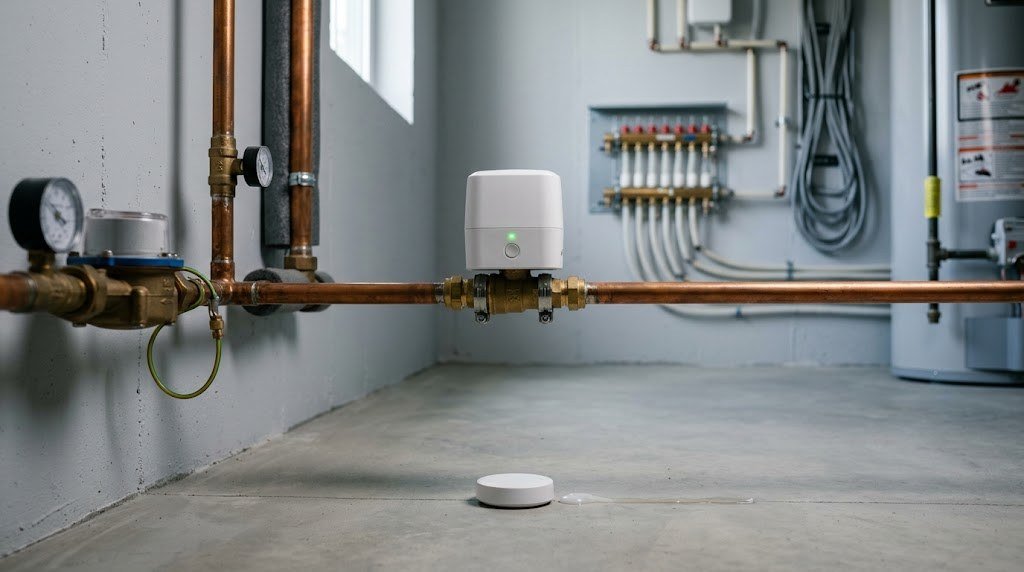
What Is a Smart Water Shut Off Valve?
A smart water shut off valve is a motorized valve (or a motor that turns your existing valve) connected to your home network. When it gets a signal that something is wrong, it closes the main water supply to your whole house. You can also open or close it from your phone, a voice assistant or a smart home routine.
There are two things a smart valve can react to:
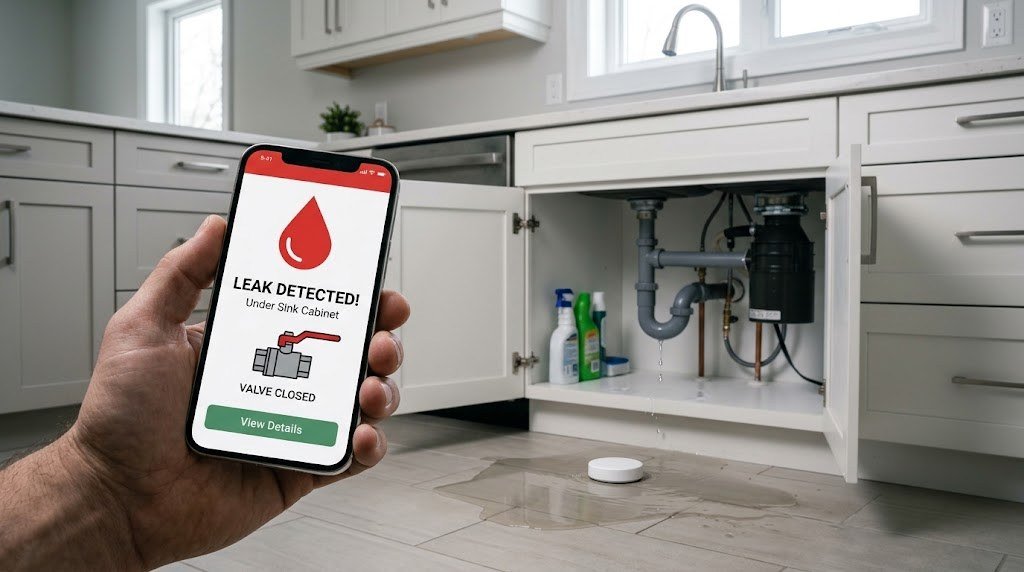
- Signals from leak sensors. Small sensors under sinks, behind the washing machine or next to the water heater detect water on the floor and tell the valve to close.
- Unusual water flow. More advanced inline valves measure flow and pressure themselves. If water keeps running at a rate that doesn’t match normal use, such as a burst pipe or a toilet that won’t stop filling, they shut off the water on their own.
The result is simple: instead of a flooded basement, you get a phone alert and a small puddle.
How a Smart Water Shut Off Valve Works
Every system follows the same basic chain of events:
- Detect. A leak sensor gets wet, or the valve’s built-in flow sensor spots abnormal flow.
- Decide. The valve (or your smart home hub) checks the rules you’ve set, such as “close the main valve if any leak sensor detects water.”
- Close. A motor turns the valve to the closed position, usually in 5 to 30 seconds depending on the model and pipe size.
- Alert. You get a push notification, and on some systems a phone call or text.
- Reset. Once the leak is fixed, you open the valve from the app or by hand.
Most smart valves also keep a manual override lever, so you can still operate them during a power or internet outage.
Inline vs Retrofit Smart Valves
This is the most important decision you’ll make, because it decides your budget and whether you need a plumber.
Inline smart valves
An inline valve replaces a section of your main water pipe. The plumber cuts the pipe and installs the valve body directly in the line. Because water flows through the device, most inline valves also include flow, pressure and temperature sensors. That lets them detect leaks anywhere in the house, including hidden leaks inside walls, without any separate sensors.
- Examples: Moen Flo Smart Water Monitor and Shutoff, Phyn Plus, Grohe Sense Guard
- Typical price: $400 to $800 plus installation
- Best for: Homeowners who want whole-home leak detection and don’t mind paying a plumber
Retrofit valve controllers (actuators)
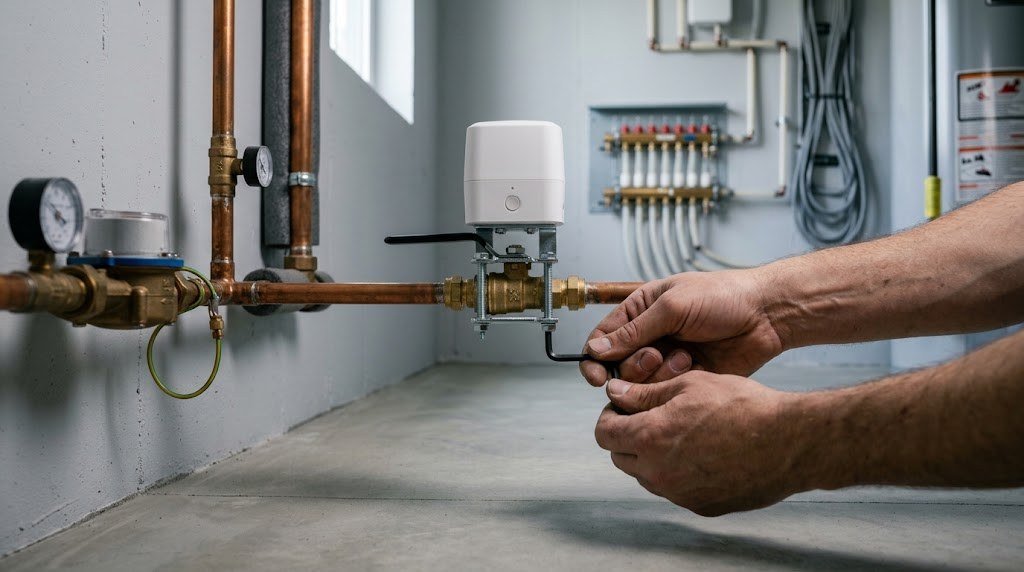
A retrofit controller clamps onto your existing quarter-turn ball valve and turns the handle with a motor. No pipe cutting is needed, and most people can install one in under 30 minutes with basic tools. The trade-off is that retrofit controllers don’t measure flow, so they rely on separate leak sensors to know when to close.
- Examples: YoLink Valve Controller, Zooz Titan Water Actuator, EcoNet Bulldog Valve Robot
- Typical price: $80 to $300
- Best for: Renters, DIYers and anyone with a working quarter-turn main valve
| Feature | Inline valve | Retrofit controller |
|---|---|---|
| Installation | Plumber usually needed | DIY in about 30 minutes |
| Price | $400 to $800+ | $80 to $300 |
| Built-in flow monitoring | Yes (most models) | No |
| Detects hidden leaks in walls | Yes | Only with sensors nearby |
| Needs leak sensors | Optional | Yes |
| Works with old gate valves | Yes (replaces pipe section) | No, needs a quarter-turn ball valve |
Tip: Check your main valve before buying a retrofit controller. If it has a round wheel handle, it’s a gate valve, and most retrofit controllers won’t work on it. You’ll need a plumber to swap it for a quarter-turn ball valve first, which is often a smart upgrade anyway.
The Best Smart Water Shut Off Valves in 2026
1. Moen Flo Smart Water Monitor and Shutoff: Best Overall
Moen Flo is the best-known inline smart valve, and for good reason. It monitors water pressure, flow rate and temperature around the clock and runs a daily “health test” that closes the valve briefly to check for tiny leaks, such as a dripping faucet or a running toilet. If it detects a major leak, it can shut off the water automatically.
It works on copper, PEX and PVC pipes. Moen lists it at about $500 for 3/4-inch pipes, $550 for 1-inch and $800 for 1-1/4-inch, not counting installation. Moen recommends a professional plumber. The optional FloProtect plan (around $5 a month) adds deductible coverage and a longer warranty, but the valve works fully without it.
- Type: Inline
- Connection: 2.4GHz Wi-Fi
- Works with: Alexa, Google Assistant, Moen Flo leak detectors
- Standout feature: Daily microleak test and whole-home water usage tracking
Good for: Homeowners who want the most complete protection and water usage insights.
Keep in mind: Needs an outlet nearby and professional installation for most people.
2. Phyn Plus Smart Water Shutoff: Best for Hidden Leak Detection
Phyn Plus uses high-frequency pressure sensing to learn the “signature” of every fixture in your house. That lets it spot small, slow leaks that other systems miss, such as a pinhole leak inside a wall. It also runs regular plumbing health checks and can shut off water automatically.
- Type: Inline
- Connection: Wi-Fi
- Works with: Alexa, Google Assistant, Phyn leak sensors
- Standout feature: Fixture-level water usage and very sensitive leak detection
Good for: Larger homes and anyone worried about leaks hidden behind walls or under floors.
Keep in mind: Professional installation is recommended, and very sensitive detection can occasionally flag normal usage until it learns your home’s patterns.
3. YoLink Valve Controller: Best Budget Retrofit Option
YoLink uses its own long-range LoRa wireless technology, which is excellent for basements, garages and crawl spaces where Wi-Fi is weak. The controller clamps onto your existing quarter-turn valve, and when a YoLink leak sensor detects water, the valve can close directly, even if your internet is down, thanks to YoLink’s device-to-device “Control-D2D” pairing.
- Type: Retrofit controller
- Connection: LoRa (needs the YoLink hub)
- Works with: Alexa, Google Assistant, IFTTT, Home Assistant
- Standout feature: Long range and works locally with YoLink leak sensors
Good for: Budget buyers and homes with the main valve far from the router.
Keep in mind: Requires the YoLink hub, and it only works on quarter-turn ball valves.
4. Zooz Titan Water Actuator: Best for Z-Wave Smart Homes
If you already use a Z-Wave hub such as Home Assistant, Hubitat or SmartThings, the Zooz Titan is a strong retrofit choice. It fits 1/2-inch to 1-1/4-inch pipes, uses a dual clamp design that installs without tools, calibrates itself and is rated IP66, so it can go in damp spaces. It even works with Ring Alarm.
- Type: Retrofit controller
- Connection: Z-Wave
- Works with: Home Assistant, Hubitat, SmartThings, Ring Alarm
- Standout feature: Tool-free install and a 5-year warranty
Good for: Z-Wave users who want local, reliable automation.
Keep in mind: You need a Z-Wave hub. Not sure which protocol to use? Our guide to the best smart home hubs can help.
5. EcoNet Bulldog Valve Robot: Most Powerful Motor
Old valves can be stiff, and some retrofit controllers simply aren’t strong enough to turn them. The Bulldog Valve Robot has a high-torque motor built to handle stubborn valves, fits 1/2-inch to 1-1/2-inch pipes and mounts to the valve body for a solid grip.
- Type: Retrofit controller
- Connection: Z-Wave
- Standout feature: High torque for older, stiff valves
Good for: Older homes with hard-to-turn main valves.
Keep in mind: Needs 110V power nearby and a Z-Wave hub.
6. Grohe Sense Guard: Best Build Quality
Grohe Sense Guard is an inline valve with solid brass fittings, clear status lights and built-in flow, pressure and temperature sensing. It can even warn you about freezing pipe temperatures. Smart home integration is limited compared with Moen and Phyn, but it works well as a standalone system with Grohe’s own leak sensors.
- Type: Inline
- Connection: Wi-Fi
- Standout feature: Premium build and frost warnings
Good for: Buyers who want a well-built, self-contained system.
Keep in mind: Limited smart home integrations and fewer pipe size options.
Comparison Table
| Valve | Type | Connection | Approx. price | Best for |
|---|---|---|---|---|
| Moen Flo | Inline | Wi-Fi | $500 to $800 | Complete protection |
| Phyn Plus | Inline | Wi-Fi | $400 to $600 | Hidden leaks |
| YoLink Valve Controller | Retrofit | LoRa | Under $150 | Budget, long range |
| Zooz Titan | Retrofit | Z-Wave | $200 to $300 | Z-Wave homes |
| EcoNet Bulldog | Retrofit | Z-Wave | $200 to $300 | Stiff old valves |
| Grohe Sense Guard | Inline | Wi-Fi | $400 to $500 | Build quality |
Prices are approximate and change often, so check the current listing before buying.
Where to Place Leak Sensors With a Smart Valve
A smart valve is only as good as the information it receives. Even if you choose an inline valve with flow monitoring, adding a few leak sensors makes the system faster and more precise. Put sensors in the spots where leaks usually start:
- Under the kitchen sink and dishwasher
- Behind the washing machine
- Next to the water heater
- Under bathroom sinks and behind toilets
- Near the sump pump and in the basement’s lowest point
- Under the refrigerator if it has an ice maker line
For a full room-by-room plan, see our water leak sensor guide: 12 best places to put them.
How to Install a Smart Water Shut Off Valve
Installing a retrofit controller (DIY)
- Find your main shut off valve. It’s usually where the water line enters the house, often in a basement, garage, utility room or crawl space.
- Check the valve type. You need a quarter-turn ball valve with a lever handle.
- Test the valve by hand. Turn it off and on a few times so it isn’t stuck.
- Attach the mounting bracket around the pipe on both sides of the valve.
- Connect the motor arm to the valve lever, following the manual for your pipe size.
- Plug in the power supply and pair the controller with its app or your hub.
- Calibrate and test by closing and opening the valve from the app.
- Link your leak sensors and create a rule: if any sensor detects water, close the valve.
Installing an inline valve (plumber recommended)
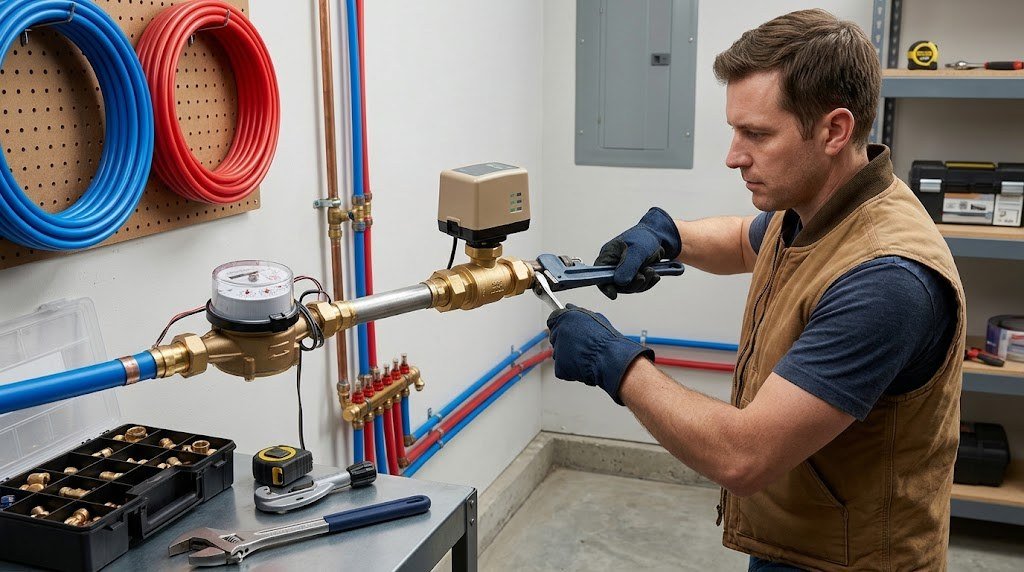
Inline valves require cutting into the main water line, so most people should hire a licensed plumber. Expect the job to take one to three hours. The plumber will shut off the water at the street, cut out a section of pipe, install the valve with the correct fittings, check for leaks and restore water. Ask them to install it after the main shut off and before any branches, so the valve protects the entire house. If you want to irrigate your garden with a separate line, make sure it’s plumbed before or after the valve based on whether you want it protected.
Is a Smart Water Shut Off Valve Worth It?
For most homeowners, yes. Here’s why:
- Water damage is expensive. A single burst pipe can cause thousands of dollars in damage, plus mold remediation and higher future premiums.
- Insurance discounts. Many insurers offer discounts for automatic water shut off devices, and some even provide them for free or at a discount. Ask your insurer before you buy.
- Peace of mind when traveling. You can close the main valve from your phone when you leave for vacation, and reopen it on your way home.
- Lower water bills. Flow-monitoring valves catch running toilets and dripping faucets that waste water every day.
The main reasons to skip one are if you rent and can’t modify plumbing (though a retrofit controller may still be allowed), or if your main valve is in a spot with no power and poor wireless coverage.
Pros and Cons
| Pros | Cons |
|---|---|
| Stops leaks automatically, even when you’re away | Inline models are expensive and need a plumber |
| Remote control from your phone | Retrofit models need a working quarter-turn valve |
| Possible insurance discounts | Most models need a nearby power outlet |
| Flow monitoring catches hidden leaks (inline) | Some advanced features depend on the internet |
Smart Home Automation Ideas
Once your valve is set up, a few automations make it even more useful:
- Vacation mode: Close the valve automatically when everyone leaves home, and open it when someone returns.
- Freeze protection: If a temperature sensor near exposed pipes drops below 35°F, send an alert (or close the valve if you’re away).
- Weekly valve exercise: Close and reopen the valve once a week so it doesn’t seize up over time.
- Voice control: “Alexa, close the water valve” is handy when a hose or pipe bursts and you need water off immediately.
Frequently Asked Questions
What does a smart water shut off valve do?
It automatically closes your home’s main water supply when a leak is detected, either by leak sensors or by its own flow monitoring. You can also control it remotely from your phone or a voice assistant.
Can I install a smart water shut off valve myself?
Retrofit controllers that clamp onto an existing quarter-turn valve are designed for DIY installation and usually take under 30 minutes. Inline valves require cutting the main water pipe, so a licensed plumber is recommended.
Does a smart water valve work without Wi-Fi?
It depends on the system. Many valves have a manual override for outages. Some systems, like YoLink with direct device pairing or Z-Wave valves with a local hub, can still close automatically when the internet is down, as long as they have power.
How much does a smart water shut off valve cost?
Retrofit controllers typically cost $80 to $300. Inline valves with flow monitoring cost roughly $400 to $800, plus $150 to $500 for professional installation depending on your area and pipe size.
Do smart water valves need a subscription?
Most don’t. Moen Flo, Phyn and the retrofit controllers in this guide work without a subscription. Moen’s optional FloProtect plan adds extra warranty and deductible coverage, but it isn’t required for automatic shut off.
Will a smart valve lower my insurance premium?
Often, yes. Many insurers offer discounts for automatic water shut off systems. Contact your insurance company to ask which devices qualify before buying.
Final Verdict
A smart water shut off valve is one of the few smart home devices that can pay for itself by preventing a single disaster. If you want the most complete protection and can budget for a plumber, Moen Flo or Phyn Plus will monitor your whole home and catch even hidden leaks. If you’d rather install it yourself, a retrofit controller like the YoLink Valve Controller or Zooz Titan, paired with a few leak sensors, gives you automatic shut off for a fraction of the cost.
Whichever you choose, start by checking your main valve type, place leak sensors near every water source, and test the shut off every month. Your floors, and your insurance company, will thank you.