
Eight Sleep and Chilipad are the two names that come up most when people look for a bed that actively cools (and warms) them at night. Both use water to change the temperature of your bed surface, both offer dual-zone control for couples, and in 2026 both cost roughly the same up front for a queen. The real differences are in how they are built, how much sleep data you get, and what you pay after the first year.
This comparison puts the new Eight Sleep Pod 6 against the Chilipad 2.0 by Sleepme across price, cooling, tracking, upkeep and long-term cost, so you can decide which one fits your sleep and your budget.
Table of Contents
- Quick Verdict
- Specs Compared
- Design and Setup
- Cooling and Heating
- Sleep Tracking and Smart Features
- Price and Cost Over Time
- Maintenance, Noise and Warranty
- Who Should Buy Which
- Alternatives to Consider
- FAQ
- Final Verdict
Quick Verdict
- Choose the Eight Sleep Pod 6 if you want the most advanced system: automatic temperature changes through the night, detailed sleep and heart data, a vibration alarm, and a compact hub that hides under the bed. Budget for the required membership.
- Choose the Chilipad 2.0 if you mainly want powerful cooling and heating with no subscription, a physical remote, and a system that keeps running on a schedule even without Wi-Fi.
Specs Compared
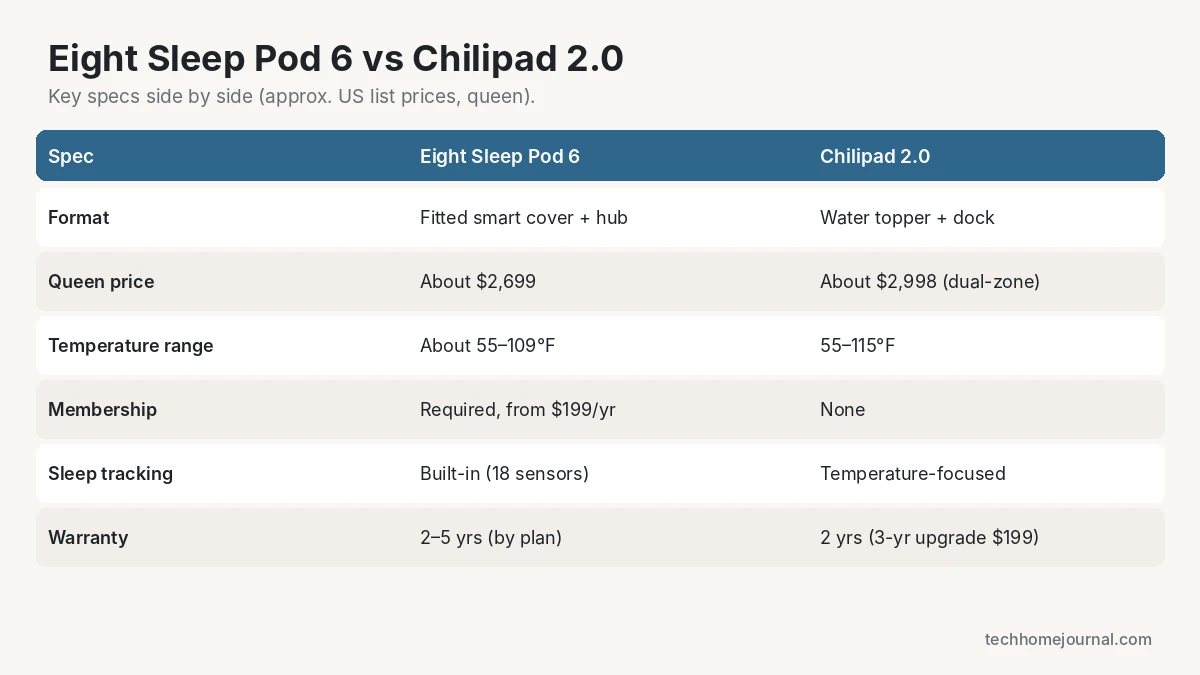
| Spec | Eight Sleep Pod 6 | Chilipad 2.0 |
|---|---|---|
| Format | Fitted cover + hub | Topper + dock |
| Queen price (approx. list) | $2,699 | $2,998 dual-zone |
| Smallest option | Solo from $1,999 | Twin XL from $1,599 |
| Temperature range | About 55–109°F per side | 55–115°F |
| Dual-zone | Yes (Standard sizes) | Yes (queen and up) |
| Membership | Required, $199–$399/yr | None |
| Sleep tracking | Built in, 18 sensors | Temperature-focused |
| Controls | App + automatic Autopilot | App, haptic remote, dock buttons |
| Warranty | 2–5 years depending on plan | 2 years (3-year upgrade $199) |
Design and Setup
Eight Sleep Pod 6. The Pod is a cover that fits over your mattress like a fitted sheet, held in place by straps, with a tube running from the head of the bed to the hub. The Pod 6 hub is about 50% smaller than the Pod 5’s and has a built-in reservoir, and it is designed to slide under standard bed frames. That makes a big difference in a tidy bedroom, where the old hub was hard to hide. Standard sizes come in queen, king and California king, while Solo sizes cover a twin or one side of a larger bed.
Chilipad 2.0. The Chilipad is a topper with a network of water channels that lies on top of the mattress under your sheet, connected to a cube-shaped dock beside the bed. Version 2.0 adds a washable top cover and a built-in waterproof protector, so you do not need a separate one. Dual-zone setups use two hydrolayers for queen beds and up, and Sleepme also sells half-bed versions for one sleeper.
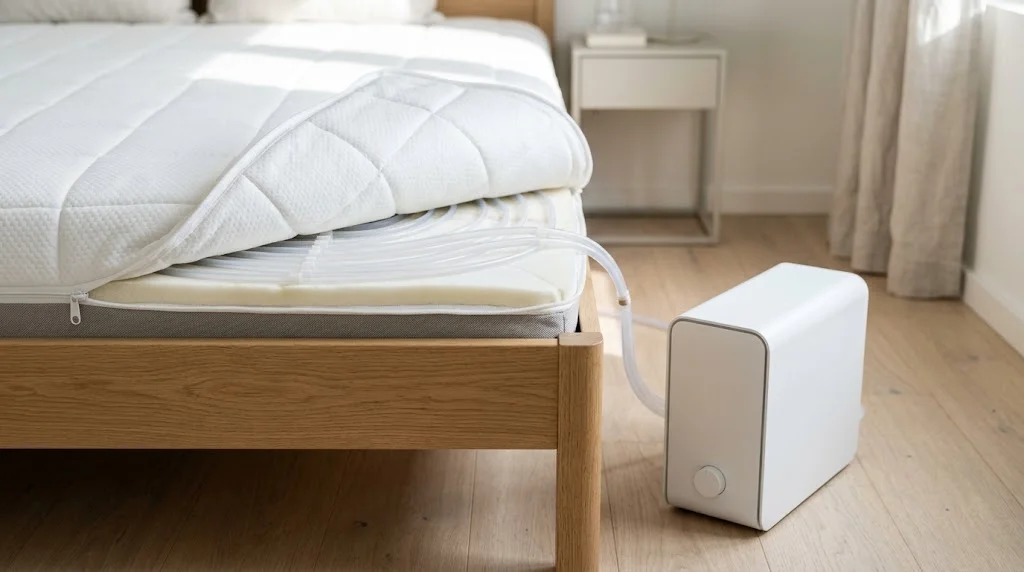
Setup is similar for both: fit the layer, connect the tubes, fill with water and pair the app. In both cases, check that your mattress depth, bed frame clearance and outlet location work before you order.
Cooling and Heating
On paper, the Chilipad has the wider range. Sleepme says it cools to 55°F and heats to 115°F, while the Pod 6 covers about 55 to 109°F on each side. In practice, both go well beyond what most people use. The Sleep Foundation suggests a 65–68°F room for sleep, and many owners set the bed surface somewhere in the 60s or low 70s.
Where Eight Sleep pulls ahead is speed and automation. Eight Sleep says the Pod 6 has a 550W thermal engine per side and reaches its target temperature about 20% faster than the Pod 5. Its Autopilot feature changes the temperature through the night based on your sleep stages and other signals, so you do not have to build a schedule by hand.
The Chilipad uses schedules instead. You set temperatures for bedtime and the hours before your alarm, including a gradual wake-up warm. The upside is predictability: once set, the schedule runs even if your Wi-Fi goes down. Optional in-bed detection starts the schedule when you lie down.
For couples: both offer separate control for each side. The Pod 6’s nine sensors per side help it keep each sleeper’s temperature separate even when you sleep close together. The Chilipad does the same job with two separate hydrolayers.
Sleep Tracking and Smart Features
This is the biggest difference between the two. The Pod 6 is a full sleep tracker built into the bed. It records sleep stages, heart rate, heart rate variability and breathing rate, and Eight Sleep has added extras like pregnancy mode and the ability to ignore a pet or child in the bed. You can wake to a vibration or a thermal alarm instead of a sound. Eight Sleep has also filed for FDA clearance for sleep apnea detection, but at the time of writing that was still pending, so it should not be treated as a medical device.
The Chilipad 2.0 focuses on temperature. Its app handles schedules and gives general sleep guidance, but it does not offer the same level of biometric tracking. If you want data, pair it with a wearable or an under-mattress sensor, such as those covered in our smart mattress guide.
On the smart home side, both can fit into a bedtime routine alongside your smart lighting, smart blinds and thermostat. Let the room cool a little, and let the bed do the fine-tuning.
Price and Cost Over Time
Up front, the two are close. A queen Pod 6 starts at about $2,699, and a dual-zone queen Chilipad 2.0 is about $2,998, according to Mattress Clarity. The gap opens over time because the Pod needs an Autopilot membership: Standard is $199 a year, Enhanced $299 and Elite $399. One membership covers both sleepers.

- After 1 year: Pod 6 about $2,898 vs Chilipad about $2,998.
- After 3 years: Pod 6 about $3,296 vs Chilipad about $2,998.
- After 5 years: Pod 6 about $3,694 (Standard plan) or $4,194 (Enhanced) vs Chilipad about $2,998, or $3,197 with the three-year warranty upgrade.
For one sleeper, the gap gets smaller at the low end: the Pod 6 Solo starts at $1,999 and a Twin XL Chilipad at $1,599. Plug your own numbers and sale prices into our free Smart Mattress Cost Calculator to see the totals for the years you plan to keep it.
Maintenance, Noise and Warranty
Water care. Both need water. With the Chilipad 2.0, you use distilled water and add cleaning solution about once a month, and Sleepme includes a year’s supply of cleaner. The top cover is machine-washable. The Pod 6 hub has an integrated water reservoir. Follow Eight Sleep’s guidance on refills and cleaning.
Noise. Every heat pump makes some sound. Reviewers describe the Chilipad dock as a low hum that some find soothing, and Sleepme says version 2.0 is quieter than the 1.0. Moving the Pod 6 hub under the bed helps reduce how much you notice it. Light sleepers should read recent reviews of both.
Warranty and trial. The Chilipad 2.0 comes with a 30-day trial and a two-year warranty, with a three-year upgrade for $199. Eight Sleep links warranty length to your plan: two years on Standard and five on Enhanced or Elite. Check the current trial terms on Eight Sleep’s site before ordering, because they can differ by region.
Who Should Buy Which
Buy the Eight Sleep Pod 6 if you:
- Want the bed to adjust automatically through the night without setting schedules.
- Care about sleep data like HRV, heart rate and sleep stages without wearing a tracker.
- Want a vibration or thermal alarm that will not wake your partner.
- Prefer a hub that can hide under the bed frame.
- Are comfortable paying at least $199 a year.
Buy the Chilipad 2.0 if you:
- Want strong cooling and heating with no ongoing fees.
- Like a physical remote and a schedule that works even when the Wi-Fi is down.
- Already track sleep with a ring or watch, or do not care about sleep data.
- Want the widest temperature range, especially for heating in winter.
- Plan to keep the system for many years and want a predictable total cost.
One more thing: neither system will fix a mattress that does not suit you. If yours is too soft, too firm or sagging, start with our free Mattress Finder Quiz, and see our smart mattress cover guide for other options, such as air-based systems and passive cooling covers.
Alternatives to Consider
If neither system feels quite right, a few other options cover the same problem from different angles.
- BedJet 3 (air-based): Instead of water, a fan unit blows cooled or warmed air under your sheets. The queen model lists at about $1,549, with no water to manage and no subscription. It cools quickly but makes more noise, and you feel moving air rather than a cool surface.
- Sleep Number ClimateCool (full smart bed): If you also want adjustable firmness on each side, this bed builds active cooling into the mattress itself. It costs about $5,499 for a queen, with no membership, but you replace your whole mattress.
- Passive cooling covers: A cool-to-the-touch cover, such as Helix’s GlacioTex option, costs a few hundred dollars and needs no power. It will not change temperature on its own, but it helps mild hot sleepers.
- Room-level cooling: Sometimes the cheapest fix is the room. A smart thermostat schedule that drops the bedroom to the mid-60s at night, plus a quiet smart ceiling fan, can be enough for many people.
A good rule of thumb: if you only overheat in summer, try room-level fixes first. If you sleep hot year-round or share a bed with someone who runs cold, an active system like the Pod 6 or Chilipad 2.0 is where the real difference shows.
FAQ
Is Eight Sleep better than Chilipad?
Eight Sleep is better if you want automation and sleep tracking. Chilipad is better if you want cooling and heating without a subscription. On temperature control alone, both are very capable.
Can you use Eight Sleep without a subscription?
For the Pod 6, the Autopilot membership is required, starting at $199 a year. The plan also sets your warranty length.
Which one gets colder?
Both list a low of about 55°F. The Chilipad heats higher, up to 115°F compared with about 109°F on the Pod 6.
Do they work for couples?
Yes. Both offer dual-zone setups so each person can choose their own temperature. The Pod 6 manages both sides from one hub, and dual-zone Chilipads use two hydrolayers.
Do they work with any mattress?
Both are designed for standard foam, hybrid and innerspring mattresses. Check the depth limits for the Pod cover and make sure there is room for the hub or dock and a nearby outlet.
Which is cheaper over five years?
At list prices for a dual-zone queen, the Chilipad 2.0 (about $2,998) works out cheaper than the Pod 6 on the Standard plan (about $3,694 over five years).
Final Verdict
The Eight Sleep Pod 6 is the smarter system. It adjusts itself, tracks your sleep in detail, wakes you quietly and now has a hub small enough to hide. If those features matter to you and the yearly membership does not bother you, it is the one to get.
The Chilipad 2.0 is the simpler, more predictable buy. It has a wider temperature range, a real remote and schedules that do not depend on Wi-Fi, and it has no subscription, which makes it the cheaper option over the years you will own it. If your goal is simply to stop sleeping hot, and you do not need another source of sleep data, the Chilipad is hard to beat.