
A smart mattress sounds like something out of a sci-fi hotel, but in 2026 it is a fairly practical upgrade. Some models cool one side of the bed and warm the other. Some change their firmness with a tap in an app. Others quietly track your breathing and heart rate without anything on your wrist. The tricky part is that “smart mattress” now covers everything from a $130 sensor pad to a $10,000 climate-controlled bed, and the marketing rarely makes the differences clear.
This guide breaks down what a smart mattress actually is, the four main types you can buy, what the popular options cost once subscriptions are included, and how to fit one into the rest of your smart home. We also look at a smarter-on-a-budget route: pairing a well-built hybrid like the Helix with a few add-ons instead of buying a full smart bed.
Free tools: Not sure where to start? Take our 60-second Mattress Finder Quiz, or see the real long-term price of any setup with the Smart Mattress Cost Calculator.
Table of Contents
- What Is a Smart Mattress?
- Quick Picks
- Smart Mattress Comparison Table
- The 4 Types of Smart Mattresses
- Best Smart Mattress Options in 2026
- The Budget Route: Helix + Smart Add-Ons
- The Real Cost: Subscriptions and 3-Year Totals
- How a Smart Mattress Fits Your Smart Home
- How to Choose the Right Smart Mattress
- FAQ
- Final Verdict
What Is a Smart Mattress?
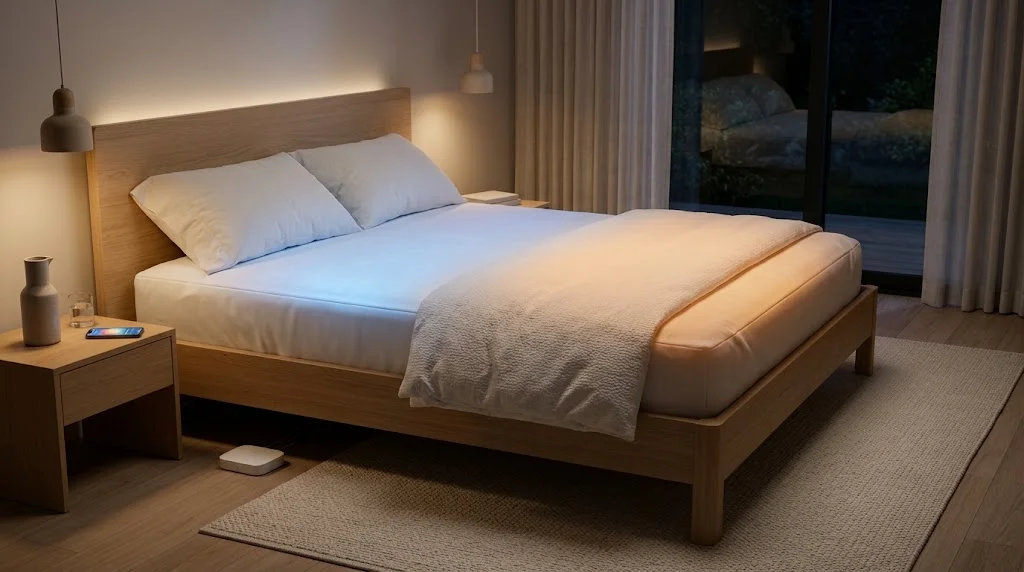
A smart mattress is a mattress (or a mattress add-on) with built-in sensors, motors, pumps or heating and cooling hardware that connects to an app. In practice, “smart” usually means it does at least one of three things:
- Tracks your sleep using sensors in or under the mattress, measuring movement, heart rate and breathing so you get sleep stages and a nightly score without wearing anything.
- Controls temperature by pumping water or air through a cover or topper, often with separate zones for each side of the bed.
- Adjusts firmness or position, either through air chambers you inflate and deflate or through an adjustable base that raises your head or feet.
One thing to watch out for: some regular mattresses use “smart” in the product name without any electronics. Beautyrest PressureSmart, for example, is a conventional hybrid with pocketed coils and pressure-relief foam. It may be a perfectly good mattress, but it does not connect to an app, track sleep or change temperature. If a listing does not mention an app, sensors or a power cable, it is not a smart mattress in the tech sense.
Why bother at all? Temperature is the big one. The Sleep Foundation puts the ideal bedroom temperature at roughly 65 to 68°F, because your core body temperature needs to drop to fall asleep and stay in deep sleep. A smart cover or topper lets you hit that range right at the mattress surface, which is far more efficient than cooling the whole room all night.
Quick Picks
- Best for hot sleepers and couples: Eight Sleep Pod 6. A smart cover with dual-zone cooling and heating that goes on top of the mattress you already own.
- Best full smart bed: Sleep Number ComfortNext. Adjustable firmness on each side plus built-in sleep sensing, with no subscription.
- Best for serious heat problems: Sleep Number ClimateCool. Active cooling built into an adjustable-firmness bed, at a premium price.
- Best cooling without a subscription: Chilipad 2.0 by Sleepme. A water-based topper that covers 55 to 115°F.
- Best budget way to “smarten” any bed: Withings Sleep Analyzer. An under-mattress pad for about $130.
- Best comfort-first combo: Helix Midnight (or another Helix Core model) plus a sensor pad. You get a great mattress first and the smart features later.
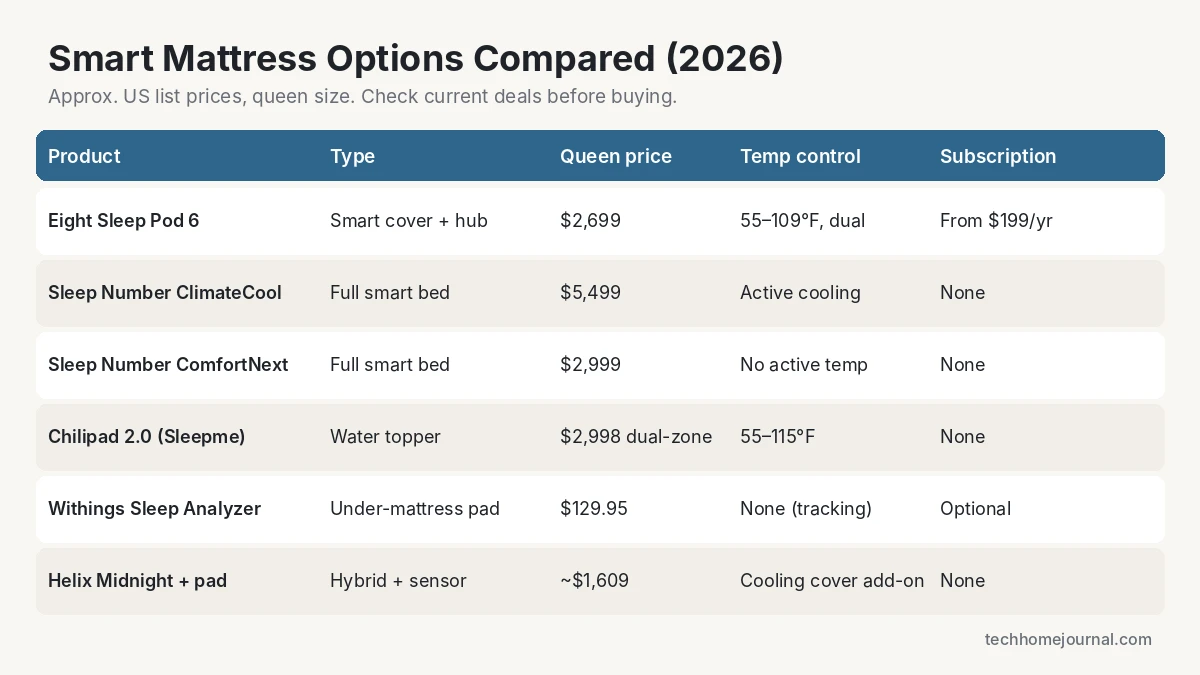
Smart Mattress Comparison Table
Prices below are approximate US list prices for a queen and change often, so always check current deals before you buy.
| Product | Type | Queen price (approx.) | Temperature control | Subscription |
|---|---|---|---|---|
| Eight Sleep Pod 6 | Smart cover + hub | $2,699 | Dual-zone, about 55–109°F | Autopilot required, from $199/yr |
| Sleep Number ClimateCool | Full smart bed | $5,499 | Active cooling | None |
| Sleep Number ComfortNext | Full smart bed | $2,999 | No active temperature control | None |
| Chilipad 2.0 (Sleepme) | Water-based topper | $2,998 dual-zone (Twin XL from $1,599) | 55–115°F, single or dual zone | None |
| Withings Sleep Analyzer | Under-mattress sensor | $129.95 | None (tracking only) | Optional |
| Helix Midnight + sensor pad | Hybrid mattress + add-on | About $1,609 | Optional cooling cover | None |
The 4 Types of Smart Mattresses
Before you compare brands, decide which type you need. This choice affects your budget far more than the brand does.
1. Full smart beds
These are complete mattresses with the technology built in. Sleep Number is the best-known example: air chambers inside let each sleeper set their own firmness, and sensors track sleep without a wearable. Higher-end models add active heating or cooling. They are the most integrated option, but also the most expensive, and you are tied to one brand’s ecosystem for the life of the bed.
2. Smart covers
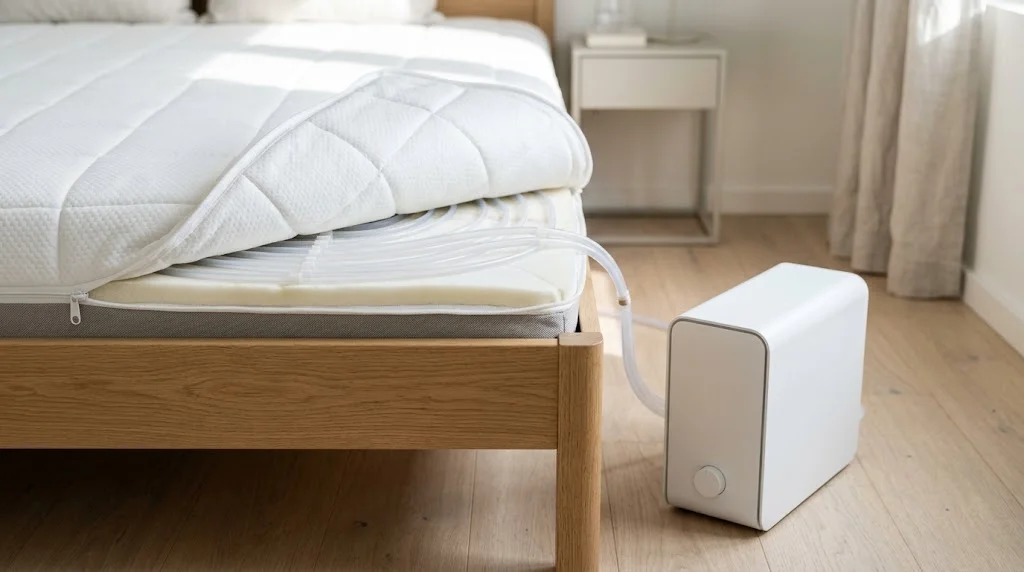
A smart cover is a fitted layer that zips or stretches over your existing mattress. It is connected by tubes to a hub that heats or cools water. The Eight Sleep Pod is the headline product here. The big advantage is that you keep the mattress you already like and add temperature control and tracking on top.
3. Cooling and heating toppers
Similar idea, different form. A topper like the Chilipad sits on top of the mattress under your sheet and circulates temperature-controlled water through thin tubes. Toppers tend to cost less than covers and often skip the subscription, but they focus on temperature and offer less sleep tracking.
4. Under-mattress sensors
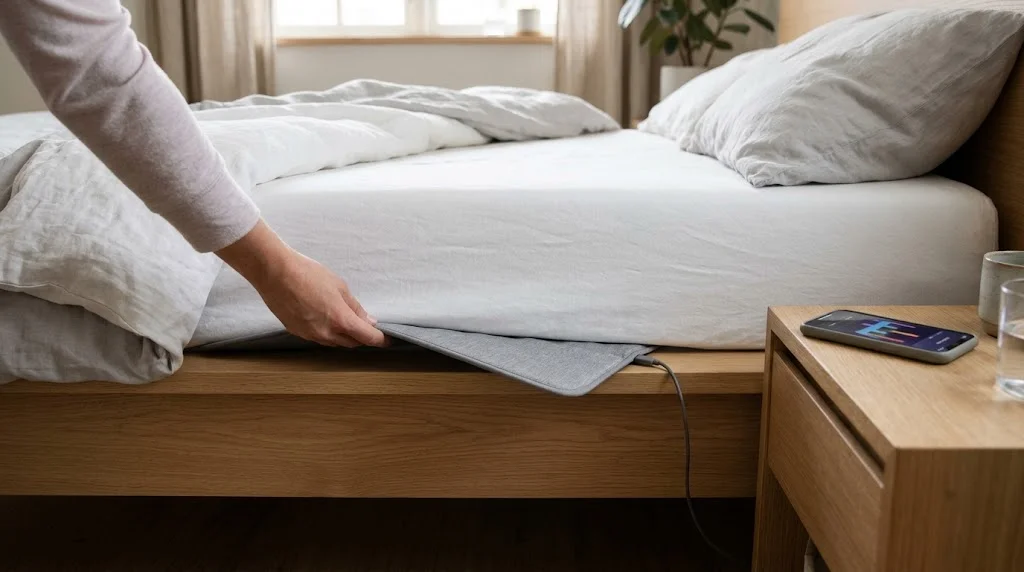
The cheapest way in. A thin pad slides between your mattress and the bed base and tracks breathing, movement and heart rate. It will not change how your bed feels, but it gives you sleep data and can trigger smart home routines when you get into or out of bed.
Best Smart Mattress Options in 2026
Eight Sleep Pod 6: best for hot sleepers and couples
Specs: Smart cover + water hub | Dual-zone | About 55–109°F | Queen from about $2,699 (Solo from $1,999) | Autopilot membership required, from $199/yr
Eight Sleep launched the Pod 6 in September 2026, and it replaces the Pod 5. It is still a cover that fits over your current mattress and connects to a hub beside the bed, and each side of the bed can be set to its own temperature. That means a hot sleeper and a cold sleeper can share a bed without fighting over the duvet.
The upgrades are practical. The hub is about half the size of the previous one and slides under most bed frames, and Eight Sleep says it changes temperature about 20% faster. The cover now has 18 sensors (nine per side), which helps it control temperature for each sleeper even when you lie close together. It also adds Solo sizes from $1,999 that cover a twin or one side of a bigger bed, and two Solo covers can later be joined.
On the tracking side, you get sleep stages, heart rate, heart rate variability and breathing rate, plus a vibration or thermal alarm instead of a loud one. An optional adjustable base can raise the head of the bed to help with snoring.
The catch is the Autopilot membership, which is required. Plans run $199, $299 or $399 a year, and the tier also decides your warranty (two years on Standard, five on the higher tiers). That adds up fast, which is why we break down the three-year cost further down.
- Pros: Works with the mattress you already own; true dual-zone heating and cooling; smaller hub than before; detailed tracking without a wearable; Solo option for one sleeper.
- Cons: Membership required; warranty depends on your plan; still one of the priciest ways to cool a bed.
Sleep Number ComfortNext: best full smart bed
Specs: Adjustable air chambers | Built-in SleepIQ sensors | Queen from about $2,999 | No subscription
Sleep Number redesigned its lineup in 2026, and ComfortNext is the entry point to its app-connected beds. Each side has its own air chamber, so you and your partner can choose different firmness levels and change them whenever you like. If your back is sore one week, you can firm it up from your phone.
The bed runs on SleepIQ technology. Sensors inside the bed give you a nightly SleepIQ score from 5 to 100, plus average heart rate and breathing rate trends, with nothing to wear or charge. It needs Wi-Fi, and there is a Privacy Mode if you want to pause data recording. Sleep Number also sells ComfortNext Lux (about $3,999) and ComfortNext Ultra (about $4,499) with more premium comfort layers, and ComfortMode Lux (about $2,099) if you want adjustable firmness without the app.
- Pros: Separate firmness for each side; no subscription; tracking built into the bed; good for couples with different needs.
- Cons: No active heating or cooling at this tier; the air-chamber feel is not for everyone; you are locked into one brand.
Sleep Number ClimateCool: best for serious overheating
Specs: Adjustable air chambers | Active cooling | SleepIQ sensors | Queen about $5,499 | No subscription
ClimateCool combines Sleep Number’s adjustable firmness with active cooling built into the bed, so you do not need a separate cover or hub. If you want both heating and cooling, the Climate360 is the flagship, but it sits around $9,999 for a queen. For most people that is hard to justify, but if you sleep very hot and want everything in one product with no monthly fee, ClimateCool is the cleanest all-in-one setup.
- Pros: Cooling, firmness control and tracking in one bed; no extra hub on the floor; no membership.
- Cons: Very expensive; cooling only (heating needs the pricier Climate360); you replace your whole mattress.
Chilipad 2.0 by Sleepme: best cooling without a subscription
Specs: Water-based topper | 55–115°F | Single or dual zone | From about $1,599 (Twin XL), about $2,998 dual-zone queen | No subscription
The Chilipad 2.0 is a topper that circulates water through thin tubes beneath your sheet. Sleepme says it can cool down to 55°F and heat up to 115°F, which is a wider range than most people will ever need. You can set sleep schedules in the app so it cools you down at bedtime and warms up before your alarm, and in-bed detection starts the schedule when you lie down. A bedside remote with a dial handles quick changes without your phone.
Sleepme also says there are no subscription fees, which makes the long-term cost much easier to predict than with the Eight Sleep Pod. The trade-off is less detailed sleep tracking, so many owners pair it with a wearable or sensor pad.
- Pros: Wide temperature range; no membership; dual-zone option; works on any mattress.
- Cons: Water reservoir needs occasional refilling and cleaning; less sleep data than the Pod; tubes can be felt by some sleepers.
Withings Sleep Analyzer: best budget smart upgrade
Specs: Under-mattress sensor pad | Tracks breathing, movement and heart rate | About $129.95 | Subscription optional
If you like your current mattress and mostly want data, an under-mattress sleep tracker is the simplest route. The Withings pad slides under the mattress, plugs into the wall and works out sleep stages from your breathing, movement and heart rate. There is nothing to wear or charge, and it also supports home automation. For example, it can dim the lights when you get into bed or start the coffee maker when you get up.
- Pros: Very affordable; works with almost any mattress; no wearable; smart home triggers.
- Cons: No temperature or firmness control; one pad tracks one sleeper; very thick mattresses may affect accuracy.
If you would rather wear something, a smart ring like the Oura Ring 4 (from about $349, plus a membership of about $5.99 a month after the first year) tracks sleep from your finger and goes with you when you travel.
The Budget Route: Helix + Smart Add-Ons
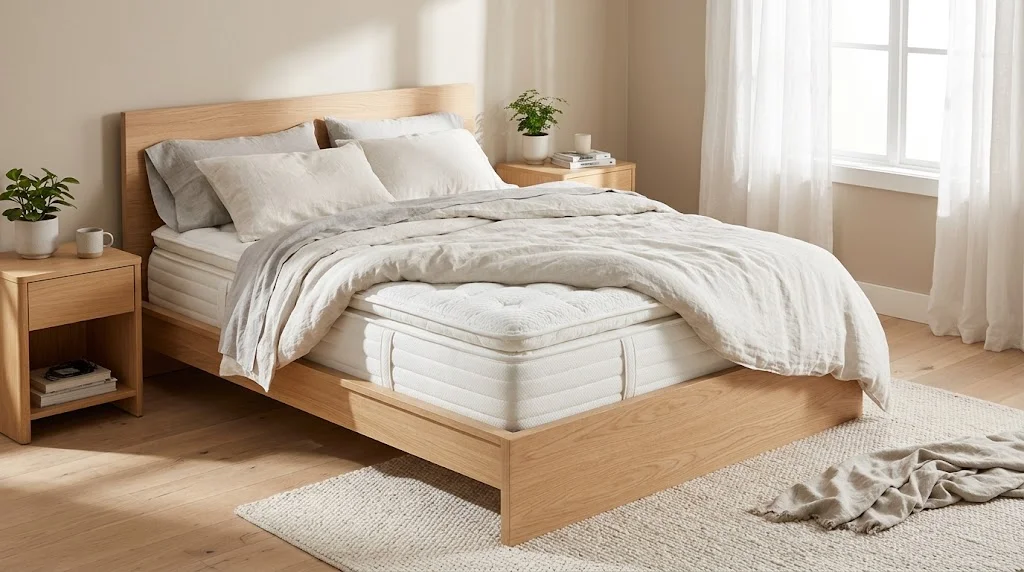
Here is something the smart bed ads do not say: no amount of technology fixes a mattress that is the wrong firmness for your body. For many people, the smartest move is to buy a well-made regular mattress that suits how they sleep, then add tracking or cooling later. Helix Sleep is a popular choice for this because its whole lineup is built around sleep position and feel.
How the Helix lineup works
Helix sells three collections, and each comes in six feels: three designed for side sleepers and three for back and stomach sleepers.
- For side sleepers: Sunset (soft), Midnight (medium) and Twilight (firm).
- For back and stomach sleepers: Moonlight (soft), Dusk (medium) and Dawn (firm).
- For bigger bodies: Helix Plus, a medium-firm model (7/10 on Helix’s scale) built for plus-size and big-and-tall sleepers.
The collections differ in height and materials. Core models are 11.5 inches tall, with a queen listed around $1,479 before discounts. Luxe models are 13.5 inches with extra layers and lower-back support, at around $2,499 for a queen. Elite models are 15 inches with a GlacioTex cooling pillow top as standard, at about $4,371 for a queen at list price. Helix runs sales often (20% off was running at the time of writing), so the real price is usually lower.
Helix Midnight: the most popular starting point
Specs: Hybrid | 11.5 inches | Medium (6/10) | Up to 1,000 wrapped coils | Queen about $1,479 list | 365-night trial | Limited lifetime warranty
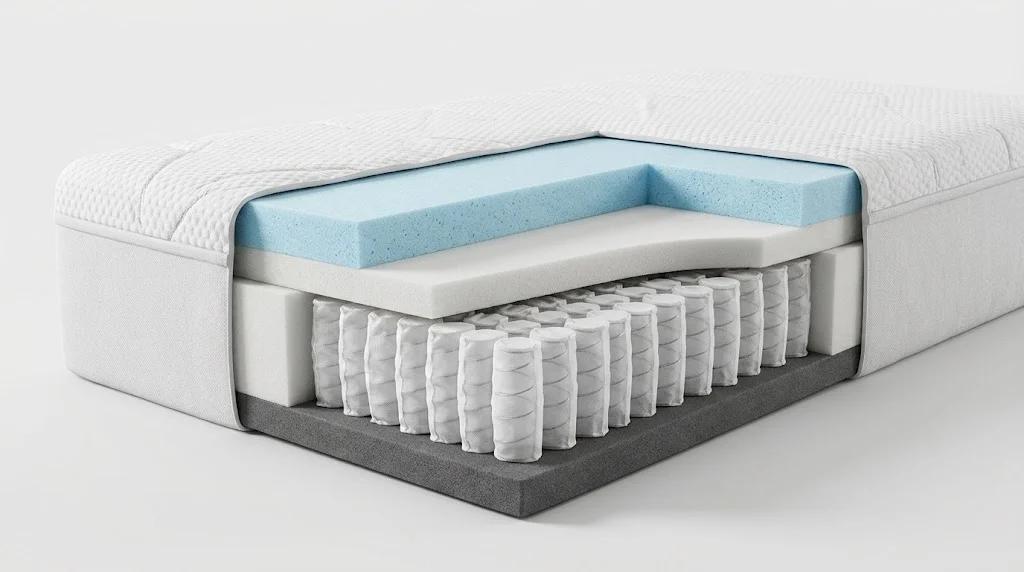
The Helix Midnight is aimed at side sleepers and people who change position during the night. It layers ultra-high-density memory foam and gel memory foam over responsive support foams and up to 1,000 individually wrapped coils with reinforced edges, all on a dense base foam. Helix says the foams are CertiPUR-US certified, the mattress is free of fiberglass, and it is assembled in Arizona.
Two add-ons are worth knowing about. The GlacioTex cooling cover with pillow top (about $374 extra at list price) helps hot sleepers. The ErgoAlign layer (about $249 extra) adds firmer foam under the hips for lower-back support. Add a Withings pad under the mattress and you have a setup that tracks your sleep and suits your sleep position for roughly $1,609 at list price, well under the cost of most full smart beds. If temperature is your main problem, a Chilipad on top of a Helix is another strong combination.
- Pros: Six feels matched to sleep position; 365-night trial; limited lifetime warranty; free shipping in the contiguous US; much cheaper than a smart bed.
- Cons: No built-in electronics; cooling cover and lumbar layer cost extra; the higher collections get pricey.
Want more support or a plusher feel? The Helix Luxe collection adds height and comfort layers across the same six feels. And if you are refreshing the whole room, our budget DIY headboard ideas pair nicely with a new mattress.
The Real Cost: Subscriptions and 3-Year Totals
Sticker prices only tell half the story. Some smart mattress products need an ongoing membership for their best features, and covers and toppers still need a decent mattress underneath. Here is roughly what each setup costs over three years at list price for a queen (or plug in your own numbers with our cost calculator):
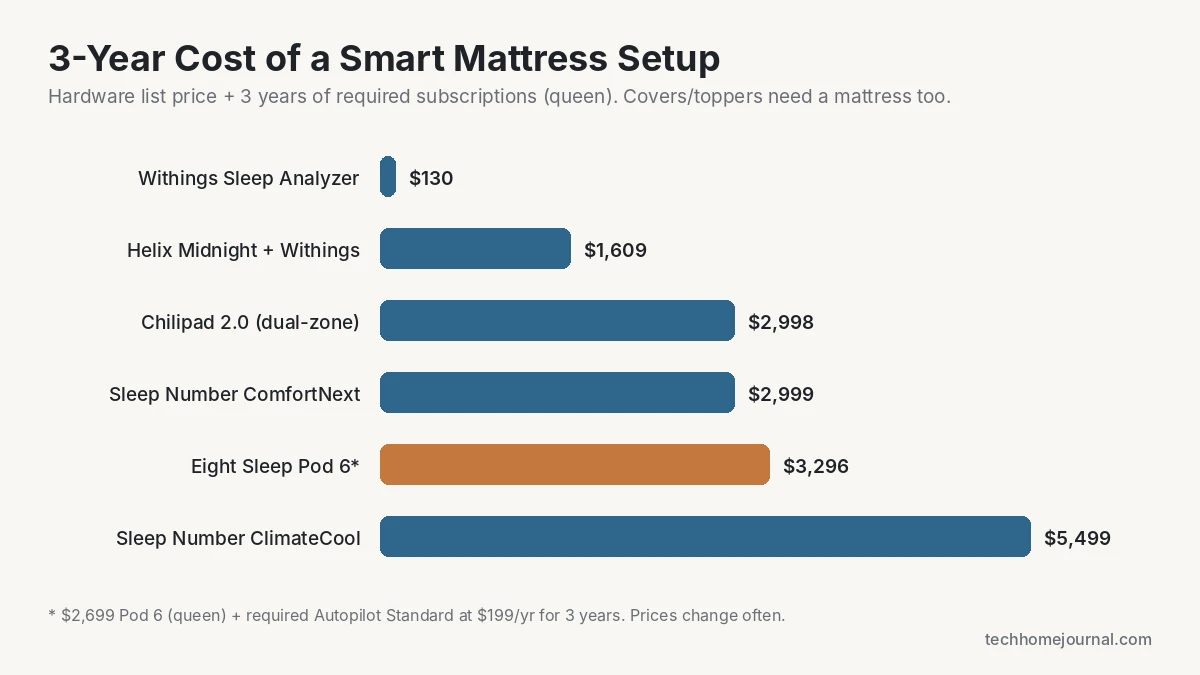
- Withings Sleep Analyzer: about $130. Tracking only.
- Helix Midnight + Withings: about $1,609. A mattress and tracking together.
- Chilipad 2.0 (dual-zone queen): about $2,998. No subscription, but you still need a mattress.
- Sleep Number ComfortNext: about $2,999. No subscription.
- Eight Sleep Pod 6: about $3,296 ($2,699 for a queen plus three years of the required $199 Autopilot plan), and you still need a mattress.
- Sleep Number ClimateCool: about $5,499. No subscription.
Also think about power use and noise. Hubs and pumps run all night, so put them where you will not hear the fan, and keep the cable runs tidy so nobody trips over a water line on the way to the bathroom.
How a Smart Mattress Fits Your Smart Home
A smart mattress works best as part of a whole sleep routine, not as a gadget on its own. A few ideas that work well together:
- Room temperature: Let your smart thermostat drop the bedroom toward 65–68°F at bedtime while the bed handles fine-tuning. Because the bed cools you directly, you can often set the room a degree or two warmer and save energy.
- Air movement: A quiet smart ceiling fan on a low schedule helps hot sleepers without the noise of a box fan.
- Light: Use smart lighting to warm and dim the lights an hour before bed, and smart blinds to open slowly in the morning for a natural wake-up.
- Air quality: A quiet air purifier in sleep mode keeps dust and allergens down without lighting up the room.
- Routines: Tie it together with Alexa routines, Google Home or Apple HomeKit scenes. A bed sensor that knows you are in bed can trigger “goodnight” automatically: lights off, doors locked, thermostat set back.
One safety note: plug hubs, pumps and heated toppers straight into a wall outlet, as the manufacturer recommends. A smart plug is great for a bedside lamp or sound machine, but not for anything that heats.
How to Choose the Right Smart Mattress
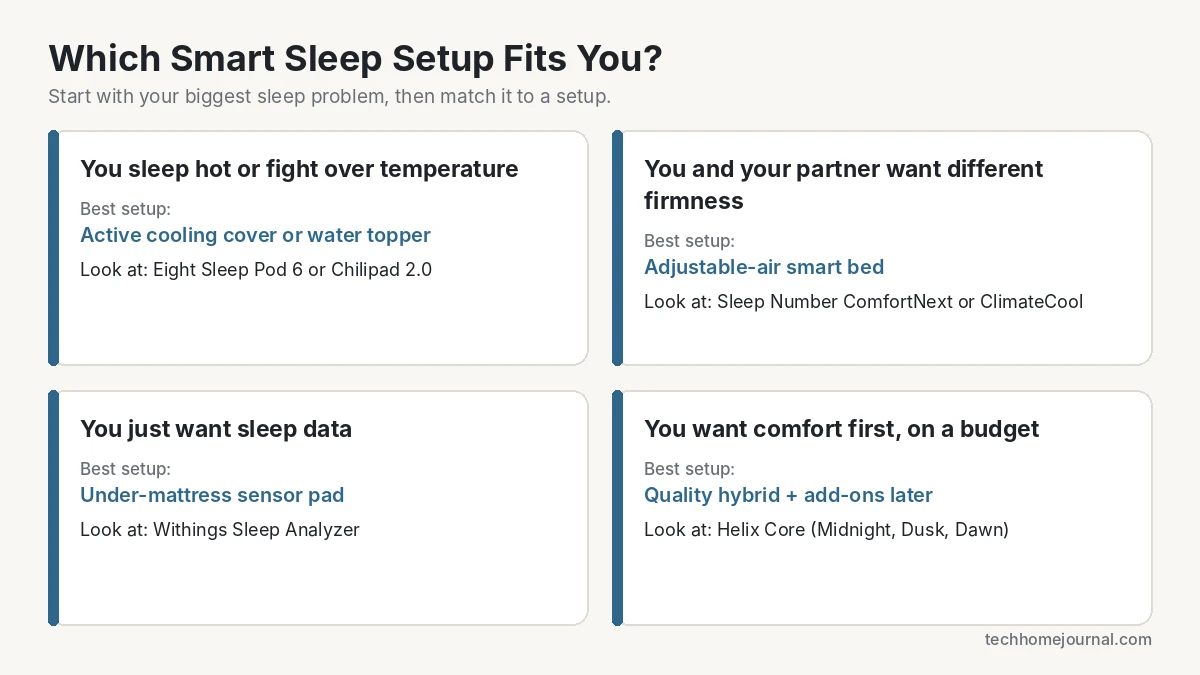
Start with your main problem
If you wake up sweaty, temperature control matters most, so look at a cover or topper. If you and your partner disagree on firmness, an adjustable air bed solves that directly. If you just want to understand your sleep, a sensor pad is enough. And if your current mattress is sagging or uncomfortable, replace that first, because no app will fix it. Our Mattress Finder Quiz can point you to the right firmness in about a minute.
Match firmness to how you sleep
Side sleepers usually do best on soft to medium surfaces that let the shoulders and hips sink in a little. Back sleepers tend to prefer medium to medium-firm, and stomach sleepers usually need firmer support to keep the hips from dipping. Heavier sleepers generally need more support and thicker comfort layers.
Check the subscription and data policy
Find out what still works if you cancel the membership, how long the warranty lasts with and without it, and how your sleep and health data is stored. Look for a privacy mode or local controls if that matters to you.
Look at trial and warranty terms
Mattresses take a few weeks to get used to. Helix, for example, offers a 365-night trial but asks you to try the mattress for at least 30 nights first. Electronics usually have shorter warranties than foam and coils, so read both sets of terms before you buy.
Plan for setup and space
Covers and toppers need floor space for a hub next to the bed, a nearby outlet and room for the tubes. Smart beds need Wi-Fi coverage in the bedroom, so check your signal before delivery day.
FAQ
Is a smart mattress worth it?
It is worth it if you have a specific problem it solves, such as sleeping hot, a partner who needs a different firmness, or a real interest in sleep data. If your only goal is better comfort, a quality regular mattress matched to your sleep position is usually the better value.
Can I make my current mattress smart?
Yes. A smart cover like the Eight Sleep Pod or a topper like the Chilipad adds temperature control, and an under-mattress pad like the Withings Sleep Analyzer adds tracking. Neither requires a new mattress, as long as your current one is still in good shape.
Do smart mattresses need Wi-Fi?
Most app-connected models do. Sleep Number’s SleepIQ beds need Wi-Fi for tracking and app control, and the Eight Sleep Pod uses it for Autopilot. Some products, like the Chilipad remote or Sleep Number’s ComfortMode beds, still offer basic controls without the app.
Is Helix a smart mattress?
No. Helix mattresses are hybrid mattresses without built-in electronics. You can still pair one with a sensor pad, cooling topper or smart cover to add those features.
What is the best temperature for sleep?
The Sleep Foundation recommends a bedroom temperature of roughly 65 to 68°F. Smart covers and toppers can cool the bed surface directly, which helps when the room itself runs warm.
Are smart mattresses safe?
Products from established brands are designed for overnight use. Follow the setup instructions, plug hubs straight into the wall, keep water reservoirs clean and check cables now and then. If you have a medical condition, treat sleep tracking as general wellness information, not a diagnosis, and talk to a doctor about any concerns.
Final Verdict
The best smart mattress is the one that fixes your actual sleep problem without locking you into costs you do not need. For hot sleepers and couples who disagree on temperature, the Eight Sleep Pod 6 is the most capable option, as long as you are fine with the required membership. For couples who want different firmness and no monthly fee, the Sleep Number ComfortNext is the most complete smart bed for the money, and ClimateCool adds serious cooling if your budget allows.
If you want strong cooling without a subscription, go with the Chilipad 2.0. And if comfort is your priority on a sensible budget, start with a Helix that matches your sleep position, such as the Midnight for side sleepers or the Dusk for back sleepers, then add a $130 sensor pad. That combination covers most of what people actually use a smart bed for, at a fraction of the price. Connect it to your thermostat, lights and blinds, and your bedroom becomes one of the smartest rooms in the house.