
An air purifier can make a real difference to how your home feels, especially if you live with pets, allergies, city traffic or the occasional wildfire smoke. The challenge is that every box promises “medical grade” or “99.97%” cleaning, while the details that actually matter, such as clean air delivery rate, room size, noise and filter costs, are buried in small print.
This guide cuts through the marketing. We explain how air purifiers work, compare popular models from Levoit, Coway, Winix, Blueair, Dyson, Rabbit Air and others, and show you how to size one for your living room or bedroom. Because this is a smart home site, we also cover app-connected purifiers, air quality sensors and automations that run the purifier only when your air needs it.
Table of Contents
- Quick Picks
- Air Purifier Comparison Table
- How Air Purifiers Work
- The Best Air Purifiers in Detail
- Smart Air Purifiers and App Features
- How to Size an Air Purifier for Your Room
- Filter Types Explained
- Running Costs: Filters and Electricity
- Where to Place an Air Purifier
- What Air Purifiers Can’t Do
- Choosing for Allergies, Pets and Smoke
- Frequently Asked Questions
- Final Verdict
Quick Picks
- Best budget smart purifier: Levoit Core 300S: small, quiet and app-connected for bedrooms.
- Best value for living rooms: Coway Airmega AP-1512HH “Mighty”: a long-time favourite with strong performance for the price.
- Best for allergies on a budget: Winix 5500-2: True HEPA plus a carbon filter for odours.
- Best design for Scandinavian homes: Blueair Blue Pure series: simple Swedish design with washable fabric pre-filters.
- Best large-room smart purifier: Rabbit Air A3: app control, auto mode and customisable filters.
- Best purifier and fan in one: Dyson Purifier Cool range: purifies and cools with detailed air quality data in the app.
- Best for whole-home coverage: AirDoctor or Medify large models: very high airflow for open-plan spaces.
Air Purifier Comparison Table
CADR (clean air delivery rate) figures below are approximate and based on manufacturer ratings or independent testing. Prices are approximate US street prices and change often.
| Model | Approx. CADR | Room size | App / smart | Approx. price |
|---|---|---|---|---|
| Levoit Core 300S | ~140 CFM | Bedrooms, small rooms | Yes (VeSync, Alexa, Google) | $100 to $150 |
| Coway Airmega AP-1512HH | ~240 CFM | Medium living rooms | No (app version sold separately) | $170 to $230 |
| Winix 5500-2 | ~240 CFM | Medium living rooms | No | $150 to $200 |
| Blueair Blue Pure series | Varies by size | Small to large rooms | On “i” and newer models | $150 to $400 |
| Rabbit Air A3 | ~285 CFM | Large rooms | Yes | $750 to $900 |
| Dyson Purifier Cool range | Lower than dedicated purifiers | Bedrooms, offices | Yes (MyDyson app) | $450 to $650 |
| AirDoctor / Medify large models | 500+ CFM | Open-plan and whole floors | Varies | $500+ |
How Air Purifiers Work
Most home air purifiers are simple: a fan pulls room air through a stack of filters and blows clean air back out. The quality of the filters and the amount of air the fan moves decide how well it works.
- Pre-filter: catches hair, dust and lint so the main filter lasts longer.
- HEPA filter: a true HEPA filter captures at least 99.97% of particles at 0.3 microns, the size that’s hardest to catch. It traps dust, pollen, pet dander and smoke particles.
- Activated carbon filter: absorbs odours and some gases, such as cooking smells.
- Fan: moves air through the filters. More airflow means faster cleaning.
The EPA’s Guide to Air Cleaners in the Home recommends choosing portable purifiers by their CADR and room size, and it warns against ozone generators, which can harm your lungs.
The Best Air Purifiers in Detail
1. Levoit Core 300S: best budget smart purifier
Specs: True HEPA-style 3-stage filter, roughly 140 CFM CADR, VeSync app, works with Alexa and Google Assistant, quiet sleep mode.
The Core 300S is a small cylinder that suits bedrooms, home offices and nurseries. The app lets you set schedules, check filter life and turn on auto mode with the built-in air quality sensor. It’s not powerful enough for a big open-plan living room, but it’s one of the easiest ways to add a smart purifier on a budget.
- Pros: low price, quiet, app and voice control, compact.
- Cons: limited airflow for large rooms, filters need regular replacement.
2. Coway Airmega AP-1512HH “Mighty”: best value for living rooms
Specs: True HEPA and carbon filters, roughly 240 CFM CADR, air quality indicator, auto and eco modes.
The Mighty has been a top budget choice for years thanks to strong performance, low noise on lower settings and reasonable filter prices. The standard version has no app, but Coway sells smart Airmega models if you want app control.
- Pros: strong cleaning for the price, auto mode, long track record.
- Cons: no app on the standard version, plain design.
3. Winix 5500-2: best for allergies on a budget
Specs: True HEPA, washable carbon filter, roughly 240 CFM CADR, auto mode, remote control.
The Winix 5500-2 offers similar airflow to the Coway with a slightly bigger carbon filter, which helps with cooking and pet smells. It also includes an ioniser (PlasmaWave) that you can switch off if you prefer.
- Pros: good value, odour control, remote included.
- Cons: no app, ioniser feature not needed for most people.
4. Blueair Blue Pure series: best design for Scandinavian homes
Specs: particle and carbon filters, washable fabric pre-filters in several colours, app control on “i” and newer models.
Blueair is a Swedish brand, and its Blue Pure purifiers look at home in minimal Scandinavian-style living rooms. The fabric pre-filter cover comes in soft colours and can be washed. Choose the size based on your room; the larger models handle open-plan spaces well.
- Pros: attractive design, simple to use, washable pre-filter.
- Cons: proprietary filters, smart features depend on the model.
5. Rabbit Air A3: best large-room smart purifier
Specs: six-stage filtration with customisable filter options, roughly 285 CFM CADR, app control, auto mode with particle sensor.
The A3 is a premium purifier that can hang on the wall like artwork or stand on the floor. It’s quiet for its power and lets you pick a custom filter for pet allergies, odours or toxins. It’s expensive, but a good fit for large living rooms where design matters.
- Pros: quiet, wall-mountable, strong app, custom filters.
- Cons: high price, more filters to replace.
6. Dyson Purifier Cool range: best purifier and fan in one
Specs: sealed HEPA and carbon filters, bladeless fan, detailed air quality sensors, MyDyson app.
Dyson purifiers combine a fan with a purifier and show detailed readings of particles, gases and humidity in the app. They’re stylish and great for summer cooling, but their clean air delivery rate is lower than dedicated purifiers at the same price.
- Pros: fan and purifier in one, excellent app data, attractive.
- Cons: expensive for the cleaning power, filters are costly.
7. AirDoctor and Medify large models: best for whole-home coverage
Specs: very high airflow, often 500 CFM or more in independent testing, HEPA and carbon filtration.
If you have a large open-plan home, one powerful unit may replace two smaller ones. These purifiers are big and louder on high, but they clean large spaces quickly.
- Pros: huge coverage, fast cleaning.
- Cons: large, noisy on high, expensive filters.
Smart Air Purifiers and App Features
A smart air purifier connects to Wi-Fi so you can control it from your phone or with your voice. Useful features include:
- Auto mode with a sensor: the purifier speeds up when it detects dust or smoke and slows down when the air is clean.
- Air quality history: see when pollution spikes, such as during cooking or rush hour.
- Schedules: run on high while you’re out and switch to quiet mode at bedtime.
- Filter alerts: reminders based on actual use, not just a timer.
- Voice control: turn on the purifier with Alexa or Google Assistant.
- Automations: in Alexa, Google Home or Home Assistant, run the purifier when a smoke alarm or outdoor air quality alert is triggered.
If you already use Alexa or Google, check compatibility before buying. Our guide to the best smart speakers covers the platforms, and a smart plug can add simple scheduling to a non-smart purifier that turns back on after a power cut.
How to Size an Air Purifier for Your Room
The most common mistake is buying a purifier too small for the room. A simple rule from the Association of Home Appliance Manufacturers (AHAM) is that the purifier’s smoke CADR should be at least two-thirds of the room’s floor area in square feet.
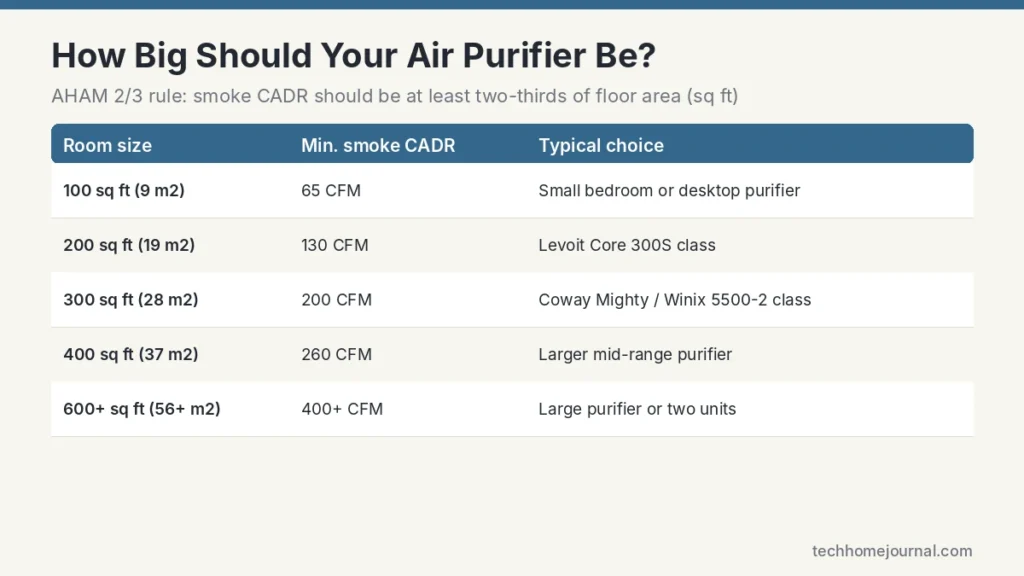
| Room size | Minimum smoke CADR (approx.) | Typical choice |
|---|---|---|
| 100 sq ft (9 m²) | 65 CFM | Small desktop or bedroom purifier |
| 200 sq ft (19 m²) | 130 CFM | Levoit Core 300S class |
| 300 sq ft (28 m²) | 200 CFM | Coway Mighty or Winix 5500-2 class |
| 400 sq ft (37 m²) | 260 CFM | Larger mid-range purifier |
| 600+ sq ft (56+ m²) | 400+ CFM | Large purifier or two units |
Look for the AHAM Verifide seal, which shows independently tested CADR numbers. For allergies or smoke, size up: buying one class larger lets you run the purifier on a quieter setting while still cleaning effectively. You can check certified figures in the AHAM Verifide directory.
Filter Types Explained
| Filter | What it removes | Notes |
|---|---|---|
| True HEPA | Dust, pollen, pet dander, smoke particles | Look for “True HEPA” or H13; “HEPA-type” may be weaker |
| Activated carbon | Odours, some VOCs and gases | More carbon means better odour control |
| Pre-filter | Hair, lint, large dust | Often washable; extends HEPA life |
| Ioniser | Charges particles so they stick to surfaces | Optional; some produce small amounts of ozone |
| UV-C | Claims to reduce germs | Limited benefit in portable units |
Avoid “ozone generator” air cleaners. The EPA warns that ozone can irritate the lungs and is not an effective way to clean indoor air.

Running Costs: Filters and Electricity
The purchase price is only part of the cost. Before buying, check:
- Filter price and lifespan: most HEPA filters last 6 to 12 months with daily use. Expensive or short-lived filters can cost more than the purifier within a few years.
- Electricity: most purifiers use roughly 20 to 60 W on medium settings. Running one all day costs a few dollars a month for many homes. ENERGY STAR certified models use less power for the same cleaning.
- Auto mode: lets the purifier slow down when air is clean, saving power and filter life.
An energy monitoring smart plug shows exactly what your purifier uses, and our guide to lowering your electricity bill has more ways to save.
Where to Place an Air Purifier
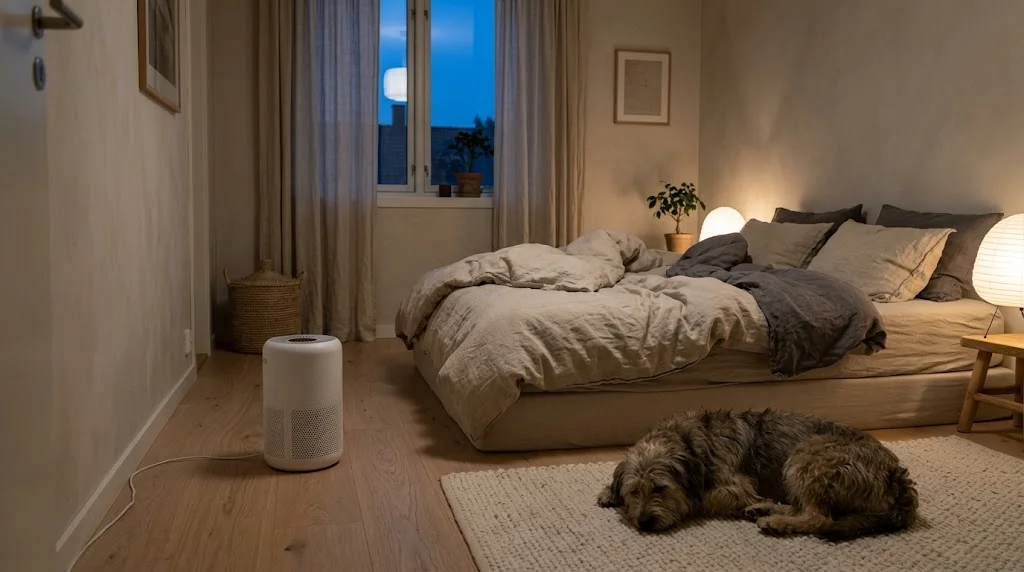
- Leave space around it: keep at least 30 cm (12 in) from walls and furniture so air flows freely.
- Put it where you spend time: the bedroom at night, the living room during the day. A portable unit can move between rooms.
- Close windows and doors when running it for allergies or smoke.
- Keep it off the floor in dusty homes only if the model is designed for it; most work best standing on the floor.
- Avoid corners and behind curtains, where airflow is blocked.
In a calm Scandinavian-style living room, a simple white or fabric-covered purifier near the sofa often looks like a side table. Pair it with plants and soft lighting, and it blends in rather than looking like an appliance.
What Air Purifiers Can’t Do
- Remove carbon monoxide. You need a CO alarm. See our guide to smart carbon monoxide detectors.
- Fix mould or damp problems. They can catch spores in the air, but you still need to fix the moisture source.
- Replace ventilation. Fresh air from windows or a ventilation system is still important, especially for CO₂.
- Clean dust from surfaces. Regular cleaning and a good vacuum are still needed. Our guide to the best robot vacuums for pet hair can help with that.
Choosing for Allergies, Pets and Smoke
For allergies and asthma
Choose a True HEPA purifier sized one class larger than your room, and run it on auto mode around the clock during pollen season. Put a second, smaller unit in the bedroom, since that’s where you spend the most hours. Wash bedding weekly and keep windows closed on high pollen days.
For pets
Pet hair clogs pre-filters quickly, so pick a model with an easy-to-clean or washable pre-filter, and a thicker carbon filter for odours. Vacuum regularly so less hair reaches the purifier in the first place.
For wildfire smoke and city pollution
Smoke particles are tiny, so a high smoke CADR matters most. During smoke events, run the purifier on high in one room with the doors and windows closed to create a clean room, as public health agencies recommend. A purifier with a particle sensor and app shows when the air has improved.
For cooking smells
Carbon does the work here. Look for a purifier with a substantial carbon filter rather than a thin carbon-coated sheet, and use your kitchen extractor fan while cooking.
Frequently Asked Questions
Do air purifiers really work?
Yes, for airborne particles like dust, pollen, pet dander and smoke, a properly sized HEPA purifier can reduce levels significantly. They’re less effective for gases unless they have a substantial carbon filter.
Should I run my air purifier all the time?
For allergies or poor outdoor air, yes. Auto mode is the best option: it runs quietly when air is clean and speeds up when it detects particles.
What size air purifier do I need?
Choose a purifier with a smoke CADR at least two-thirds of the room’s floor area in square feet. Size up for allergies or smoke.
Are smart air purifiers worth it?
They’re worth it if you want schedules, auto mode, filter alerts and air quality history. For a simple bedroom unit, a non-smart model on auto mode works fine.
How often should I change the filter?
Most HEPA filters last 6 to 12 months, depending on use and air quality. Pre-filters should be cleaned every few weeks.
Do air purifiers help with pets?
Yes. HEPA filters catch pet dander, and carbon filters reduce odours. Pair a purifier with regular vacuuming for the best results.
Are ionisers safe?
Most modern ionisers produce very little ozone, but you can usually switch them off. Avoid devices sold as ozone generators.
Can one air purifier clean the whole house?
Only in small homes or with a very powerful unit. Air doesn’t move freely between closed rooms, so most homes do better with one purifier for the main living area and a smaller one for the bedroom.
Is it safe to sleep with an air purifier on?
Yes. Use sleep mode or a low fan speed, dim the display lights, and place it a few feet from the bed. Many people find the gentle fan noise helps them sleep.
Do air purifiers dry out the air?
No. Purifiers filter air but don’t remove moisture. If your air feels dry in winter, a humidifier is the right tool.
Final Verdict
For most bedrooms, the Levoit Core 300S is an easy, affordable smart choice. For living rooms, the Coway Airmega Mighty and Winix 5500-2 give excellent cleaning for the money, while the Blueair Blue Pure series suits design-focused Scandinavian homes. If you want premium features and wall mounting, the Rabbit Air A3 stands out, and Dyson makes sense if you also want a cooling fan.
Whatever you buy, size it correctly using CADR, budget for replacement filters, and use auto mode. Do those three things and an air purifier quietly improves the air you breathe every day.