

Your porch light should be on when you pull into the driveway at night, and off when the sun comes up. You shouldn’t have to remember either. A dusk to dawn light bulb handles both on its own, with no app, no hub and no timer to reset when the clocks change.
It sounds simple, and mostly it is. But plenty of people buy one, screw it into a covered porch light and then wonder why it stays on all day or flickers all night. This guide explains how these bulbs actually work, which ones are worth buying in 2026, how bright they should be for each spot around your home, and how to fix the most common problems.
Table of Contents
- What Is a Dusk to Dawn Light Bulb?
- How a Dusk to Dawn Bulb Works
- Quick Picks: Dusk to Dawn Bulbs Worth Buying
- Comparison Table
- How Bright Should It Be?
- How to Choose the Right Bulb
- Installation Tips That Prevent Problems
- Troubleshooting Common Problems
- Dusk to Dawn vs Motion Sensor vs Smart Bulb
- How Much Does It Cost to Run All Night?
- Frequently Asked Questions
- Final Verdict
What Is a Dusk to Dawn Light Bulb?
A dusk to dawn light bulb is a regular-looking LED bulb with a small light sensor built in. When the light around it fades in the evening, it turns itself on. When daylight returns in the morning, it turns itself off. You leave the wall switch on permanently and the bulb does the rest.
Most of these bulbs use a standard E26 medium base, so they fit the same porch lights, wall lanterns, lamp posts and garage fixtures that already take a normal household bulb. Some versions use the smaller E12 candelabra base for decorative lanterns.
They are mainly designed for outdoor fixtures that see the sky. That is the key to how well they work, and it is the reason most problems happen.
How a Dusk to Dawn Bulb Works
Inside the bulb sits a photocell, a tiny sensor that reacts to light. On Feit Electric models, for example, the company says the sensor is located inside the bulb right at its base, often visible as a small dark lens. When ambient light drops below the bulb’s set level, the circuit switches the LED on. When enough light returns, it switches off.
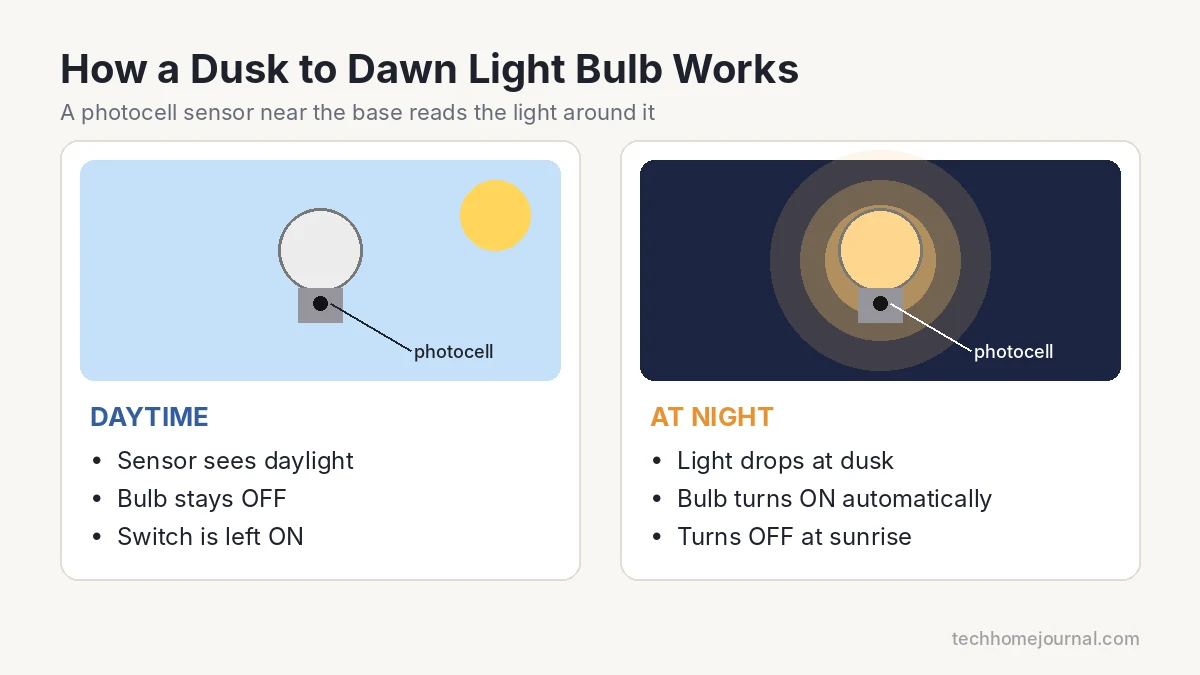
Because the bulb reacts to light and not to the clock, it adjusts automatically as days get shorter in winter and longer in summer. That is the big advantage over a mechanical timer.
There are three rules that come straight from how the sensor works:
- The switch must stay on. The bulb needs constant power to watch the light level.
- The sensor needs to see daylight. A bulb deep under a roof overhang or inside a closed fixture may never “see” morning.
- Other light confuses it. A bright street light, a neighbor’s floodlight or the bulb’s own glow bouncing back off a wall can trick the sensor.
Quick Picks: Dusk to Dawn Bulbs Worth Buying
These picks are based on published manufacturer specs. Prices change often, so treat the figures as a rough guide and check current deals before you buy.
Best overall: Feit Electric A19 Soft White Dusk to Dawn LED
Specs: 8.8W, 800 lumens (60W equivalent), 2700K, CRI 90, E26 base, 15,000-hour rated life, enclosed fixture rated, damp rated, not dimmable.
The Feit A19 dusk to dawn bulb is the easy default for a covered porch light or wall lantern. The warm 2700K color looks welcoming instead of harsh, and the enclosed-fixture rating means it can go inside a glass lantern without overheating.
- Pros: warm light, high CRI for accurate colors, works in enclosed fixtures, widely available.
- Cons: damp rated (not wet rated), so keep it in a covered fixture; not dimmable.
Best vintage look: Feit Electric ST19 Dusk to Dawn Filament LED
Specs: 8.8W, 800 lumens, 2700K, CRI 90, E26 base, 15,000-hour rated life, enclosed fixture rated, damp rated, not dimmable.
If your lantern has clear glass, the bulb is part of the look. The Feit ST19 filament dusk to dawn bulb gives you an Edison-style filament with the same automatic on/off behavior. It pairs well with farmhouse and Scandinavian-style exteriors.
- Pros: attractive filament style, warm glow, same efficiency as the standard version.
- Cons: clear glass shows more glare in open fixtures.
Best for brighter spots: GE LED+ A21 Dusk to Dawn (100W replacement)
Specs: 13W, 1,600 lumens, 2700K soft white (a daylight version is also sold), CRI 80, E26 base, not dimmable, 3-year warranty, GE lists about 22.8 years of life.
For a garage door, back door or driveway where you want real brightness, the GE LED+ A21 dusk to dawn bulb doubles the light output of a 60W-equivalent bulb. GE notes the sensor must be exposed to ambient light to work properly.
- Pros: 1,600 lumens, longer warranty, no app or hub needed.
- Cons: larger A21 shape may not fit small lanterns; check the fixture’s wet or damp rating before outdoor use.
Best for candelabra lanterns: Feit Electric A19 E12 Dusk to Dawn LED
Specs: 8.8W, 60W equivalent, 5000K daylight, E12 candelabra base.
Some decorative coach lights and small lanterns take the smaller E12 base. The Feit E12 dusk to dawn bulb fills that gap. Note the 5000K daylight color: it looks crisp and bright, but cooler than the 2700K picks above.
- Pros: fits candelabra fixtures, bright clean light.
- Cons: cool white color will not match warm bulbs elsewhere on the house.
Comparison Table
| Bulb | Brightness | Color | Base | Enclosed rated | Best for |
|---|---|---|---|---|---|
| Feit A19 Soft White | 800 lm | 2700K | E26 | Yes | Porch lights, wall lanterns |
| Feit ST19 Filament | 800 lm | 2700K | E26 | Yes | Clear-glass lanterns |
| GE LED+ A21 | 1,600 lm | 2700K or daylight | E26 | Check package | Garage, driveway, back door |
| Feit A19 E12 | 60W equivalent | 5000K | E12 | Check package | Candelabra coach lights |
How Bright Should It Be?
Brightness is measured in lumens, not watts. As the FTC’s light bulb shopping guide explains, a traditional 60-watt incandescent bulb gives about 800 lumens. Use that as your reference point.
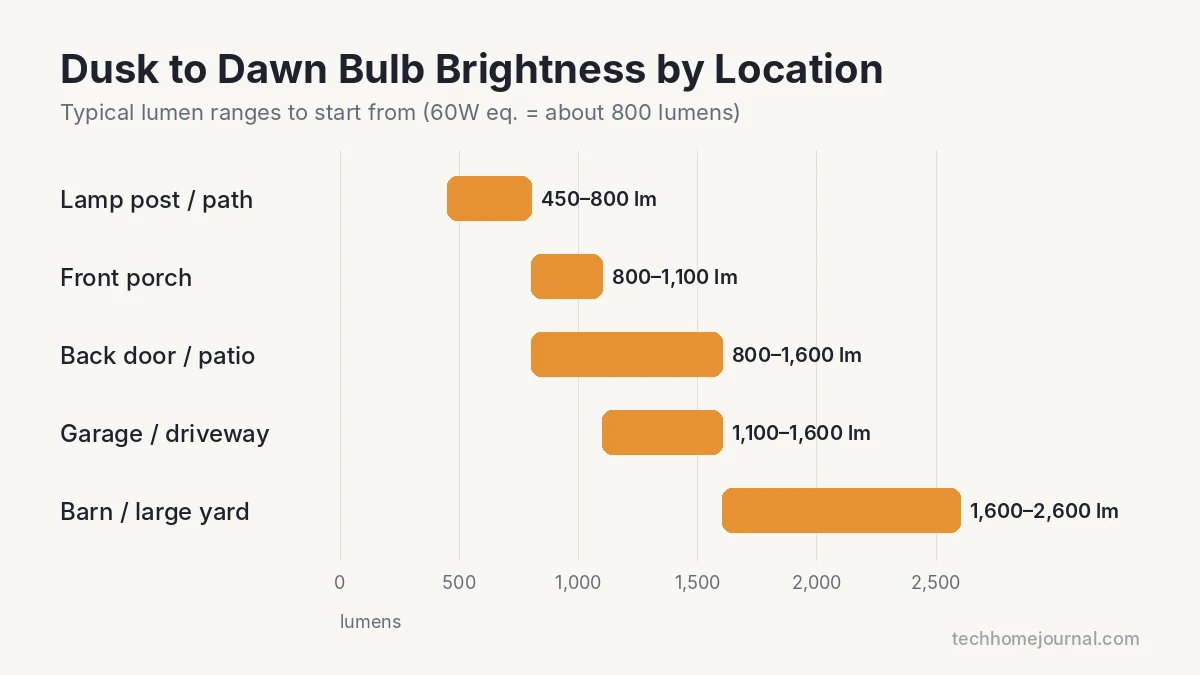
These ranges are good starting points:
- Lamp posts and path lights: 450–800 lumens. Enough to see the walkway without lighting up the whole street.
- Front porch: 800–1,100 lumens. Bright enough to see faces and find keys.
- Back door and patio: 800–1,600 lumens, depending on the area you need to cover.
- Garage and driveway: 1,100–1,600 lumens for a clear view of the cars and the approach.
- Barns and large yards: 1,600 lumens and up, usually in a dedicated security fixture.
Brighter is not always better. A bulb that is too strong for a small porch creates glare and can bother neighbors. If you want strong light only when someone walks up, a motion sensor light is often the better tool for that job.
How to Choose the Right Bulb
Color temperature
Warm white (2700K–3000K) suits most homes. It feels welcoming and matches indoor lighting seen through the windows. Daylight bulbs (5000K) look bright and crisp and are common for security lighting, but they can look harsh on a front porch. Pick one color and use it across the whole front of the house so it looks planned.
Damp, wet and enclosed ratings
This is the spec most people skip. A damp-rated bulb is fine in a covered porch light. A bulb exposed directly to rain needs a wet-rated fixture or bulb. If the bulb sits inside a closed glass lantern, check that it is enclosed fixture rated, because trapped heat shortens LED life.
Base type and shape
Check your old bulb before you buy. Most porch fixtures use E26; small coach lights may use E12. The larger A21 shape is brighter but may not fit inside compact lanterns.
Color rendering (CRI)
CRI tells you how natural colors look under the light. A CRI of 90, like the Feit picks above, makes brick, wood and plants look more natural than a CRI 80 bulb. It matters most on the front of the house, where looks count.
Filament or standard
Filament-style bulbs look great in clear glass lanterns. In frosted or closed fixtures, a standard A19 bulb gives smoother light and the style difference won’t show.
Installation Tips That Prevent Problems
- Turn the wall switch on and leave it on. Flipping it off cuts power to the sensor.
- Point the sensor toward daylight. Feit suggests lifting the bulb slightly in the socket and rotating it so the photo-eye faces the sky.
- Keep the sensor clean. Dust, fingerprints or marks on the photo-eye can change when the bulb switches.
- Avoid timers, dimmers and other sensors. Feit states its dusk to dawn bulbs are not compatible with digital or mechanical timers, and they should not be wired behind another photocell or motion sensor.
- Test it in daytime. Cover the sensor completely with electrical tape. The bulb should light like a normal bulb. Remove the tape and clean the lens afterward.
Troubleshooting Common Problems
Most “faulty” dusk to dawn bulbs are actually placement problems. Feit’s troubleshooting guide lists the same causes we see again and again.
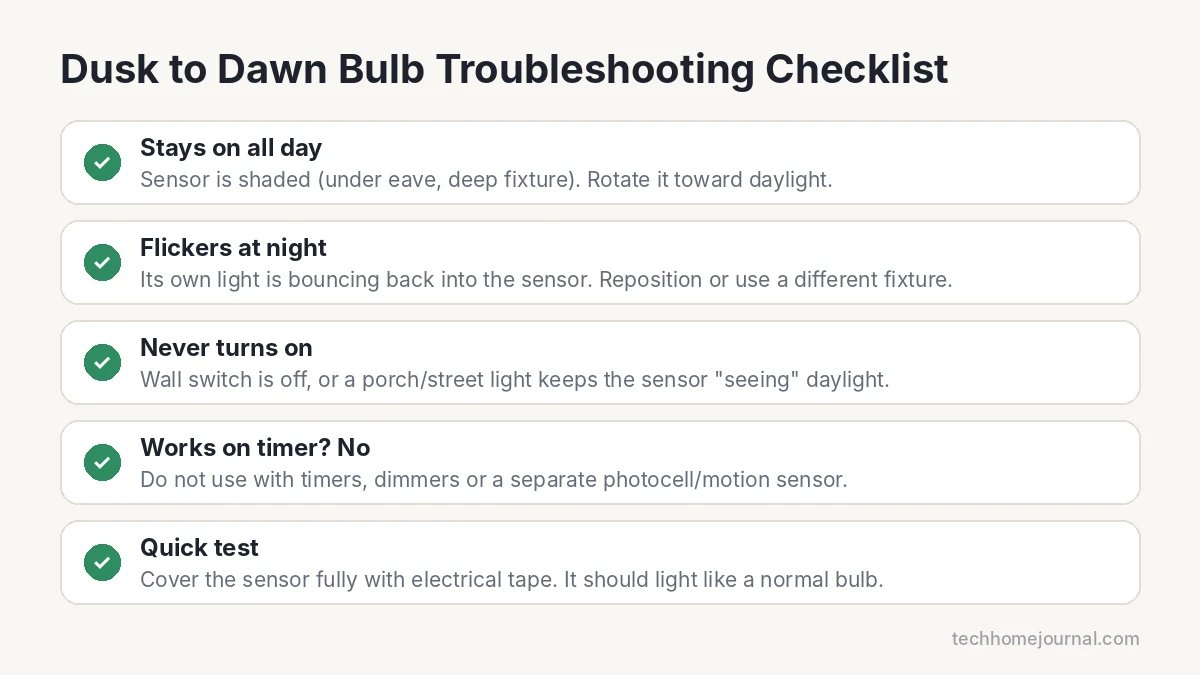
| Problem | Likely cause | Fix |
|---|---|---|
| Stays on during the day | Sensor is shaded under an eave or deep fixture, or the day is very overcast | Rotate the bulb so the sensor faces the sky, or move it to a more open fixture |
| Flickers at night | The bulb’s own light reflects back into the sensor | Rotate the bulb, or use a fixture with less reflective glass |
| Never turns on | Switch is off, or a street light or floodlight keeps the area bright | Leave the switch on; shield the sensor side from other lights |
| Erratic on/off timing | Dirty sensor or a timer/dimmer on the circuit | Clean the photo-eye; remove timers and dimmers |
Dusk to Dawn vs Motion Sensor vs Smart Bulb
A dusk to dawn bulb is the simplest way to automate a light. But it is not the only option, and sometimes it is not the best one.
| Option | How it switches | Best for | Main downside |
|---|---|---|---|
| Dusk to dawn bulb | Built-in light sensor | Porch and lamp post lights that should stay on all night | No scheduling or remote control |
| Motion sensor light | Turns on when movement is detected | Driveways, side yards, back doors | Off most of the night |
| Smart bulb | App schedules, sunset timing, voice | Full control and dimming | Costs more; needs Wi-Fi or a hub |
| Smart plug or switch | App schedules for the whole fixture | Plug-in lamps and string lights | Does not dim most bulbs |
For dark side paths with no power, a solar motion sensor light avoids wiring altogether. If you want app control without replacing every bulb, read our guide to what a smart plug can do. And if you are planning a full lighting upgrade, our best smart light bulbs guide covers bulbs with sunset schedules and dimming.
Good exterior lighting also makes your cameras more useful at night. If you are adding one, see our Ring floodlight camera guide or our list of doorbell cameras with no subscription.
How Much Does It Cost to Run All Night?
Very little. A dusk to dawn bulb typically runs 10–14 hours a night depending on the season. Using 12 hours as an average:
- 8.8W LED: 8.8 × 12 × 365 ÷ 1,000 = about 38.5 kWh a year, or roughly $6.50 at an example rate of 17¢ per kWh.
- 60W incandescent doing the same job: about 263 kWh a year, or roughly $44.70 at the same rate.
That gap is why LED is the only sensible choice for all-night lighting. To see the savings for your own bulbs, use our free LED vs incandescent savings calculator. The U.S. Department of Energy says residential LEDs use at least 75% less energy than incandescent lighting and last much longer. For more ways to cut your bill, see our smart home energy saving tips. If you are curious why old-style bulbs are hard to find now, our incandescent light bulb guide explains the rules.
Frequently Asked Questions
Can I use a dusk to dawn light bulb indoors?
You can, but only where the sensor sees real daylight, such as a lamp right next to a window. In most rooms, indoor lights, shades and curtains confuse the sensor. For indoor lamps, a smart plug or smart bulb with a sunset schedule works more reliably.
Why does my dusk to dawn bulb stay on during the day?
The sensor is not seeing enough daylight. This happens under deep roof overhangs, in shaded corners or on very dark, overcast days. Rotate the bulb so the sensor faces the sky, or move it to a more open fixture.
Can I use a dusk to dawn bulb with a dimmer or timer?
No. These bulbs need full, constant power. Feit specifically says its dusk to dawn bulbs do not work with digital or mechanical timers, and the bulbs listed above are not dimmable.
Do dusk to dawn bulbs work in enclosed fixtures?
Some do. Look for “enclosed fixture rated” on the box. The Feit A19 and ST19 models are rated for enclosed fixtures, but the sensor still needs to see daylight through the glass.
How long do dusk to dawn light bulbs last?
Feit rates its models at 15,000 hours, and GE lists about 22.8 years for its A21 version based on its own usage assumptions. Because these bulbs run all night, expect real-world life to be shorter in years than a bulb used only a few hours a day.
Are dusk to dawn bulbs good for security?
They help. A lit porch and entry make a home look occupied and make cameras more useful at night. For stronger protection, pair them with motion lighting and a camera, or a motion sensor alarm.
Final Verdict
A dusk to dawn light bulb is one of the cheapest, easiest home upgrades you can make. For most porch lights and wall lanterns, the Feit A19 Soft White is the safe pick: warm 2700K light, CRI 90 and an enclosed-fixture rating. Choose the Feit ST19 filament bulb for clear-glass lanterns, and step up to the 1,600-lumen GE LED+ A21 for garages and driveways.
Get the placement right, leave the switch on, and keep the sensor facing daylight. Do that, and your outdoor lights will simply be on when you need them, every night, without you thinking about it again.



