

You know the scene. You walk up to your own front door at 9pm, keys in hand, and fumble around in the dark because the porch light burned out again. A solar motion sensor light fixes that problem without an electrician or a single wire run through your wall.
But here’s the catch nobody tells you at the hardware store: plenty of cheap solar units fade out within a year or two. Not because solar is a bad idea, but because the panel, battery and sensor inside were never matched to each other properly. This guide walks through what actually separates a light that keeps working through several winters from one that’s dead by spring.
Table of Contents
- Quick Answer: What to Look For
- How Solar Motion Sensor Lights Actually Work
- Lumens: The Number That Matters Most
- Battery Type Decides Whether It Survives Winter
- Sensor Range and Detection Angle
- IP Rating and Weatherproofing
- Mounting Styles for an Entry Wall or Patio
- Matching Scandinavian Style Without Sacrificing Output
- Solar Panel Placement Is Where Most Buyers Mess Up
- Smart Solar Lights: Are They Worth It?
- Price Bands and What You’re Actually Paying For
- Common Failure Points to Spot Before Buying
- Installation and Maintenance Tips
- Buying Checklist
- Frequently Asked Questions
- Final Verdict
Quick Answer: What to Look For
Short on time? A good solar motion sensor light for a front door, patio or living room exterior wall usually has:
- 300–700 lumens for entries and patios (800+ only for driveways and big yards)
- A lithium battery (18650 lithium-ion or LiFePO4), ideally replaceable
- IP65 or better weather rating
- Adjustable PIR sensitivity with roughly a 120° angle and 15–30 ft range
- A separate solar panel on a cable if your wall doesn’t get 4–6 hours of direct sun
- 3000K–4000K warm or neutral white light
How Solar Motion Sensor Lights Actually Work
A solar motion sensor light has three parts working together: a photovoltaic panel, a rechargeable battery and a passive infrared (PIR) sensor. The panel charges the battery during daylight hours. At dusk, a built-in light sensor (a photoresistor, or LDR) tells the unit it’s dark enough to arm the motion sensor.
When the PIR sensor detects a heat signature moving across its field, it switches the LED on for a set time, usually 15–60 seconds. Most units run in one of two modes: a dim “standby” glow that brightens on motion, or a true off-until-triggered mode that saves more battery.
The standby mode looks nicer next to a living room window or entryway, since it’s never pitch black. But it drains the battery faster, which matters more in low-sun months like December and January. If you mostly want the light as a deterrent, pairing it with a motion sensor alarm gives you sound as well as light.
Lumens: The Number That Matters Most
Brightness is measured in lumens, not watts, and this trips up a lot of first-time buyers. Watts tell you how much energy a light uses; lumens tell you how much light it actually puts out. The FTC’s guide to buying light bulbs explains the difference well. Solar listings also love inflated claims like “3000 LM” on a tiny panel, so treat oversized numbers on cheap units with suspicion.
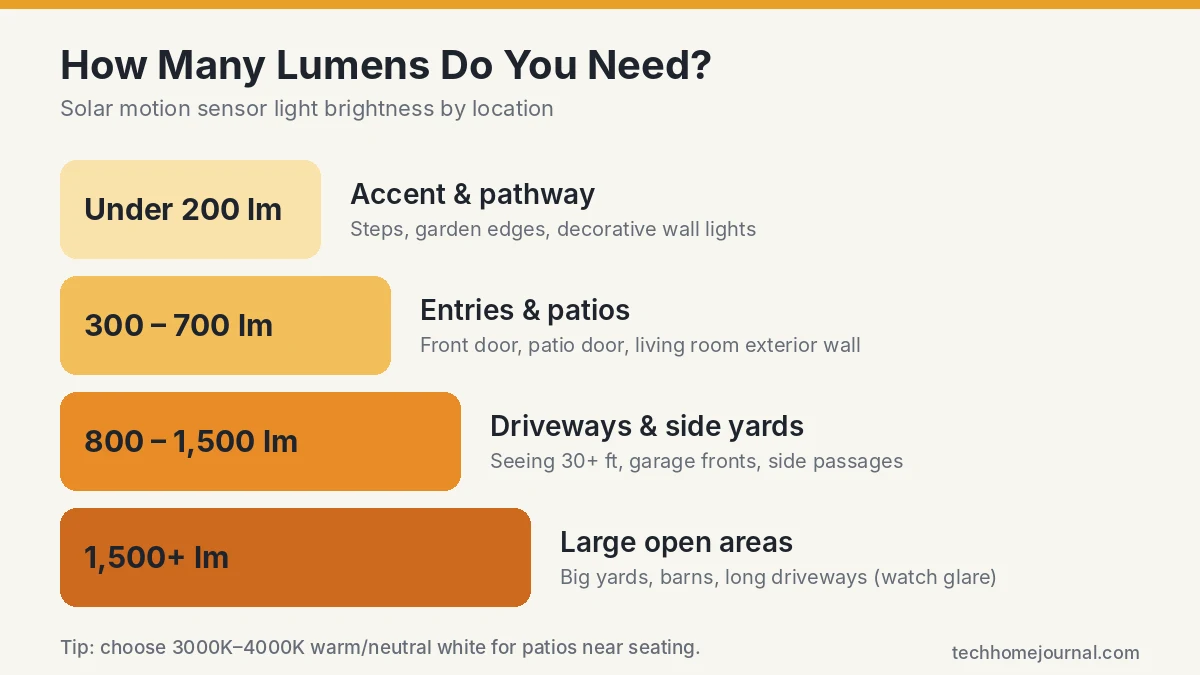
For a living room window, patio door or entry near seating, aim for 300–700 lumens. That’s enough to read a house number or spot a step without blinding anyone sitting nearby on a patio chair.
- Under 200 lumens: accent or pathway use only, not functional security lighting
- 300–700 lumens: ideal for entries, patios and living room exterior walls
- 800–1,500 lumens: driveways, side passages and garage fronts
- 1,500+ lumens: large yards or long driveways where you need to see 30+ feet
If you’re lighting a longer drive rather than a doorway, our guide to driveway solar lights covers that layout in more detail.
Pro tip: check the CCT (correlated color temperature) rating too. Anything above 5000K reads as cold blue-white. For a Scandinavian-style exterior, look for 3000K–4000K, which gives a warmer, more neutral glow that matches pale wood and white trim. It’s also kinder to neighbors and wildlife; DarkSky International’s lighting principles recommend warmer light, aimed only where it’s needed.
Battery Type Decides Whether It Survives Winter
This is the part most buyers skip, and it’s the single biggest reason solar lights fail. There are three common battery chemistries in solar motion sensor lights: NiMH (nickel-metal hydride), NiCd (nickel-cadmium) and lithium, either standard lithium-ion (often an 18650 cell) or LiFePO4 (lithium iron phosphate).
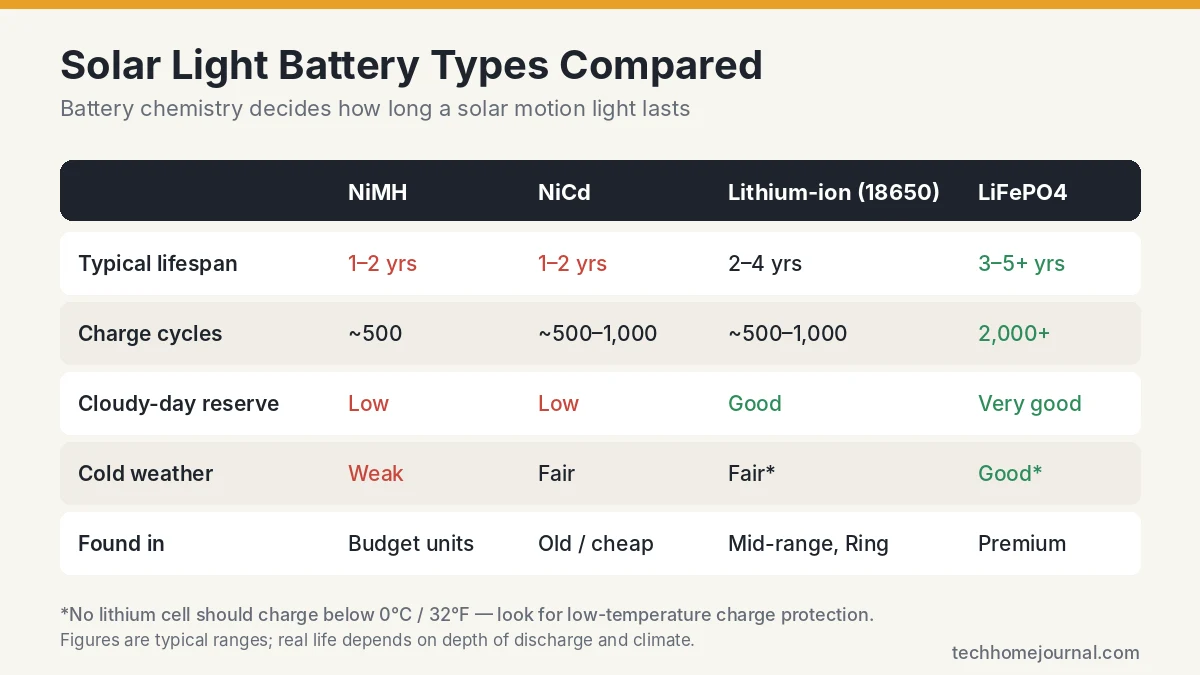
NiMH batteries are cheap and common in budget units, but they hold less energy and usually need replacing after 1–2 years. NiCd is older tech, prone to the “memory effect,” and mostly phased out. Lithium cells store more energy in the same space and hold a charge through cloudy stretches far better. LiFePO4 is the toughest of the lot: Battery University lists it at 2,000+ charge cycles and as one of the safest lithium chemistries.
One honest caveat: cold reduces the performance of every battery type, and no lithium cell should be charged below freezing (0°C / 32°F). Better-made lights include low-temperature charge protection that pauses charging until the cell warms up. If you live somewhere with hard winters, look for that line on the spec sheet.
Note: if the product listing doesn’t specify battery chemistry, that’s a red flag. Reputable brands print it right on the spec sheet because buyers who’ve been burned before are looking for it.
Also check whether the battery is replaceable. Many budget lights seal the battery in, so when it degrades (often after 18–24 months of regular use), the whole fixture becomes e-waste. Units with a swappable 18650 or AA-format battery cost a bit more upfront but save you from buying a whole new fixture later.
Sensor Range and Detection Angle
PIR sensors have two specs that matter: detection range and detection angle. Range is how far out the sensor picks up motion, usually listed in feet. Angle is how wide a cone it covers, typically somewhere between 90 and 180 degrees, with some multi-head units claiming 270°.
For a wall facing your patio or front walk, you don’t need a 270-degree sensor meant for open driveways. A 120-degree angle with a 15–25 foot range covers a typical patio or walkway without constantly tripping on street traffic or a neighbor’s cat three houses down.
Sensitivity is adjustable on most mid-range and higher units, usually a small dial or switch on the back. Lower sensitivity helps if you’re getting false triggers from blowing leaves or passing cars. This one adjustment solves more “my light won’t stop turning on” complaints than any other fix. Keep in mind PIR sensors see heat moving across their view much better than heat walking straight toward them, so angle the light to look across your path, not down it.
IP Rating and Weatherproofing
The IP (Ingress Protection) rating tells you how well the housing keeps out dust and water. The first digit covers solids, the second covers liquids. For an outdoor solar light, IP65 (dust-tight and protected against water jets) is the sensible minimum, and IP66 adds protection against stronger jets. RS Components has a clear IP ratings explainer if you want the full chart.
Ratings like IP44 are fine under a covered porch but not for a fully exposed wall. And if a listing says “waterproof” with no IP number at all, assume it hasn’t been tested to any standard.
Mounting Styles for an Entry Wall or Patio
Three mounting styles dominate this category: surface-mount with screws, adhesive-backed and bracket-and-swivel. Surface-mount is the most secure and is the right choice for anything over 500 lumens, since heavier units can sag or fall off adhesive strips within a season.
Bracket-and-swivel mounts let you angle the light down or sideways after installation, which matters a lot near a living room window, where you want light on the walkway, not glaring straight into your own glass at night. Adhesive mounts work fine for lightweight accent lights under 200 lumens but aren’t built for anything doing real security work.
Check the bracket material too. Plastic brackets exposed to direct sun can turn brittle within a couple of years in hot climates. Aluminum or powder-coated steel brackets cost more but hold up through temperature swings far better. The same logic applies to side doors and outbuildings; our garage security ideas guide covers where extra lighting helps most.
Matching Scandinavian Style Without Sacrificing Output
Scandinavian exterior design leans on clean lines, matte finishes and neutral tones, usually white, black or natural wood-look composite. Most solar lights on the market are glossy black plastic with visible screw heads and an obvious “security light” look, which clashes with that aesthetic.
Look for matte white or matte black housings with a slim, low-profile shape rather than the bulky floodlight style. A few practical workarounds if your preferred style doesn’t come in high lumens:
- Pair a low-profile accent light near the door with a separate higher-output unit mounted less visibly, like under an eave with its panel run out into the sun
- Choose warm white (3000K) over cool white regardless of brand, since it reads as more intentional and less “construction site”
- Avoid chrome or shiny black finishes that catch glare and look dated against matte Scandinavian palettes
For more ways to make tech blend in rather than stand out, see our roundup of smart devices for a Scandinavian living room.
Solar Panel Placement Is Where Most Buyers Mess Up
One of the most common mistakes is mounting the whole fixture, panel included, under an eave or awning for weather protection. That shades the panel and starves the battery, even if the LED housing itself stays dry.
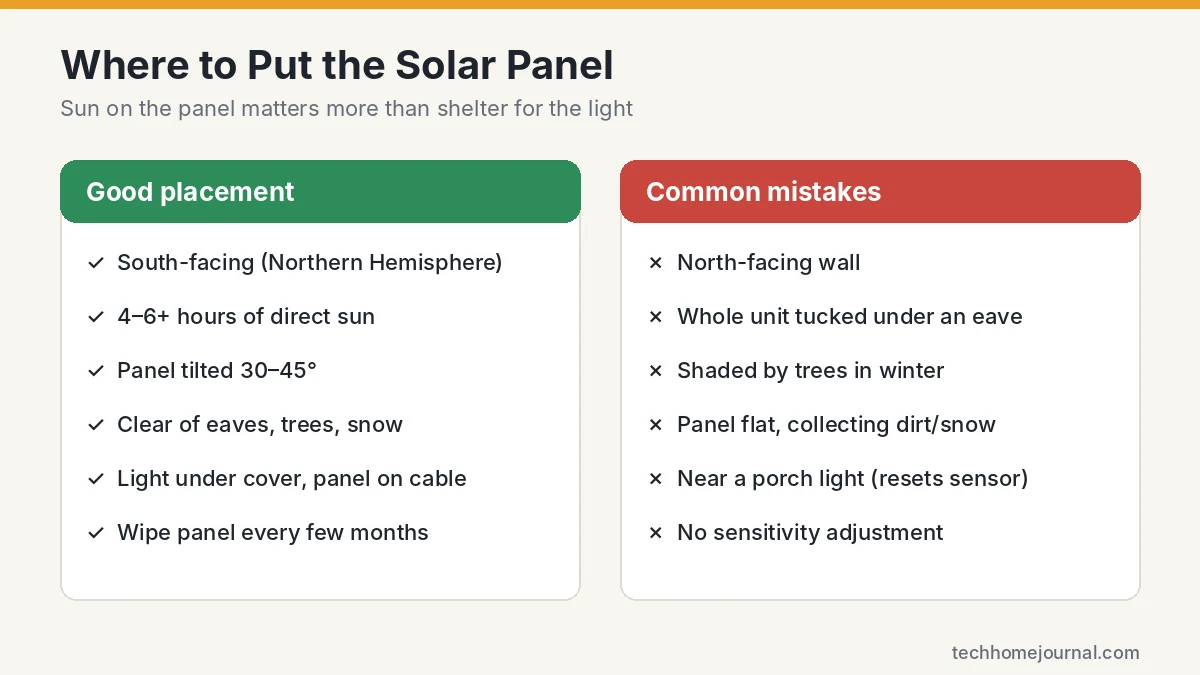
Separate-panel units solve this. The panel sits on a cable, usually 10–16 feet long, so you can mount the light under cover while running the panel out to a spot that gets direct sun for at least 4–6 hours a day. South-facing placement works best in the Northern Hemisphere (north-facing in the Southern Hemisphere), with the panel tilted roughly 30–45° so rain helps wash it clean.
If you’re stuck with an integrated panel-and-light unit, prioritize sun exposure over weather protection. An IP65-rated housing handles rain fine without an overhang.
Warning: never mount a panel facing north in the Northern Hemisphere, even if the spot looks bright to your eye. It’ll undercharge every single day, no matter how good the battery is. Also keep the light away from porch lights or street lights, which can trick the dusk sensor into thinking it’s still daytime.
Smart Solar Lights: Are They Worth It?
Most solar motion lights are “dumb”: they turn on with motion and that’s it. Smart versions connect to an app so you can change brightness, set schedules, get motion alerts and link several lights so the whole path lights up together.
Ring is the best-known example. The Ring Solar Pathlight (up to 80 lumens) and Ring Solar Steplight (up to 50 lumens) both use a 3500K warm white LED, a rechargeable 18650 lithium-ion battery, IP66 weatherproofing, a 120° view and around 15 ft of motion detection, with list prices around $30–35 (check current deals). Note that app control needs a Ring Bridge or Alarm Pro base station, unless Amazon Sidewalk covers your area. Without one, they still work as basic motion lights. A smart home hub is worth thinking about if you plan to add more outdoor devices later.
These are path and step lights, not floodlights. If you want bright light plus video, you’re looking at a camera: a wired option like the Ring Floodlight Camera, or one of the best solar-powered security cameras if you don’t want to run wiring.
Price Bands and What You’re Actually Paying For
| Tier | Approx. price per light | Typical battery | What you get | Realistic lifespan |
|---|---|---|---|---|
| Budget | $10–30 (often sold in multi-packs) | NiMH or sealed lithium | Basic PIR, integrated panel, plastic housing | 1–2 years |
| Mid-range | $35–70 | Lithium-ion / LiFePO4 | Adjustable sensitivity, separate panel, IP65+ | 3+ years |
| Smart | $25–80 + hub | 18650 lithium-ion | App control, schedules, alerts, linked lights | 3+ years |
| Camera + light | $100–250+ | Rechargeable pack + solar panel | Video, two-way talk, spotlight | Varies |
Budget units can be fine for low-stakes spots like a shed path, but the mid-range band is where most buyers land, and where the value actually holds up over three-plus years. In the smart and camera tiers, you’re paying for app features and integration, not necessarily brighter or longer-lasting hardware. If you’re building out security on a tight budget, our cheap home security ideas guide shows where solar lights fit in.
Common Failure Points to Spot Before Buying
Most solar motion sensor light failures trace back to the same handful of issues, and you can often spot the risk before you even open the box:
- Sealed, non-replaceable batteries that force a full fixture replacement once capacity drops
- Integrated panels mounted in shaded or north-facing spots, leading to chronic undercharging
- Cheap PIR sensors with no sensitivity adjustment, causing constant false triggers from wind or small animals
- Plastic housings and brackets that turn brittle under UV exposure within 2–3 years
- No published IP rating, meaning the manufacturer isn’t confident about weatherproofing
- Wildly inflated lumen claims that don’t match the size of the panel
Reading the spec sheet before buying solves most of this. If a listing is vague on battery type, IP rating or sensor adjustability, treat that vagueness as the answer itself.
Installation and Maintenance Tips
- Charge before mounting: leave a new light switched on in full sun for a day or two, so the battery starts full.
- Mount at 6–8 feet: high enough to be hard to tamper with, low enough for the PIR sensor to read people rather than rooftops.
- Test at night: walk your path after dark and adjust angle and sensitivity before you call it done.
- Clean the panel: wipe off dust, pollen and bird droppings every few months, and clear snow in winter.
- Swap the battery, not the light: when nightly runtime drops noticeably, a fresh cell of the same type usually brings it back.
Solar lights work best as one layer of a bigger plan. Combined with cameras and sensors from a wireless home security system, they make your entry points far less inviting.
Buying Checklist
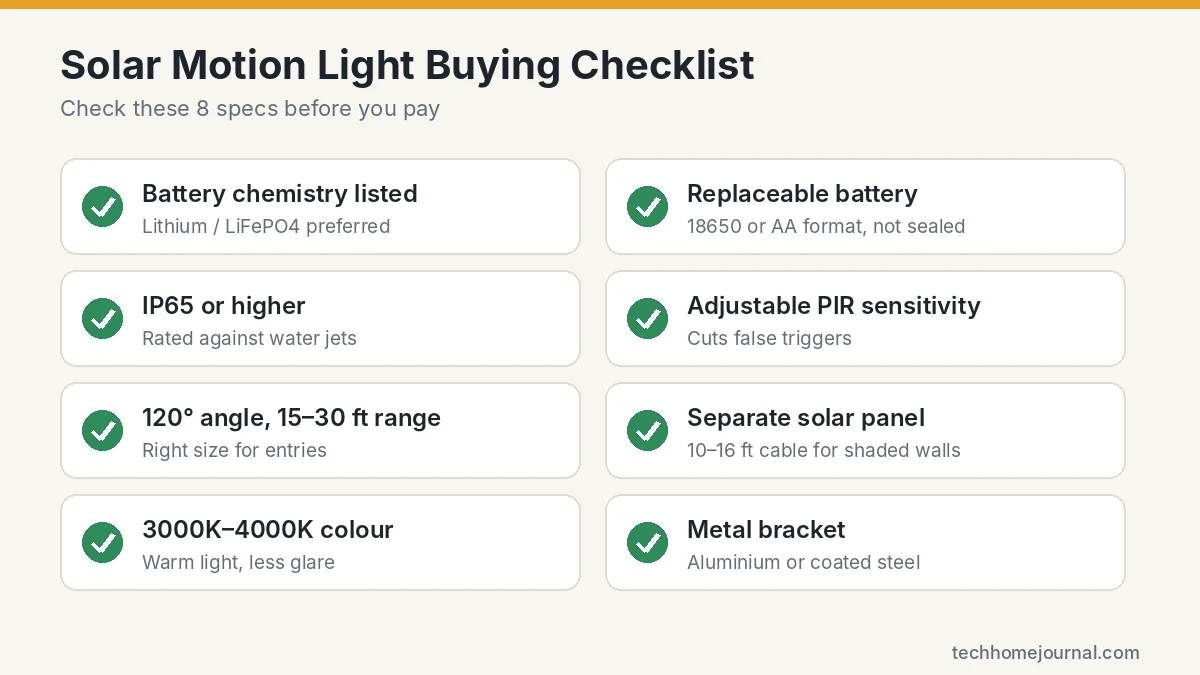
The right solar motion sensor light for an entry wall isn’t the brightest one or the cheapest one. It’s the one where the battery chemistry, panel placement and lumen output all match what your specific wall, patio or entry actually needs. Run through the checklist above, and if a product can’t tick at least six of the eight boxes, keep looking.
Frequently Asked Questions
How long do solar motion sensor lights last at night on one charge?
Because they only switch on with motion, most mid-range units last the whole night on a full charge with normal foot traffic. Lithium-based units typically hold a usable charge through 2–3 cloudy days in a row, while NiMH units may struggle after just one overcast day. Constant triggering, or a bright standby mode, drains them faster.
Can a solar motion sensor light work without direct sunlight?
It can charge from indirect or filtered light, but output and recharge speed drop significantly. Units in shaded spots can take two to three times longer to reach full charge, which shortens nightly runtime. A model with a separate panel on a cable is the best fix for a shaded wall.
Do solar motion sensor lights work in winter?
Yes, but shorter days and a lower sun angle mean less charging time. Lithium batteries hold more charge than NiMH through cloudy stretches, and good models include low-temperature protection that pauses charging below freezing. Tilting the panel more steeply in winter and keeping it clear of snow helps a lot.
Is a higher lumen rating always better?
Not necessarily. For a seating area or a wall near your windows, 300–700 lumens usually gives enough visibility without glare or light spilling into neighboring windows. Anything above 800 lumens is better suited to driveways or larger open yards.
How often do I need to replace the battery in a solar light?
NiMH batteries typically need replacing after 1–2 years of regular use, and if they’re sealed in, the whole unit goes with them. Replaceable 18650 lithium cells commonly last 2–4 years, and LiFePO4 longer still. Swap the cell when nightly runtime drops noticeably.
Why does my solar motion light stay on or keep flashing?
Usually it’s one of three things: sensitivity set too high (moving branches, passing cars), a nearby heat source like a vent, or a low battery that can’t hold the LED on. Lower the sensitivity, re-aim the sensor and give the battery a couple of sunny days to recover. If it still flickers, the battery is likely worn out.
Do solar motion lights actually deter burglars?
They help by removing dark hiding spots and making movement obvious, which is why lighting shows up in most home security advice. They work best alongside other layers like door sensors, cameras or a full outdoor camera system, rather than on their own.
Final Verdict
If you take nothing else from this guide, take this: check the battery type and panel placement before you check the price. A $45 light with a replaceable lithium battery and a properly placed panel will outlast a $60 light with a sealed NiMH battery stuck under a shaded eave, every single time.
For most entries and patios, a mid-range unit with 300–700 lumens, IP65+ weatherproofing, adjustable sensitivity and a warm 3000K–4000K glow is the sweet spot. Once the hardware is right, the aesthetic choices, matte finishes, slim housings and warm light, are easy to layer on top without giving up performance.



