

A motion sensor light turns on by itself when someone walks by and switches off again when they leave. That simple trick solves a surprising number of everyday problems: fumbling for keys at the front door, stubbing a toe on the stairs at 3 a.m., or leaving the garage light burning all night.
There are now motion lights for almost every spot in and around a home, from $12 plug-in night lights to smart floodlights that ping your phone. This guide explains how they work, which type fits which room, how bright they need to be, and the models worth looking at in 2026.
Table of Contents
- Quick Answer
- How Motion Sensor Lights Work
- Types of Motion Sensor Lights
- Indoor vs. Outdoor: What Changes
- How Bright Should It Be?
- Power Options: Plug-In, Battery, Hardwired or Solar
- Motion Sensor Lights Worth Considering
- Where to Put Motion Sensor Lights
- Are Smart Motion Lights Worth It?
- Common Problems and Fixes
- Frequently Asked Questions
- Final Verdict
Quick Answer
- Hallways and bedrooms: a plug-in or stick-on battery light with 20–100 lumens
- Stairs and closets: battery LED bars or puck lights you can mount anywhere
- Rooms you walk through often: a motion sensor wall switch that controls the existing ceiling light
- Front door and patio: an outdoor wall light with 300–700 lumens
- Driveways and side yards: a floodlight with 800+ lumens
How Motion Sensor Lights Work
Most motion lights use a passive infrared (PIR) sensor. It doesn’t send out anything; it simply watches for a change in infrared (heat) energy as a warm body moves across its field of view. When it sees that change, it switches the light on for a set time, usually 20 seconds to a few minutes, and the timer resets every time it detects more movement.
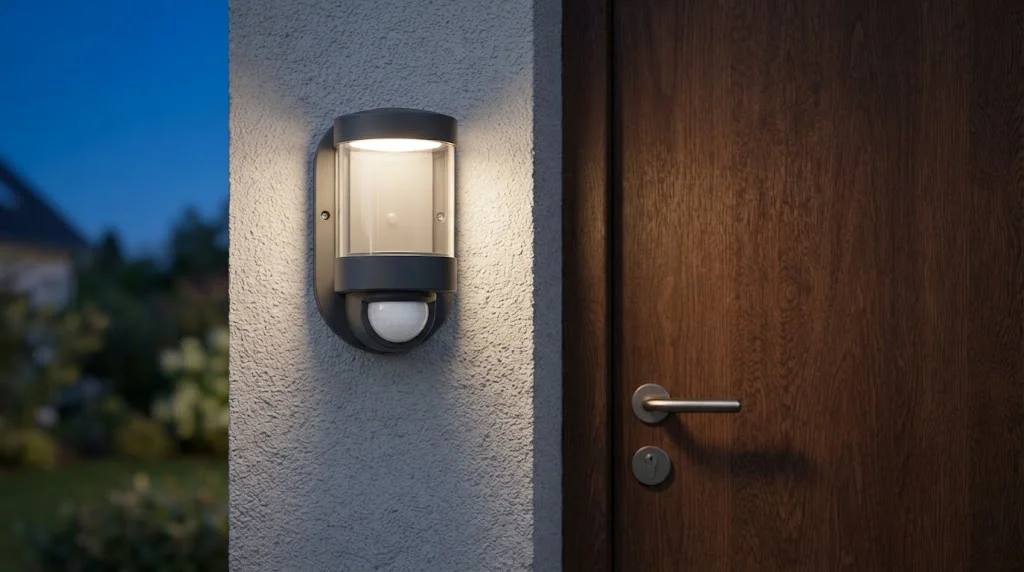
Some lights use microwave sensors instead, which send out a low-power signal and measure the reflection. They’re more sensitive and can “see” through thin materials, but they’re also more prone to false triggers. Dual-technology sensors combine both to cut false alarms. Most models also include a dusk sensor (photocell) so the light only reacts after dark.
Tip: PIR sensors detect movement across their view much better than movement straight toward them. Aim the sensor so people cross its path rather than walk directly at it.
Types of Motion Sensor Lights
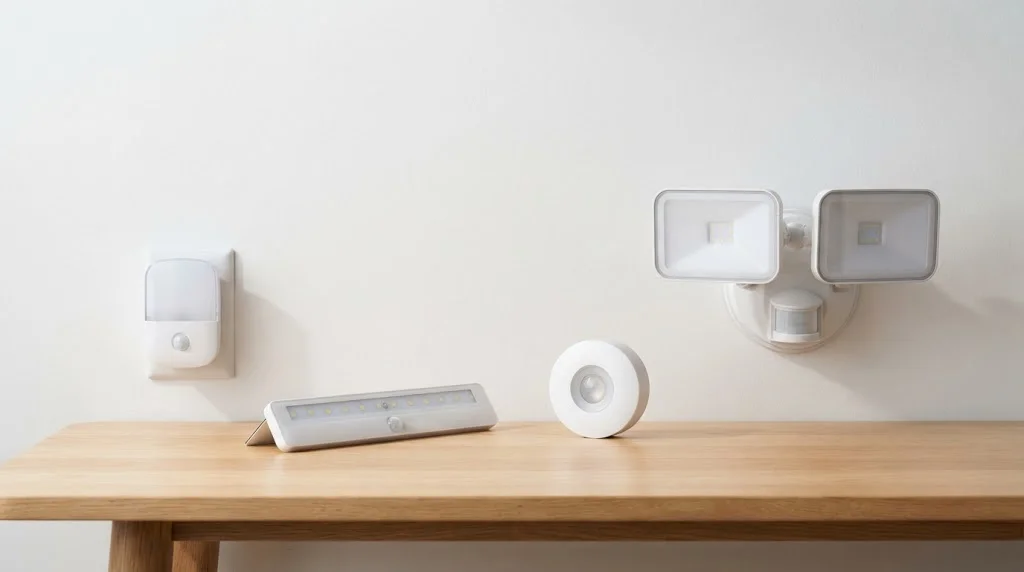
| Type | Best for | Typical brightness | Install |
|---|---|---|---|
| Plug-in night light | Hallways, bathrooms, kids’ rooms | ~10–100 lumens | Plug into an outlet |
| Battery stick-on bar or puck | Closets, stairs, under cabinets | ~20–150 lumens | Adhesive or magnet |
| Motion sensor wall switch | Laundry rooms, garages, pantries | Uses your existing fixture | Replaces a light switch |
| Motion sensor bulb | Porch lights, entryways | Like a normal bulb | Screws into a socket |
| Outdoor wall light / spotlight | Front doors, patios, side paths | ~300–700 lumens | Screws or hardwired |
| Floodlight | Driveways, yards, garages | ~800–3,000 lumens | Usually hardwired |
Indoor vs. Outdoor: What Changes
Indoors, comfort matters more than raw brightness. You want a soft, warm light that won’t wake you up fully at night, and a short timeout so it doesn’t stay on after you’ve passed. Many indoor lights have a low “night” mode or brighten gradually.
Outdoors, the priorities flip: weather resistance, range and brightness. Look for an IP rating of at least IP65 (or IP44 under a covered porch), a detection range of 20–30 feet and a sturdy mounting bracket. For lights near windows, choose a swivel head so you can aim the beam at the path, not into your own living room. Keeping light pointed down also follows DarkSky International’s lighting principles and keeps your neighbors happy.
How Bright Should It Be?
- Under 50 lumens: night lights for hallways, bathrooms and nurseries
- 50–200 lumens: closets, stairs, under-cabinet and pathway lights
- 300–700 lumens: front doors, patios and entry walls
- 800+ lumens: driveways, garages and large yards
Color temperature matters too. Around 2700K–3000K feels warm and relaxing, which suits bedrooms, hallways and Scandinavian-style interiors. 4000K–5000K looks crisper and suits garages and security lighting.
Power Options: Plug-In, Battery, Hardwired or Solar
- Plug-in: no batteries to replace, but limited to spots near an outlet.
- Battery: mount anywhere in minutes. Rechargeable (USB) models save money; disposable ones may run a year on D-cells for low-use spots.
- Hardwired: the brightest and most reliable option, but needs an existing junction box or an electrician.
- Solar: free to run and wire-free outdoors, as long as the panel gets several hours of direct sun. See our full solar motion sensor light guide for battery types and panel placement.
Motion Sensor Lights Worth Considering
These are well-known options across different types and budgets. Prices are approximate list prices; check current deals.
| Model | Type | Key specs | Approx. price |
|---|---|---|---|
| GE LED Dynamic Motion Night Light | Plug-in night light | 25 lumens, dusk-to-dawn + motion, 1 W | ~$12 |
| Mr Beams 500-lumen dual-head light | Battery outdoor | 500 lumens, 30 ft motion range, 4× D-cell (about a year at 8–10 activations/day) | Budget |
| Ring Spotlight Battery | Smart battery outdoor | Up to 400 lumens, 3500K, 120° / 30 ft, IP66 | ~$30–40 |
| Ring Floodlight Wired | Smart hardwired floodlight | Motion-activated floodlight, app control with Ring Bridge | ~$50–70 |
| Lutron Maestro MS-OPS2 | Motion sensor wall switch | Auto on/off, single-pole, 120V | ~$26 |
| Philips Hue Outdoor Sensor | Smart sensor for Hue lights | 2× AA (2+ years), IP54, daylight sensor, needs Hue Bridge | ~$55 |
GE LED Dynamic Motion Night Light: a simple plug-in night light that comes on in the dark and responds to movement, using just 1 watt. A good pick for hallways and bathrooms.
Mr Beams 500-lumen dual-head light: a wire-free battery floodlight with two adjustable heads, a 30-foot motion range and a dusk sensor. The maker rates a set of D-cells at about a year with typical use, making it good for sheds, side gates and garages without power.
Ring Spotlight Battery: a smart battery spotlight with up to 400 lumens of warm 3500K light, a 120° view and 30-foot range, and IP66 weatherproofing. It works as a regular motion light on its own; app control and linking with Ring cameras need a Ring Bridge or Alarm Pro (or Amazon Sidewalk coverage). If you also want video, see our Ring Floodlight Camera guide.
Lutron Maestro MS-OPS2: replaces a standard single-pole switch so your existing ceiling light turns on when you enter and off after you leave. It’s popular for laundry rooms, garages and pantries, and is a quick swap for anyone comfortable with basic wiring (or an electrician).
Philips Hue Outdoor Sensor: rather than a light itself, this weatherproof sensor turns your Hue lights on when it detects motion, with a built-in daylight sensor and two AA batteries rated for at least two years. It needs a Hue Bridge, and works with Alexa, Google Home, Apple Home and Matter. Pair it with smart bulbs from our smart light bulbs guide.
Where to Put Motion Sensor Lights
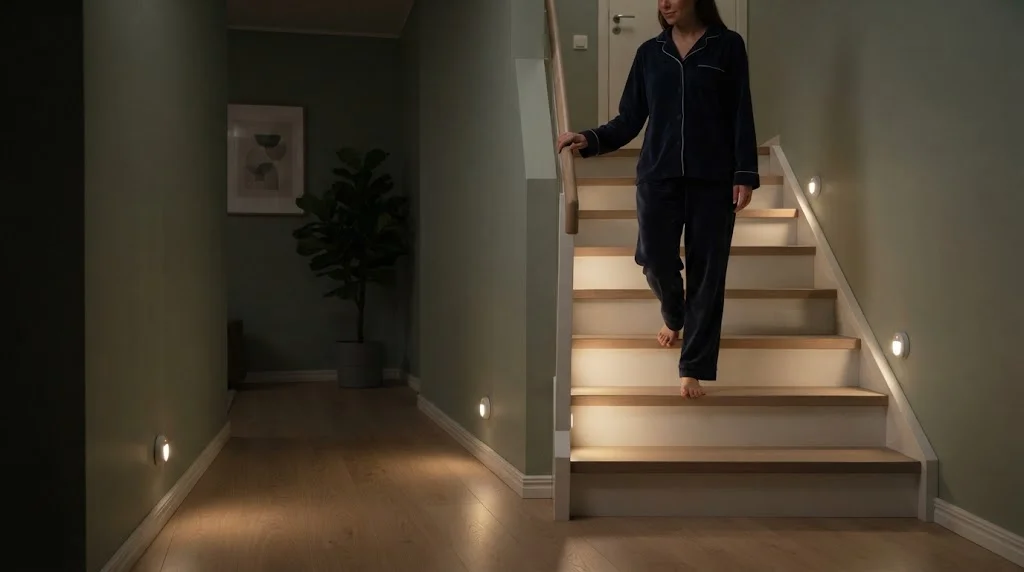
- Front door: beside or above the door, 6–8 feet up, angled across the path.
- Stairs: low on the wall every few steps, or at the top and bottom.
- Hallways: plug-in lights at outlet height, aimed along the hallway.
- Closets and pantries: battery bars on the inside of the door frame or under a shelf.
- Garage: a motion switch for the main light, or a ceiling-mounted sensor light.
- Driveway and side yard: a floodlight under the eave, aimed down at the area you want to see.
For outside spots, our garage security ideas and driveway solar lights guides go into more detail.
Are Smart Motion Lights Worth It?
A standard motion light just turns on and off. A smart one adds an app, schedules, brightness control, phone alerts and links to other devices, for example turning on every outdoor light when one detects motion, or starting a camera recording. That’s worth paying for at the front of the house or if you already use Ring, Hue or another ecosystem. For closets, stairs and hallways, a basic battery or plug-in light does the job.
Motion lights also make a good first layer of home security. Combine them with a motion sensor alarm or the ideas in our cheap home security ideas guide.
Common Problems and Fixes
- Turns on for no reason: lower the sensitivity, and keep the sensor away from heat vents, moving branches and road traffic.
- Doesn’t turn on: check the dusk setting (it may think it’s still daytime), batteries and the sensor angle.
- Stays on too long: shorten the timer, or check for constant movement like a pet bed in view.
- Only works up close: mount it higher and angle it so people cross the sensor’s view.
- Flickers: on hardwired lights, check the bulb is compatible; on battery lights, replace or recharge the batteries.
Free tools: Still using old bulbs? Our LED vs incandescent savings calculator shows your yearly savings and payback time when you switch to LED.
Frequently Asked Questions
Do motion sensor lights stay on all night?
No. They turn on when they detect movement and switch off after a set time, usually 20 seconds to a few minutes. Some outdoor models have an optional dim “dusk to dawn” mode that brightens on motion.
How far can a motion sensor light detect?
Most outdoor models detect movement 20–30 feet away; some floodlights reach farther. Indoor night lights usually cover a few feet to around 10 feet.
Can pets trigger motion sensor lights?
Yes, especially larger pets. Lowering the sensitivity or angling the sensor slightly upward helps. Some smart sensors let you set detection zones.
Do motion sensor lights save electricity?
Yes. Because they only run when someone’s there, they use far less power than lights left on all evening, and most use efficient LEDs. They’re an easy win alongside the tips in our guide to lowering your electricity bill.
Can I add a motion sensor to an existing light?
Yes: swap the wall switch for a motion sensor switch, use a motion sensor bulb in the existing fixture, or add a smart motion sensor that controls smart bulbs.
Do motion sensor lights work in cold weather?
Generally yes. Check the operating temperature range; the Ring Spotlight Battery, for example, is rated down to -4°F. Cold weather can shorten battery life.
Final Verdict
Start with the spots where you most often fumble in the dark. For hallways and bathrooms, a plug-in night light is cheap and effective. Stairs and closets suit battery lights. Rooms you pass through all day are best handled by a motion switch. Outside, pick a 300–700 lumen light for the front door and a brighter floodlight for the driveway, and go smart if you want app control or links to cameras.



