

Few things make a room feel as warm as the soft glow of an incandescent light bulb. That honey-colored light is the reason many people still look for these bulbs, especially for living rooms, reading lamps and exposed pendant fixtures.
But buying one in 2026 is confusing. Most of the bulbs you remember are no longer sold in the US, a few types are still legal, and LED makers now sell bulbs designed to look almost exactly like the old ones. This guide explains what an incandescent light bulb is, which ones you can still buy, what they really cost to run, and how to get the same warm look with far less energy.
Table of Contents
- What Is an Incandescent Light Bulb?
- Are Incandescent Bulbs Banned in the US?
- Which Incandescent Bulbs Can You Still Buy?
- Incandescent vs Halogen vs LED
- What Does an Incandescent Bulb Cost to Run?
- Why People Still Love Incandescent Light
- Base Types and Fixture Compatibility
- Dimmers and Smart Control
- How to Get the Incandescent Look With LED
- Buying Tips If You Still Need an Incandescent
- Heat and Safety Tips
- Frequently Asked Questions
- Final Verdict
What Is an Incandescent Light Bulb?
An incandescent light bulb makes light by heating a thin tungsten filament until it glows. Electricity flows through the filament, the filament gets extremely hot, and that heat produces visible light. The glass bulb is filled with inert gas to slow down how fast the filament burns out.
The design is simple and the light is beautiful, but it is not efficient. According to the U.S. Department of Energy, incandescent bulbs release about 90% of their energy as heat rather than light. That is why an old 60-watt bulb gets too hot to touch, and why it has mostly been replaced by LED.
Are Incandescent Bulbs Banned in the US?
For everyday household use, mostly yes. Federal rules now require general service lamps to produce at least 45 lumens per watt. A standard 60W incandescent bulb gives about 800 lumens, or roughly 13 lumens per watt, so it falls far short.
The Department of Energy finalized the expanded rules in 2022, and the sales ban has been enforced against manufacturers, importers and retailers since then. Law firm Beveridge & Diamond notes that DOE is actively enforcing the 45 lm/W standard, with penalties of up to $560 per non-compliant lamp sold.
There has been political pushback. A bill to repeal the rules was introduced in the Senate in 2025, but as SlashGear reported, no repeal had passed and the standard remains in effect. DOE has also adopted a tougher efficiency rule for general service lamps that starts in 2028, as covered by LightNOW.
Which Incandescent Bulbs Can You Still Buy?
The ban only applies to bulbs that count as general service lamps. Under DOE’s 2022 definitions rule, that means lamps with an output between 310 and 3,300 lumens, plus a list of 26 excluded categories. Anything outside that definition can still be sold as an incandescent.
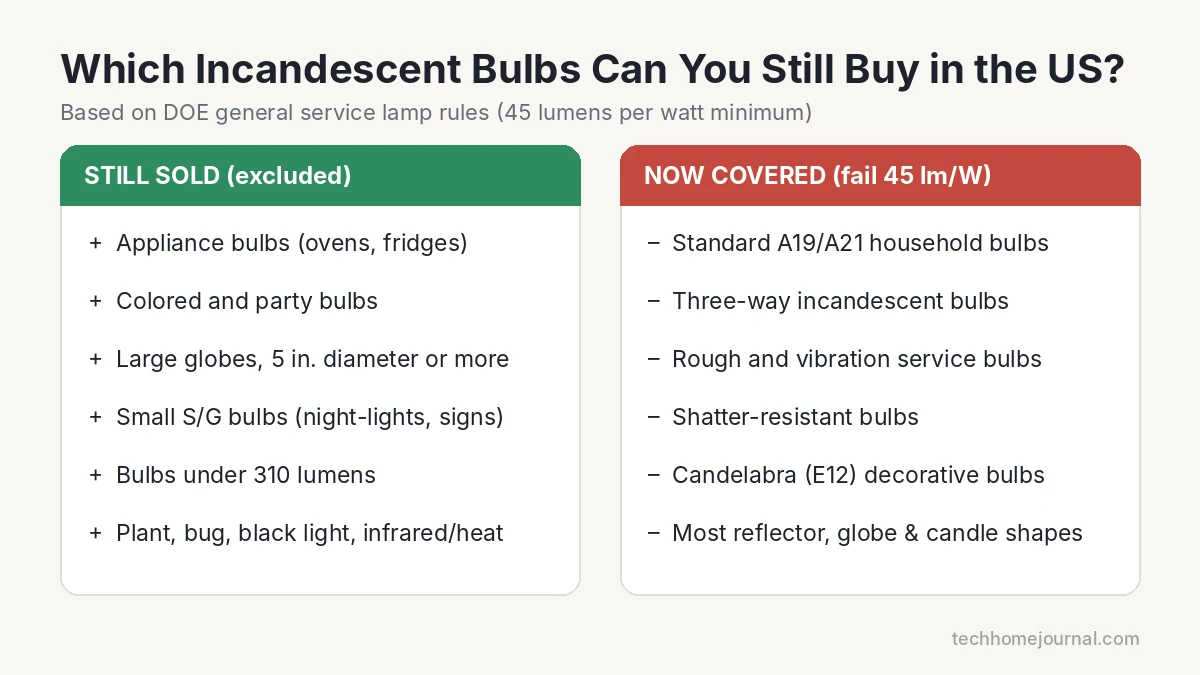
Still sold (excluded from the rules), including:
- Appliance lamps, such as oven and refrigerator bulbs
- Colored lamps
- G-shape globe bulbs with a diameter of 5 inches or more
- Small S-shape and G-shape bulbs (12.5 or smaller), common in night-lights and signs
- Plant light, bug, black light and infrared lamps
- Left-hand thread, marine, sign service, showcase and traffic signal lamps
- Bulbs that put out less than 310 lumens, such as some low-wattage decorative bulbs
No longer exempt (now covered and banned as incandescent):
- Standard A19 and A21 household bulbs
- Three-way incandescent bulbs
- Rough service, vibration service and shatter-resistant bulbs
- Candelabra base (E12) bulbs
- Most reflector, candle and smaller globe shapes
Many older articles still say three-way, rough service and candelabra incandescent bulbs are exempt. That was true before 2022, but those loopholes are now closed. If you see a “rough service” incandescent bulb marketed for living room use, be cautious.
Incandescent vs Halogen vs LED
Halogen bulbs are a type of incandescent bulb with a slightly more efficient design, but they still fall below 45 lumens per watt, so standard halogen household bulbs are covered by the same rules. LED is now the default for nearly every fixture.
| Feature | Incandescent | Halogen | LED |
|---|---|---|---|
| Power for ~800 lumens | 60W | about 43W | about 8–9W |
| Efficiency | about 13 lm/W | about 17 lm/W | often 80–100+ lm/W |
| Color rendering (CRI) | 100 | 100 | 80–95+ |
| Typical rated life | about 1,000 hours | 1,000–3,000 hours | 15,000+ hours |
| Heat | Very hot | Very hot | Warm, much cooler |
| Dimming | Smooth, warms as it dims | Smooth | Depends on bulb and dimmer |
ENERGY STAR says certified LED bulbs use up to 90% less energy and last at least 15 times longer than standard bulbs.
What Does an Incandescent Bulb Cost to Run?
Here is a simple example for one bulb used 3 hours a day, at an example electricity rate of 17¢ per kWh. Your local rate will differ, so plug in your own number.
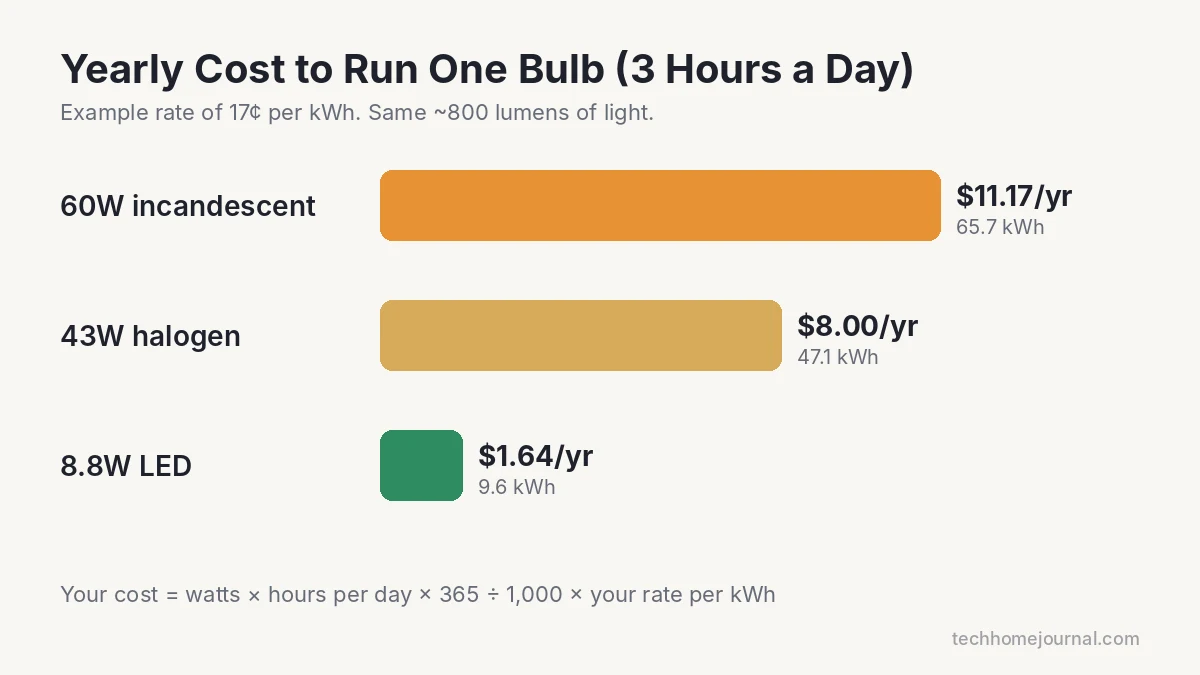
- 60W incandescent: 60 × 3 × 365 ÷ 1,000 = 65.7 kWh a year, about $11.17.
- 8.8W LED (same ~800 lumens): about 9.6 kWh a year, about $1.64.
One bulb is not a big deal. Ten bulbs across a home are roughly $95 a year in difference, and the incandescent bulbs will also need replacing many more times. If you want to see what each lamp really uses, an energy monitoring smart plug will show you in real time. Want to run your own numbers? Try our free LED vs incandescent savings calculator.
Why People Still Love Incandescent Light
There are honest reasons people miss these bulbs:
- Perfect color rendering. Incandescent light has a CRI of 100, so wood, fabrics and skin tones look natural.
- Warm, steady color. A typical bulb sits around 2700K, and it gets even warmer and more amber as you dim it.
- No flicker or buzz. There is no electronic driver, so there is nothing to hum at low brightness.
- The look of the filament. In an exposed pendant, the glowing filament is part of the decor.
In a Scandinavian-style living room full of light oak, linen and wool, that warm, full-spectrum light really does make materials look richer. The good news is that modern LEDs now copy most of this, as covered below. For room-wide ideas, see our guide to smart lighting for the living room.
Base Types and Fixture Compatibility
Whatever bulb you buy, match the base to your fixture first. The base code is usually printed on the old bulb or inside the socket.
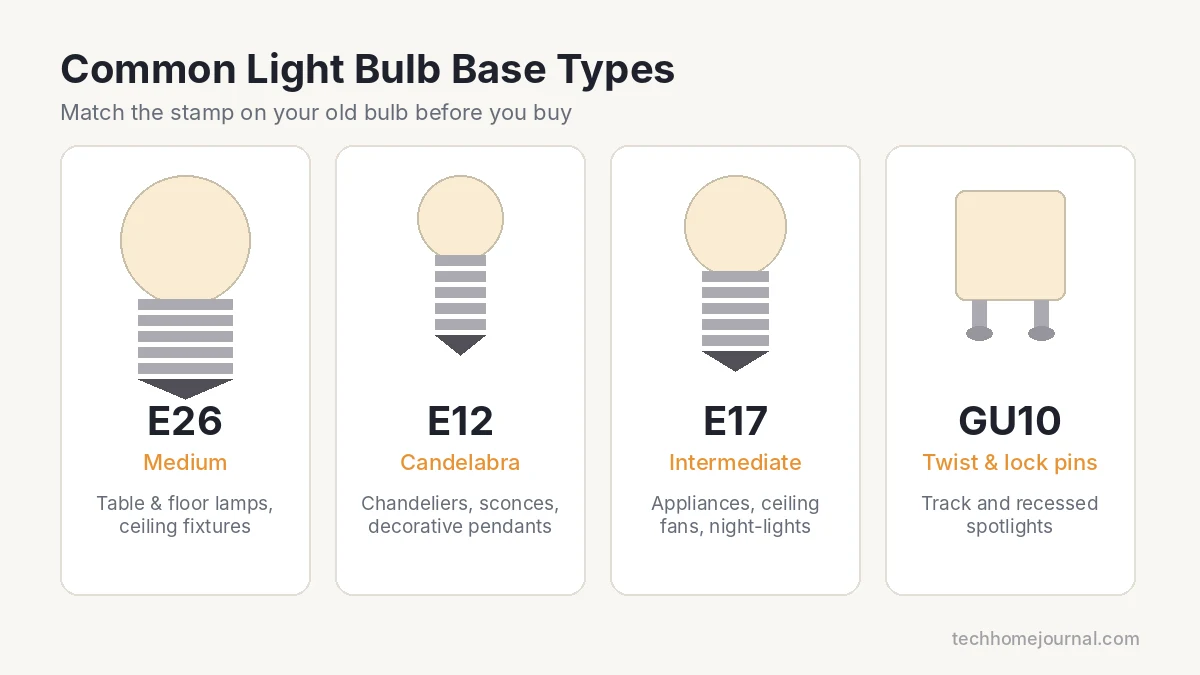
- E26 (medium): most US table lamps, floor lamps and ceiling fixtures.
- E12 (candelabra): chandeliers, wall sconces and many decorative pendants.
- E17 (intermediate): some appliances, ceiling fans and night-lights.
- GU10: a twist-and-lock pin base used in track and recessed spotlights.
Always stay at or below the fixture’s maximum wattage. This matters most with incandescent bulbs because of the heat they produce.
Dimmers and Smart Control
Incandescent bulbs work with almost any standard dimmer, and they dim smoothly. LEDs are pickier. If you switch a dimmed fixture from incandescent to LED, use a dimmable LED and check that your dimmer is rated for LED loads. Older dimmers designed for high-wattage incandescent loads can cause LEDs to flicker or buzz.
You can add smart control at the switch instead of the bulb. Smart dimmers such as Lutron Caséta control the whole circuit and work with Apple Home, Amazon Alexa and Google Home. Our guide to the best smart switches compares more options. For plug-in lamps, a smart plug adds schedules and voice control without rewiring, though most plugs only switch on and off.
How to Get the Incandescent Look With LED
If you want the warmth without the energy bill, look for these features on the LED box:
- 2700K or lower. “Soft white” at 2700K matches a classic bulb. Some vintage-style LEDs go down to 2200K for an amber glow.
- CRI 90 or higher. This gets you much closer to incandescent color quality.
- Filament style. LED filament bulbs use thin LED strips that look like the old glowing wire in a clear glass bulb.
- Dim-to-warm. These bulbs get warmer as you dim them, just like incandescent.
- Dimmable and flicker-free if the bulb is on a dimmer.
Smart bulbs can also reproduce warm light and let you change it by time of day. Our best smart light bulbs guide lists models with warm white and tunable settings. For porch lights that switch on by themselves, a dusk to dawn light bulb is a simple LED upgrade.
Buying Tips If You Still Need an Incandescent
Sometimes an incandescent bulb is still the right part, usually in an appliance or a special fixture. A few checks save a return trip:
- Copy the old bulb exactly. Match the base, shape, wattage and voltage printed on the glass or the base. Appliance and specialty bulbs are sized for a specific socket and housing.
- Use heat-rated bulbs where needed. Oven lights must be bulbs made and labeled for ovens. A regular household bulb or most LEDs will not survive that heat.
- Buy from known brands and stores. A listing that sells a “rough service” or “appliance” incandescent for ordinary lamps may be using a label to sell a bulb that does not meet the rules.
- Check the lumens on decorative bulbs. Very low-output decorative bulbs (under 310 lumens) can still be incandescent. They are for mood, not for reading or task light.
- Think about the total cost. An incandescent bulb is cheap to buy, but with about 1,000 hours of life it may need replacing many times while one LED keeps going.
Heat and Safety Tips
- Respect the wattage limit. Never put a higher-wattage bulb in a fixture than its label allows.
- Be careful in enclosed fixtures. Closed glass shades trap heat, which shortens bulb life and can damage the fixture.
- Keep fabrics away. Incandescent bulbs get very hot, so keep them clear of curtains, paper shades and bedding.
- Let it cool before changing it. A bulb that has been on for a while can burn your fingers.
Frequently Asked Questions
Can you still buy incandescent light bulbs in 2026?
Only certain types. Standard household incandescent bulbs between 310 and 3,300 lumens are covered by the 45 lumens-per-watt rule. Excluded types, such as appliance, colored, large globe and very low-output bulbs, can still be sold.
Are three-way and candelabra incandescent bulbs still exempt?
No. DOE’s 2022 definitions rule brought three-way bulbs, E12 candelabra bulbs, rough service, vibration service and shatter-resistant bulbs into the general service lamp category.
What LED replaces a 60W incandescent bulb?
Look for about 800 lumens. That is usually an LED of around 8–9 watts. Choose 2700K for the same warm color.
Why does a dimmed incandescent bulb look more orange?
As the voltage drops, the filament runs cooler, which lowers its color temperature. The light shifts toward amber, which many people find cozy. Dim-to-warm LEDs copy this effect.
Is it legal to use incandescent bulbs I already own?
Yes. The federal rules restrict the manufacture, import and sale of non-compliant bulbs. Using bulbs you already have at home is not prohibited.
Do incandescent bulbs give better light than LED?
They have perfect color rendering (CRI 100) and very smooth dimming. A good LED with CRI 90+, 2700K and dim-to-warm comes very close while using about 85% less energy.
Final Verdict
The incandescent light bulb is not fully gone, but for everyday home lighting in the US it has been replaced by LED. You can still buy appliance, colored, large globe and very low-output incandescent bulbs, while standard, three-way and candelabra versions are now covered by the efficiency rules.
If you love the warm glow, the smart move is a 2700K, CRI 90+ LED, ideally a filament or dim-to-warm style. You keep the look and the mood, and you cut the running cost by more than 80%. For more ways to save, read our smart home energy saving tips.



