
Outdoor lights, fountains, pond pumps and holiday displays are all easy to forget. They stay on all night, or you have to walk outside in the rain to switch them off. A smart outdoor plug fixes that for about $20 to $35. Plug it into an exterior outlet, connect it to Wi-Fi or Matter, and you can schedule, automate and control anything outside from your phone or voice assistant.
In this guide, we’ll cover the best smart outdoor plugs in 2026, what weather ratings actually mean, how much power they can safely handle, and the best ways to use one in your garden, patio and holiday setup.
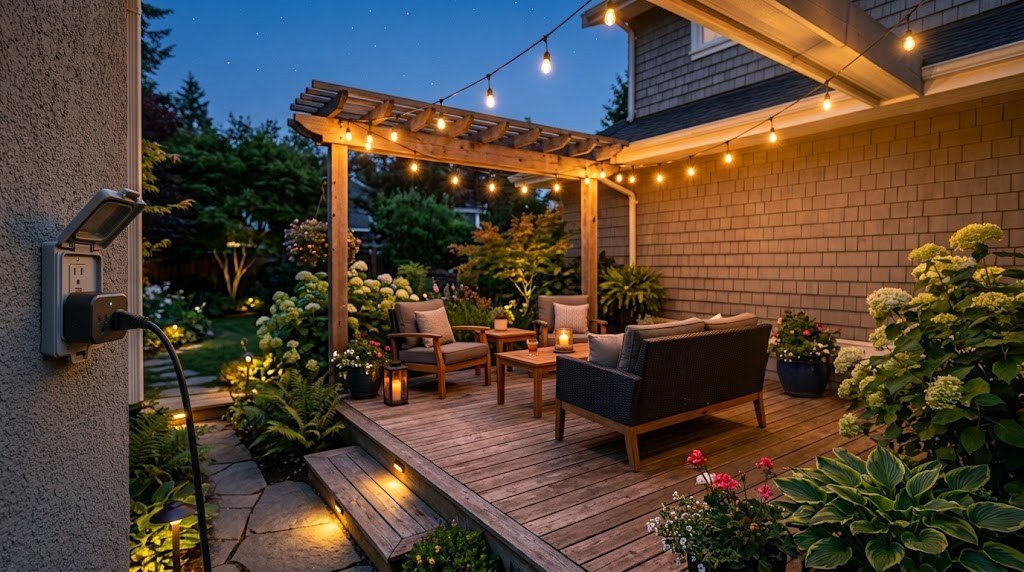
Table of Contents
- Quick Picks: Best Smart Outdoor Plugs
- What Is a Smart Outdoor Plug?
- Understanding IP Ratings
- The Best Smart Outdoor Plugs in 2026
- Comparison Table
- Best Ways to Use a Smart Outdoor Plug
- How to Set Up a Smart Outdoor Plug
- Outdoor Smart Plug vs Other Outdoor Smart Options
- How Much Can a Smart Outdoor Plug Save?
- Safety Tips for Outdoor Smart Plugs
- Wi-Fi Range Tips
- Smart Outdoor Plug Automation Ideas
- Common Mistakes to Avoid
- Frequently Asked Questions
- Final Verdict
Quick Picks: Best Smart Outdoor Plugs
- Best overall: TP-Link Tapo P400M (two outlets, IP65, Matter)
- Best for Apple Home and Matter on Kasa: TP-Link Kasa EP40M
- Best for Ring and Alexa homes: Ring Outdoor Smart Plug
- Best for dimming lights: TP-Link Kasa KP405 Outdoor Dimmer
- Best HomeKit alternative: Meross Outdoor Smart Plug (HomeKit version)
Prices change often, and outdoor plugs go on sale frequently before summer and the holidays.
What Is a Smart Outdoor Plug?
A smart outdoor plug is a weather-resistant version of a regular smart plug. It plugs into an exterior outlet and lets you turn connected devices on and off remotely, on a schedule, at sunrise or sunset, or as part of a smart home routine.
Compared with indoor plugs, outdoor models add:
- Weather resistance (usually IP64 or IP65) against rain, dust and splashes
- Rubber outlet covers to protect unused outlets
- Longer range Wi-Fi in some models to reach the yard
- Two independently controlled outlets on many models
- Higher load ratings for pumps and heavier outdoor gear
Understanding IP Ratings
The IP (Ingress Protection) rating tells you how well a device is sealed. The first number is dust protection, and the second is water protection.
| Rating | Dust | Water | What it means for you |
|---|---|---|---|
| IP44 | Objects over 1mm | Splashing water | Fine under a covered porch |
| IP64 | Dust-tight | Splashing from any direction | Good for most outdoor outlets |
| IP65 | Dust-tight | Water jets from any direction | Better protection in exposed spots |
| IP66 | Dust-tight | Powerful water jets | Very exposed locations |
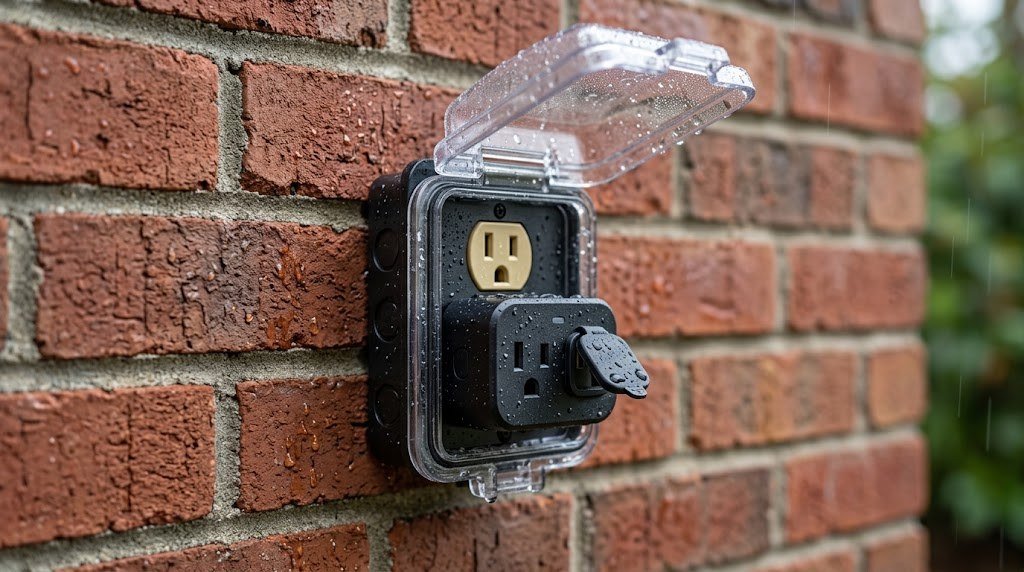
No outdoor smart plug is designed to be submerged. Always mount it facing down where possible, keep it off the ground and use an exterior outlet with an in-use (bubble) cover for the best protection.
The Best Smart Outdoor Plugs in 2026
1. TP-Link Tapo P400M: Best Overall
The Tapo P400M is the outdoor plug we’d recommend to most people. It has two individually controlled outlets, each with its own physical button and rubber cover, and an IP65 rating that’s stronger than the IP64 most competitors offer. It handles up to 1,800 watts (15 amps), enough for pond pumps up to 1/2 horsepower.
Its biggest advantage is Matter certification, which means it works with Apple Home, Google Home, Amazon Alexa and SmartThings. The Tapo app adds sunrise and sunset schedules, timers and an away mode. PCWorld’s review called it an easy choice for a top outdoor plug at its price.
- Outlets: 2 (independent)
- Weather rating: IP65
- Max load: 1,800W / 15A
- Works with: Matter (Apple Home, Google Home, Alexa, SmartThings)
- Approx. price: $25
Good for: Almost everyone, especially mixed Apple/Android households.
Keep in mind: No energy monitoring, and the power cable is short.
2. TP-Link Kasa EP40M: Best Kasa Option With Matter
Kasa’s outdoor plug has been a best-seller for years, and the EP40M adds Matter support so it works with Apple Home as well as Alexa and Google. It offers two independent outlets, an IP64 rating and a 15A load capacity. If you already use Kasa switches and plugs, it fits right into the Kasa app. The non-Matter EP40 is often cheaper if you only use Alexa or Google.
- Outlets: 2 (independent)
- Weather rating: IP64
- Max load: 15A
- Works with: Matter (EP40M), Alexa, Google Home
- Approx. price: $20 to $30
Good for: Kasa users and anyone who likes Kasa’s scheduling features.
Keep in mind: IP64 is slightly less protective than the Tapo’s IP65.
3. Ring Outdoor Smart Plug: Best for Ring and Alexa Homes
Ring’s outdoor plug has two independently controlled outlets, a strong weather rating and right-angle prongs that fit neatly under outlet covers. Its standout feature is integration with Ring cameras and alarms. For example, you can turn on floodlights when a Ring camera detects motion.
- Outlets: 2 (independent)
- Weather rating: IP66 (IP64 while in use)
- Max load: 1,875W / 15A
- Works with: Ring app, Alexa
- Approx. price: $30
Good for: Homes with Ring security cameras and Alexa.
Keep in mind: It needs a Ring Bridge or a compatible Echo device to connect, and it doesn’t work with Apple Home or Google Home.
4. TP-Link Kasa KP405 Outdoor Dimmer: Best for Dimming Lights
Most outdoor plugs only turn things on and off. The Kasa KP405 can dim compatible lights, which is perfect for creating a softer mood with patio string lights. It’s a single-outlet plug with an IP64 rating.
- Outlets: 1
- Weather rating: IP64
- Max load: 300W incandescent, 150W LED/CFL
- Works with: Alexa, Google Home, SmartThings
- Approx. price: Under $25
Good for: Patio string lights and landscape lighting you want to dim.
Keep in mind: Only for dimmable lights, not pumps or motors, and only one outlet.
5. Meross Outdoor Smart Plug (HomeKit): Best HomeKit Alternative
Meross offers an affordable outdoor plug with native Apple HomeKit support, plus Alexa and Google compatibility. It has two outlets and works well for simple scheduling. Its IP44 rating means it’s best used under an overhang or covered porch.
- Outlets: 2
- Weather rating: IP44
- Works with: Apple Home, Alexa, Google Home, SmartThings
- Approx. price: $25 to $35
Good for: Apple Home users on a budget with a covered outlet.
Keep in mind: Lower weather rating than Tapo and Kasa.
Comparison Table
| Plug | Outlets | IP rating | Max load | Matter | Best for |
|---|---|---|---|---|---|
| Tapo P400M | 2 | IP65 | 1,800W | Yes | Best overall |
| Kasa EP40M | 2 | IP64 | 15A | Yes | Kasa users |
| Ring Outdoor Plug | 2 | IP66/IP64 | 1,875W | No | Ring and Alexa |
| Kasa KP405 | 1 | IP64 | 150W LED | No | Dimming |
| Meross (HomeKit) | 2 | IP44 | Varies | Varies by model | Apple on a budget |
Best Ways to Use a Smart Outdoor Plug
1. Patio and string lights
Turn string lights on at sunset and off at 11 PM automatically. Add a voice command like “Alexa, patio lights on” for parties.
2. Landscape and path lighting
Low-voltage landscape lighting transformers often have clunky mechanical timers. Set the transformer to “always on” and let the smart plug handle scheduling, including sunset offsets that adjust automatically through the seasons.
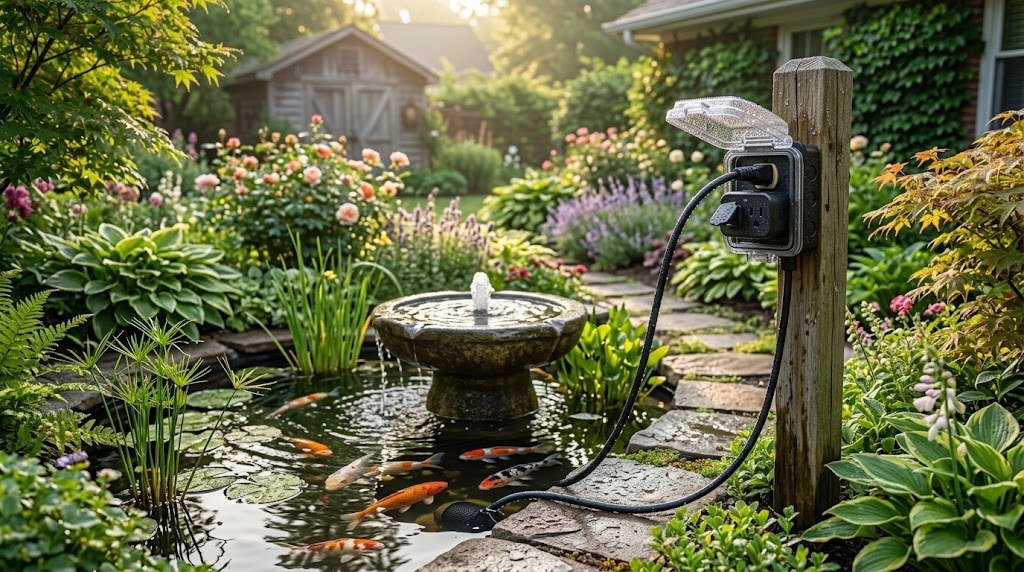
3. Fountains and pond pumps
Run fountain pumps only during the day to save energy and reduce noise at night. Check the plug’s motor rating and your pump’s power draw first.
4. Holiday lights and decorations
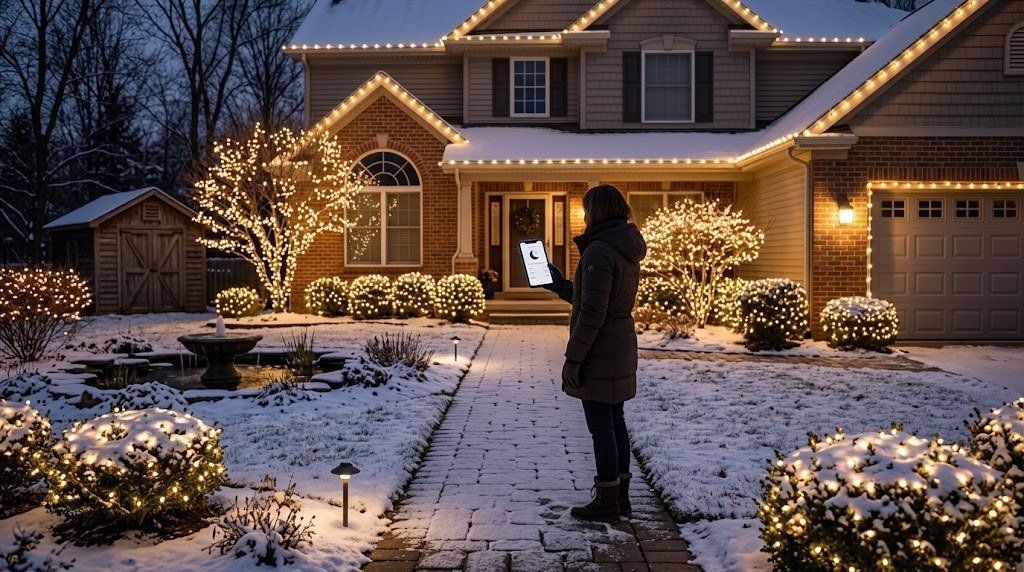
This is the classic use. Set your display to turn on at dusk and off at bedtime, and control inflatables and projectors separately using the two outlets.
5. Pool and hot tub accessories
Smart plugs can control pool lights, small filter pumps and accessories, but always check load ratings and follow the manufacturer’s safety guidance. Never use a smart plug for equipment that requires a dedicated circuit or hardwiring.
6. Bug zappers and outdoor fans
Schedule a bug zapper for dusk hours only, or turn on a patio fan when a temperature sensor reads above 85°F.
7. Security lighting
Use your outdoor plug with a camera or motion sensor to turn on lights when motion is detected at night. It’s a simple, effective deterrent.
How to Set Up a Smart Outdoor Plug
Setup takes about 10 minutes. The steps are similar for every brand.
- Check the outlet. Make sure your exterior outlet works and is GFCI protected. Press the “Test” and “Reset” buttons to confirm.
- Check the Wi-Fi signal. Stand at the outlet with your phone. If you see one bar or less, improve coverage before installing.
- Download the app (Tapo, Kasa, Ring or Meross), or open Apple Home, Google Home or Alexa if you’re using Matter.
- Plug in the smart plug and wait for the status light to blink.
- Add the device in the app. For Matter plugs, scan the QR code on the plug or in the box. Take a photo of the QR code first, because it can be hard to reach once the plug is mounted.
- Name each outlet clearly, like “Patio String Lights” and “Fountain Pump,” so voice commands are easy.
- Set schedules using sunrise and sunset triggers rather than fixed times, so they adjust automatically through the seasons.
- Test it from the app and your voice assistant before you close the outlet cover.
Outdoor Smart Plug vs Other Outdoor Smart Options
A smart plug isn’t the only way to automate outdoor devices. Here’s how it compares with the alternatives.
| Option | Best for | Pros | Cons |
|---|---|---|---|
| Outdoor smart plug | String lights, fountains, holiday displays | Cheap, no wiring, portable | Needs an outdoor outlet |
| Smart outdoor light switch | Porch and flood lights wired to a wall switch | Clean look, controls hardwired fixtures | Requires electrical work |
| Smart landscape transformer | Low-voltage path and garden lights | Built-in zones and scheduling | More expensive |
| Smart outdoor bulbs | Porch fixtures, color effects | Colors and dimming | Only for light fixtures |
| Smart irrigation controller | Sprinklers | Weather-aware watering | Different use case |
For most people, starting with one or two outdoor smart plugs is the quickest and cheapest way to automate a yard. If you later want your porch light or floodlights on the same schedule, a smart switch indoors (see our no neutral smart switch guide if your switch box is older) is a natural next step.
How Much Can a Smart Outdoor Plug Save?
A smart plug itself uses very little power, typically under one watt on standby. The savings come from not leaving things running when nobody is enjoying them. For example, a 100-watt fountain pump running 24 hours a day uses about 2.4kWh daily. Scheduling it to run 10 hours a day cuts that to about 1kWh, saving roughly 500kWh a year. Depending on your electricity rate, that’s often $70 or more per year from one small automation. Holiday displays, landscape lights and patio heaters with safe, compatible controls can add up to even bigger savings.
Safety Tips for Outdoor Smart Plugs
- Use a GFCI-protected outlet. Exterior outlets should be GFCI protected. Test the GFCI button regularly.
- Check load ratings. Add up the wattage of everything you plug in and stay well below the maximum.
- Be careful with heaters and motors. Space heaters and large pumps draw a lot of power. Check both the plug’s rating and the device’s manual.
- Mount it off the ground and facing down if possible, so water drains away.
- Use outdoor-rated extension cords only, and don’t daisy-chain multiple cords.
- Close unused outlet covers to keep water and bugs out.
Wi-Fi Range Tips
Your router might be far from the backyard. Before buying, check your phone’s Wi-Fi signal at the outdoor outlet. If it’s weak:
- Move your router or add a mesh Wi-Fi node near the back of the house.
- Choose a plug with a stronger antenna, like the Tapo P400M.
- Consider a hub-based plug (like Ring with an Echo) if your Echo is closer to the yard than your router.
Smart Outdoor Plug Automation Ideas
- Sunset patio: Turn on string lights 15 minutes before sunset.
- Goodnight garden: Turn everything off at 11 PM, or when you say “Alexa, good night.”
- Vacation mode: Randomize outdoor lights while you’re away.
- Rain delay: Use a weather-based automation to turn off a fountain when heavy rain is forecast.
- Motion lights: Turn on floodlights for five minutes when a camera sees motion after dark.
Get more ideas from our list of 25 Alexa routines, and see our smart home hub guide if you want local automations that don’t depend on the cloud. For indoor plugs that track energy use, check out our guide to the most accurate energy monitoring smart plugs.
Common Mistakes to Avoid
- Using an indoor smart plug outside. Indoor plugs aren’t sealed against moisture and can fail or become unsafe after the first rain.
- Ignoring the GFCI. If your outdoor outlet keeps tripping, don’t bypass it. Find the cause, such as a wet extension cord connection or a faulty device.
- Overloading one plug. Two large inflatables plus a projector and lights can exceed a plug’s limit. Split loads across outlets and circuits.
- Fixed-time schedules. A 6 PM schedule is too late in winter and too early in summer. Use sunset triggers instead.
- Forgetting the physical button. Most outdoor plugs have manual buttons. Show your family where they are so lights can still be switched on during an internet outage.
Related guides on Tech Home Journal:
- What Is a Smart Plug? How It Works, Uses Buying Tips (2026)
- Best Smart Sprinkler Controllers 2026: Top Picks Compared
- Smart Outlet Plug: Best Picks for Every Device & Budget 2026
- Motion Sensor Light Guide 2026: Types, Brightness Best Picks
- Dusk to Dawn Light Bulb Guide 2026: How They Work Best Picks
Official resources: ESFI outdoor electrical safety guide · IP rating (ingress protection) explained
Frequently Asked Questions
Can I leave a smart outdoor plug outside all year?
Yes, if it’s rated for outdoor use (IP64 or higher) and plugged into a covered, GFCI-protected outlet. Close unused outlet covers and mount it so water can’t pool around it.
Do smart outdoor plugs work with Alexa and Google Home?
Most do. The Tapo P400M and Kasa EP40M work with Alexa, Google Home and Apple Home through Matter. The Ring outdoor plug works with Alexa and the Ring app.
Can a smart outdoor plug handle a pond pump?
Many can. The Tapo P400M supports motors up to 1/2 horsepower within its 1,800W limit. Always check your pump’s power rating and the plug’s specifications before connecting it.
What’s the difference between IP64 and IP65?
Both are fully dust-tight. IP64 protects against splashing water from any direction, while IP65 protects against low-pressure water jets, making IP65 slightly more robust for exposed locations.
Do I need a hub for an outdoor smart plug?
Most Wi-Fi and Matter-over-Wi-Fi plugs don’t need a hub, although Matter requires a compatible controller like a smart speaker. The Ring outdoor plug needs a Ring Bridge or compatible Echo device.
Can I dim outdoor lights with a smart plug?
Only with a dimmer plug like the Kasa KP405, and only with dimmable lights. Standard smart plugs just switch power on and off.
Final Verdict
For most homes, the Tapo P400M is the best smart outdoor plug. It’s affordable, rated IP65, has two outlets and works with every major smart home platform through Matter. Kasa fans should grab the EP40M, Ring users will love the Ring Outdoor Smart Plug, and if you want to dim patio lights, the Kasa KP405 is the one to get.
Set up a sunset schedule this weekend, and your garden will take care of itself.