
Venetian blinds are one of the few window coverings that never really go out of style. A row of horizontal slats you can tilt with one twist gives you light control, privacy and a clean look for far less money than shutters. The catch is that the choices have multiplied: aluminum or wood, 25 mm or 50 mm slats, inside or outside mount, corded or cordless, and now smart motors that tilt the slats on a schedule.
This guide walks you through all of it in plain language: what Venetian blinds are, which material and slat size suit each room, how to measure, what they cost in 2026, how to keep them safe around kids, and which smart options can turn your existing blinds into automated ones.
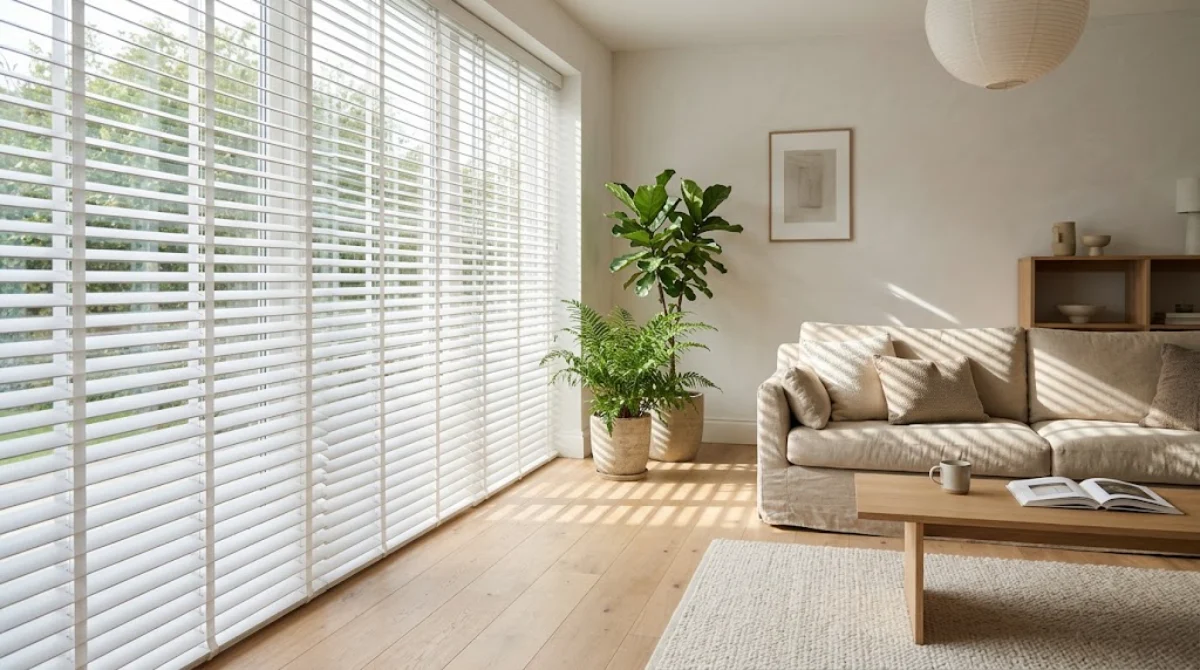
Table of Contents
- What Are Venetian Blinds?
- Quick Picks: The Best Venetian Blind for Each Room
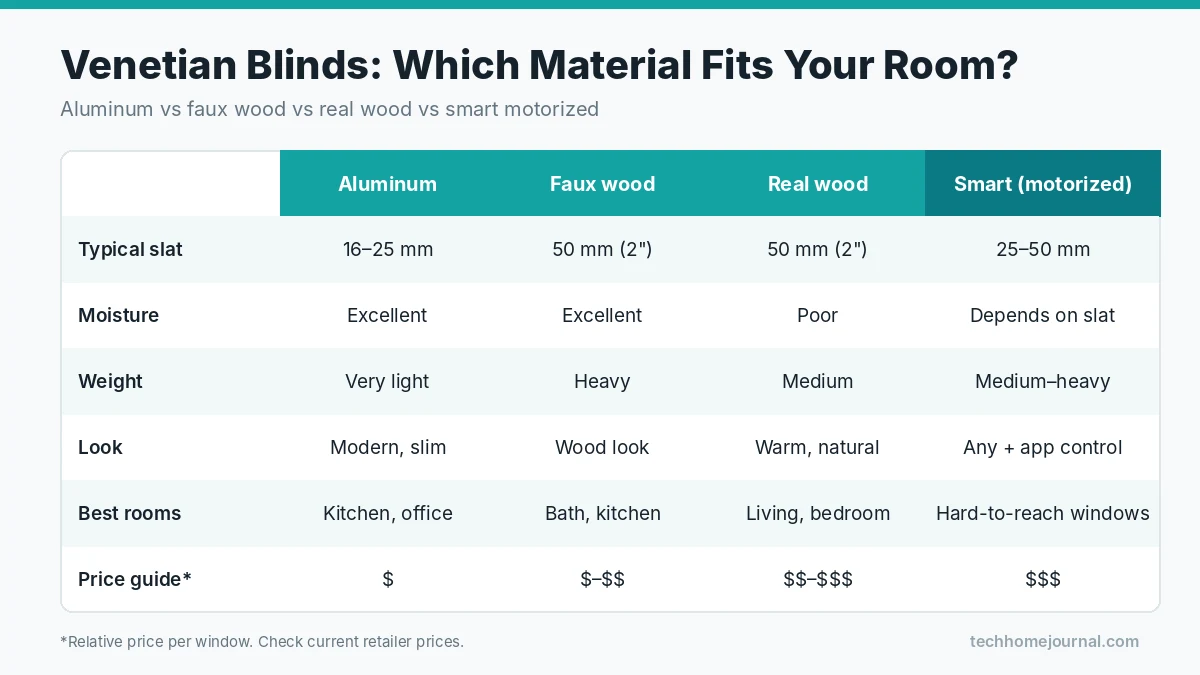
- Venetian Blind Materials Compared
- Slat Sizes: 16 mm to 63 mm
- Best Venetian Blinds Room by Room
- Smart and Motorized Venetian Blinds
- How to Measure for Venetian Blinds
- How Much Do Venetian Blinds Cost?
- Child Safety and Cordless Options
- How to Clean Venetian Blinds
- Styling Tips for Modern and Scandinavian Homes
- Venetian Blinds vs Other Window Coverings
- Frequently Asked Questions
- Final Verdict
What Are Venetian Blinds?
A Venetian blind is a window blind made of horizontal slats held together by fabric tapes or thin cords called ladders. Turning a wand (or a tilt cord on older blinds) rotates every slat at once, so you can go from fully open to fully closed in a second. Pulling the lift cord, or pushing up the bottom rail on cordless versions, stacks the slats at the top of the window.
That two-way control is what makes them so useful. You can tilt the slats up to bounce daylight onto the ceiling while blocking the view from the street, or tilt them down to keep low sun off your TV. Few other window coverings let you fine-tune light this precisely.
The design is older than most people think. Slatted blinds were already in use in Europe in the 1700s, and London blind maker Edward Bevan held a royal patent for “Venetian Blinds” in the 1770s, according to the British and Irish Furniture Makers Online record. The name is usually linked to Venice and its trade routes, though nobody can say for certain who first came up with the idea.
Today the term covers any horizontal slatted blind. In the US, you will often see the same product sold as “horizontal blinds”, “mini blinds” (for narrow 1 inch metal slats) or “wood blinds” (for 2 inch wooden slats). In the UK and Europe, “Venetian blinds” usually means metal slats, while wooden versions are often called “wooden Venetian blinds” or just “wooden blinds”.
Quick Picks: The Best Venetian Blind for Each Room
If you just want a fast answer, these are the safest picks for each situation:
- Best for kitchens and bathrooms: faux wood or aluminum slats. Both handle steam and splashes without warping.
- Best for living rooms: 50 mm real wood or faux wood. Wide slats give a bigger view when open and look more furnished.
- Best for bedrooms: 50 mm faux wood with an outside mount, which blocks more light around the edges.
- Best on a tight budget: 25 mm aluminum. Light, cheap and easy to fit yourself.
- Best for large or tall windows: 63 mm extra-wide wood or faux wood, or a motorized blind if the controls are hard to reach.
- Best smart upgrade: a retrofit tilt motor such as the SwitchBot Blind Tilt if you already have blinds with a tilt wand.
Venetian Blind Materials Compared
Aluminum (metal) Venetian blinds
Aluminum is the classic Venetian blind. The slats are thin, light and slightly curved, usually 16 mm or 25 mm wide. They are the cheapest option, resist moisture well and come in almost any color, including brushed and perforated finishes that let a little light through even when closed.
Pros: low price, very light (easy on brackets and motors), moisture resistant, slim stack when raised. Cons: slats can dent or bend, they clatter in a breeze, and they look more “office” than cozy in a living room.
Faux wood Venetian blinds
Faux wood slats are made from PVC or a composite that looks like painted or stained wood. They are the most popular choice in the US for a reason: they look like wood, cost less, and do not warp or crack in humidity. That makes them the go-to for kitchens, bathrooms and laundry rooms.
Pros: wood look for less money, waterproof, easy to wipe clean, very durable. Cons: noticeably heavier than real wood, so very wide blinds can be hard to lift and may sag over time. The grain also looks less natural up close.
Real wood Venetian blinds
Real wood blinds are usually made from basswood, bamboo or similar light hardwoods. They bring warmth that plastic cannot copy and are lighter than faux wood, which matters on wide windows. They are the right choice for living rooms, dining rooms and bedrooms where moisture is not an issue.

Pros: natural look, lighter than faux wood, good insulation, wide range of stains. Cons: more expensive, can warp or fade in wet rooms or strong sun, and need gentler cleaning.
Smart (motorized) Venetian blinds
Smart Venetian blinds use a small motor to tilt the slats, and sometimes to raise and lower the whole blind. You control them with an app, a remote, a voice assistant or a schedule. You can buy blinds with a motor built in, or add a retrofit motor to blinds you already own. More on both options below.
| Feature | Aluminum | Faux wood | Real wood | Smart / motorized |
|---|---|---|---|---|
| Common slat width | 16–25 mm | 50 mm | 50 mm | 25–50 mm |
| Moisture resistance | Excellent | Excellent | Low | Depends on slat |
| Weight | Very light | Heavy | Medium | Medium to heavy |
| Typical lifespan | 5–10 years | 10+ years | 10+ years with care | Motor 5–10 years |
| Best for | Kitchens, offices, rentals | Bathrooms, kitchens, kids rooms | Living rooms, bedrooms | Hard-to-reach or many windows |
Slat Sizes: 16 mm to 63 mm
Slat width changes both the look and how the blind performs. Wider slats mean fewer slats per window, so you get a clearer view when they are open and fewer gaps when they are closed. Narrow slats look neater on small windows and take up less space when raised.
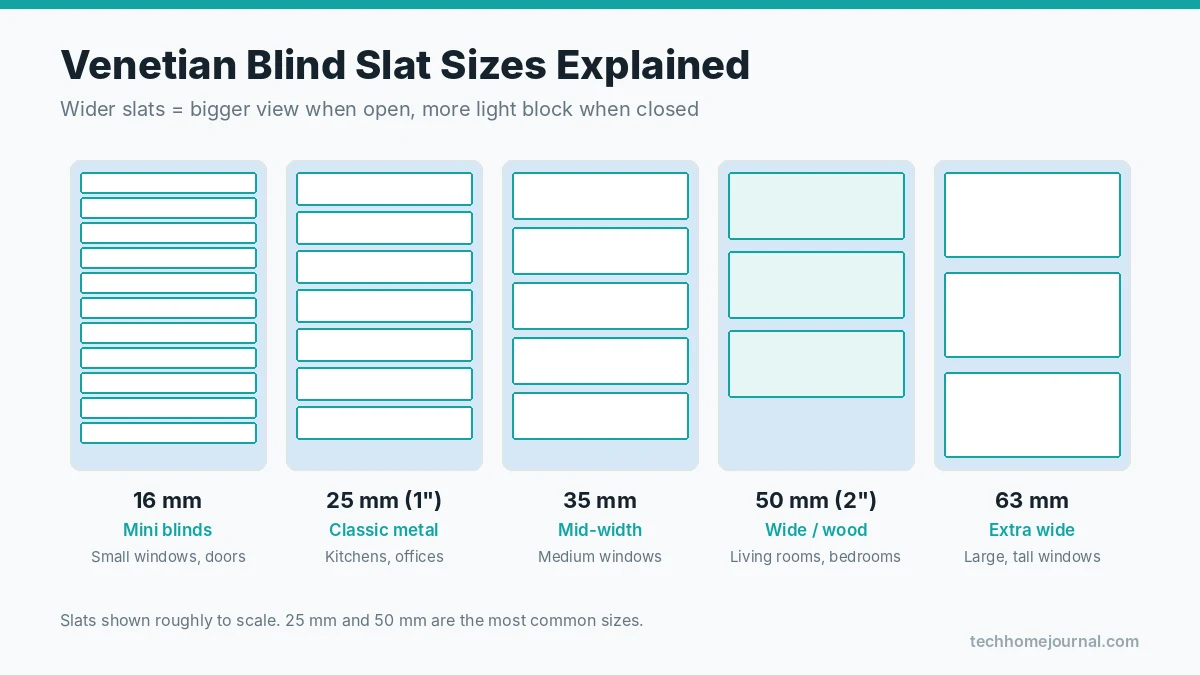
| Slat width | Usually made from | Best for |
|---|---|---|
| 16 mm | Aluminum | Small windows, door glass, tight recesses |
| 25 mm (1 inch) | Aluminum | Kitchens, offices, rentals, standard windows |
| 35 mm | Wood, faux wood, aluminum | Medium windows, a middle ground look |
| 50 mm (2 inch) | Wood, faux wood | Living rooms, bedrooms, most home windows |
| 63 mm | Wood, faux wood | Large, tall or wide windows, patio doors |
A simple rule: match slat width to window size. On a small bathroom window, 50 mm slats can look bulky. On a big living room window, 25 mm slats can look busy. If you are not sure, 50 mm is the safest choice for most rooms in a home.
Best Venetian Blinds Room by Room
Living room
Go for 50 mm real wood or faux wood in a color that matches your trim or flooring. Tilt the slats upward in the evening so passers-by cannot see in while light still reaches the ceiling. If you have a TV across from a window, Venetian blinds make it easy to cut glare without shutting out the day. For more living room ideas, see our Scandinavian living room decor guide.
Bedroom
Venetian blinds do not black out a room completely, because light leaks through the holes for the ladder cords and around the edges. Choose wide slats with an outside mount to reduce light gaps, look for “route-less” or “privacy” slats with no cord holes, or pair the blind with curtains if you need true darkness.
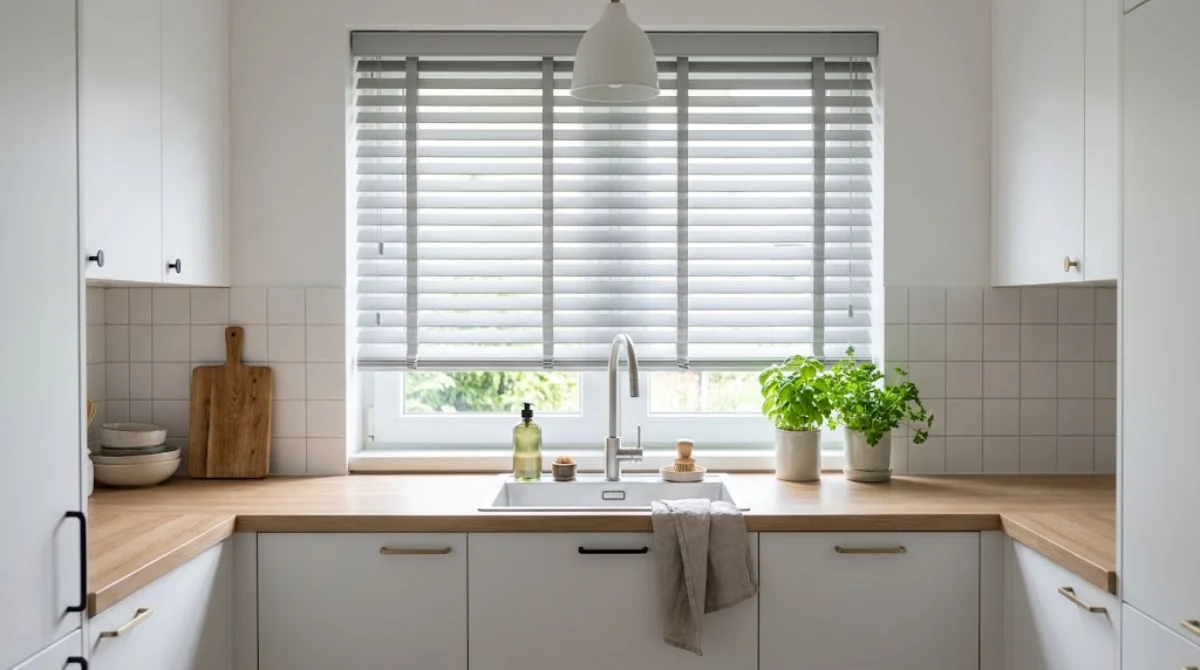
Kitchen and bathroom
Steam and splashes rule out real wood here. Aluminum or faux wood are the right picks, and both wipe clean easily. In a bathroom, a 25 mm aluminum blind fitted inside the recess keeps the look neat and leaves the windowsill free.
Home office
Venetian blinds are ideal for offices because you can angle the slats to stop glare on your screen while keeping natural light. Light gray or white aluminum keeps the space bright and modern.
Kids rooms and nurseries
Always pick a cordless blind or one with a motor. Faux wood is a good match because it is tough and easy to clean. See the safety section below before you buy.
Smart and Motorized Venetian Blinds
Smart Venetian blinds tilt automatically on a schedule, at sunrise or sunset, or when you ask your voice assistant. That is more useful than it sounds: closing the slats on hot afternoons can keep a room noticeably cooler, and opening them in the morning lets daylight wake you up. If you are new to window automation, our smart blinds buyer’s guide covers all blind types. Here we focus on options for slatted Venetian blinds.

SwitchBot Blind Tilt (retrofit)
Specs: clips onto the tilt wand rod of existing blinds · built-in 2,000 mAh battery · small solar panel included · light sensor · tilts in steps of about 2° · approx. list price $69.99 (check current deals).
The SwitchBot Blind Tilt is the easiest way to make the blinds you already have smart. It slides over the tilt rod at the top of a blind with a wand, and the solar panel sticks to the window to keep the battery topped up. On its own it works over Bluetooth with the SwitchBot app. Add a SwitchBot hub and you get Alexa and Google Home control, and the Hub 2 adds Matter, which brings it into Apple Home as well.
Pros: cheap, no new blinds needed, solar charging, works with all the major ecosystems through a hub. Cons: tilt only (it cannot raise or lower the blind), needs a compatible wand-style tilt mechanism, and the hub is an extra purchase for voice and remote control.
Serena by Lutron Smart Wood Blinds
Specs: 2 inch real basswood slats · motorized tilt with manual lift · battery powered (AA or D-cell, depending on size) or hardwired · custom widths from 20 to 72 inches · works with Alexa, Google Assistant and Siri.
The Serena Smart Wood Blinds are made-to-measure wood blinds with the motor built into the headrail, so there is nothing extra stuck to your window. You tilt the slats from the app, a small remote or by voice, and you raise them by hand using the bottom rail. Lutron says the batteries in the battery models are standard sizes, so there is no special charging. Serena is sold through authorized dealers, so pricing depends on size and finish.
Pros: clean look with no visible add-ons, real wood, quiet operation, strong Lutron ecosystem. Cons: premium price, lift is manual, ordering goes through a dealer.
Hunter Douglas PowerView blinds
Hunter Douglas offers its PowerView motorization on several of its blind lines, including wood and alternative wood blinds. PowerView adds app control, scenes and schedules, and works with the major voice assistants through the PowerView Gateway. These are custom, dealer-installed products at the top end of the price range, so get a quote and confirm which models in your region offer motorized tilt and lift.
What to check before buying any smart blind
- Tilt only or tilt and lift? Most retrofit motors only tilt. If you want the whole blind to go up and down, you need a blind with a built-in lift motor.
- Power: battery, rechargeable, solar or hardwired. Solar and hardwired mean the least upkeep.
- Ecosystem: check that it works with Alexa, Google Home or Apple Home, or with Matter. Our Matter vs Wi-Fi guide explains the difference.
- Hub: many blinds need a bridge or hub for remote access. Factor that into the price.
- Automations: the real value is in schedules. Try a sunrise routine with Alexa routines or a scene in Apple HomeKit.
How to Measure for Venetian Blinds
Measuring is where most blind orders go wrong, and made-to-measure blinds usually cannot be returned. Use a steel tape measure, write every number down, and measure to the nearest 1/8 inch or millimeter. Our free Venetian Blind Size Calculator turns your measurements into the exact size to order and checks your recess depth.
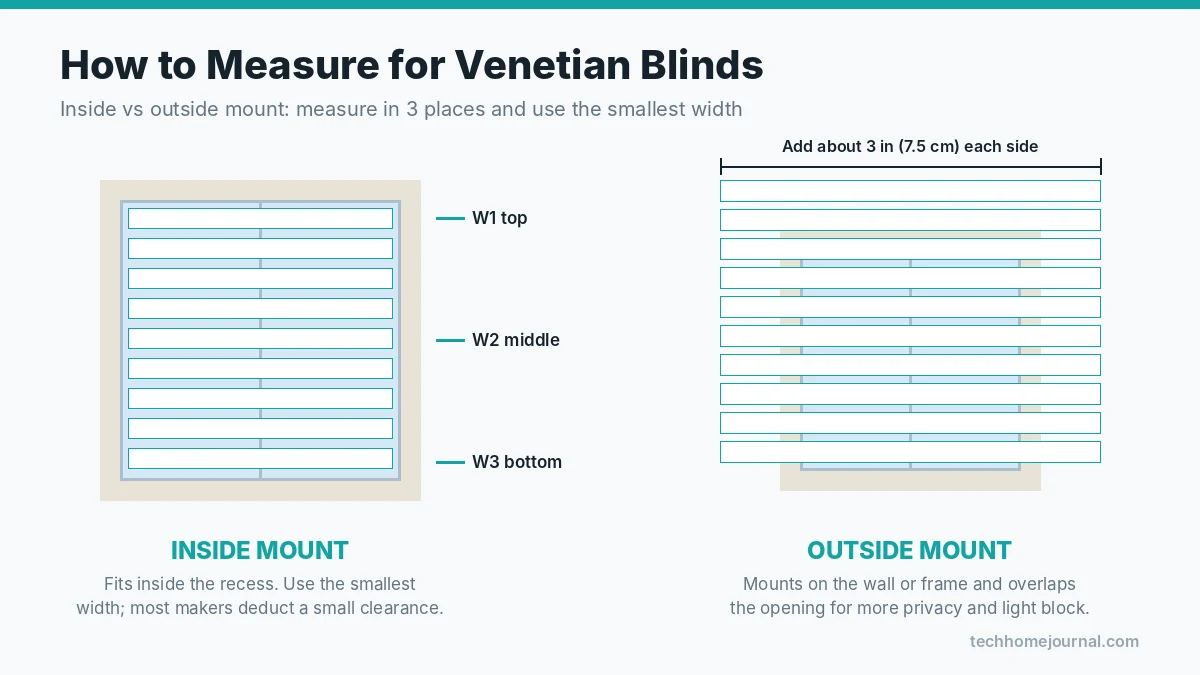
Inside mount (in the recess)
- Measure the width inside the window recess at the top, middle and bottom. Use the smallest width.
- Measure the height on the left, center and right. Use the longest height.
- Check the recess depth. Most 25 mm blinds need around 2 inches (5 cm) and 50 mm blinds around 3 inches (7.5 cm) to fit flush. Check the maker’s exact minimum.
- Give the exact measurements. Most companies take off a small clearance themselves, so do not deduct anything unless the order form asks you to.
Outside mount (on the wall)
- Measure the width of the opening and add about 3 inches (7.5 cm) on each side for privacy and light control.
- Measure the height from where the headrail will sit to the sill, or a little below if there is no sill.
- Make sure handles, tiles or radiators will not stop the slats from hanging straight.
If you are buying for a whole house, a quick room area check with our Square Footage Calculator helps when comparing quotes that are priced per square foot.
How Much Do Venetian Blinds Cost?
Prices vary a lot by size, material and whether you buy off the shelf or made-to-measure. These are rough US ranges for a standard window of about 36 x 60 inches (approx. prices, check current deals):
| Type | Ready-made (stock) | Made-to-measure |
|---|---|---|
| 25 mm aluminum | $15–$40 | $40–$120 |
| 50 mm faux wood | $30–$80 | $60–$200 |
| 50 mm real wood | $60–$120 | $100–$350 |
| Retrofit tilt motor | About $70 per window, plus hub | Same |
| Built-in motorized wood | Not common | $400–$900+ |
Professional installation usually adds a per-blind fee. Fitting a standard inside-mount blind is a simple DIY job if you have a drill and a level, so many homeowners do it themselves and save the money.
Blinds can also help with energy bills. Closing the slats on sunny summer afternoons keeps heat out, and closing them at night in winter cuts drafts a little. For a bigger effect, combine them with the tips in our guide on how to insulate windows cheaply.
Child Safety and Cordless Options
Loose blind cords are a real strangulation risk for young children. In the US, the updated voluntary safety standard (ANSI/WCMA A100.1-2018) took effect on December 15, 2018. According to the U.S. Consumer Product Safety Commission, stock blinds sold since then must be cordless, have inaccessible cords, or have short cords of 8 inches or less. Custom blinds default to a tilt wand instead of a tilt cord and carry stronger warning labels.
The CPSC also lists stock window coverings that do not meet these requirements as a substantial product hazard. You can read the details in the CPSC window coverings FAQ. In the UK and Europe, blinds must meet the EN 13120 safety standard, which also covers cord safety devices.
- Choose cordless or motorized blinds for any room a child uses.
- If you keep older corded blinds, fit cord cleats high on the wall and keep cords out of reach.
- Move cribs, beds and furniture away from windows so children cannot climb up to cords.
- Replace blinds made before 2018 if you have small children at home.
How to Clean Venetian Blinds
Dust builds up on horizontal slats quickly, but a little regular care keeps them looking new.
- Weekly: close the slats in one direction and dust with a microfiber cloth or a vacuum brush attachment, then tilt the other way and repeat.
- Monthly: wipe aluminum and faux wood slats with a damp cloth and a drop of mild dish soap. Dry them right away.
- Real wood: never soak it. Use a dry or barely damp cloth and a wood-safe cleaner.
- Deep clean: aluminum and faux wood blinds can be taken down and washed in a bathtub with warm soapy water. Keep the headrail and any motor dry.
- Smart blinds: keep water away from the motor and solar panel, and wipe the panel now and then so it charges properly.
Styling Tips for Modern and Scandinavian Homes
Venetian blinds fit almost any style, but they work especially well in clean, light-filled homes. For a Scandinavian or minimalist look, try white or pale oak 50 mm slats, mounted inside the recess so the window frame stays visible. Pair them with light linen curtains if you want a softer finish.
- Match the trim: white blinds on white window frames make the window feel bigger.
- Go natural: light wood or bamboo adds warmth to gray and white rooms.
- Use contrast sparingly: black aluminum blinds look sharp in industrial or modern spaces, but can feel heavy in small rooms.
- Hide the tech: a built-in motor keeps the look clean, while a small retrofit motor is barely noticeable at the top of the blind. See more ideas in our smart home without a hub guide.
Venetian Blinds vs Other Window Coverings
| Window covering | Light control | Privacy | Typical cost | Best for |
|---|---|---|---|---|
| Venetian blinds | Excellent (tilt) | Good | Low to medium | Most rooms, fine light control |
| Roller blinds | On/off only | Good | Low to medium | Simple, clean look, blackout |
| Vertical blinds | Good | Good | Low | Patio doors, wide windows |
| Curtains | Fair | Excellent when closed | Low to high | Softness, blackout, insulation |
| Shutters | Excellent | Excellent | High | Permanent, high-end look |
If you want the house to open and close everything automatically, curtains and roller blinds are often easier to motorize fully. Our smart curtains installation guide compares the options.
Frequently Asked Questions
Are Venetian blinds the same as horizontal blinds?
Yes, mostly. “Venetian blinds” is the traditional name for blinds with horizontal slats that tilt. In the US they are often sold as horizontal blinds, mini blinds (narrow metal slats) or wood blinds (wide wooden slats).
What is the difference between Venetian blinds and wooden blinds?
Wooden blinds are a type of Venetian blind. The term Venetian often refers to aluminum slats, especially in the UK, while wooden blinds use real or faux wood slats that are usually 50 mm wide.
Are Venetian blinds good for bedrooms?
They work, but they are not true blackout. Light passes through cord holes and around the edges. Use wide slats, an outside mount, and curtains on top if you need a dark room for sleep.
Can I make my existing Venetian blinds smart?
Yes, if they tilt with a wand. A retrofit motor such as the SwitchBot Blind Tilt fits onto the tilt rod and lets you tilt the slats from an app, by voice or on a schedule. Raising and lowering usually still needs to be done by hand.
Which slat size should I choose?
50 mm (2 inch) suits most home windows, especially in living rooms and bedrooms. 25 mm (1 inch) is better for small windows, kitchens and offices. Use 63 mm on very large windows.
How long do Venetian blinds last?
Aluminum blinds usually last 5 to 10 years, while good faux wood and real wood blinds can last more than 10 years with basic care. Motors in smart blinds generally last 5 to 10 years.
Are faux wood blinds better than real wood?
Faux wood is better in humid rooms and costs less. Real wood is lighter, looks more natural and is better for very wide windows in dry rooms.
Final Verdict
For most homes, 50 mm faux wood Venetian blinds are the best all-round choice: they look like wood, shrug off moisture and are easy to keep clean. Choose real wood in living rooms and bedrooms when you want extra warmth, and aluminum when you need something light and affordable for kitchens, offices or rentals.
Measure carefully, pick cordless if you have kids, and think about a smart tilt motor if you have many windows or ones that are hard to reach. A $70 retrofit motor on your existing blinds is one of the cheapest ways to add real, everyday automation to your home.