

Drive through Phoenix, Los Angeles or Albuquerque and stucco houses are everywhere. Smooth, sand-colored walls, curved arches, tile roofs. Head north into Seattle or Ohio, and stucco gets rarer, and when you do see it, the people living there often have strong opinions about it.
Stucco can last for generations, resists fire and needs very little upkeep. It can also hide moisture problems that are expensive to fix if the wall was installed badly. If you are thinking about buying a stucco house, building one, or re-siding your home in stucco, this guide covers what you need to know: types, costs, styles, the pros and cons, and the warning signs to look for.
Table of Contents
- What is a stucco house?
- Types of stucco: traditional, one-coat and synthetic (EIFS)
- How stucco is installed
- How much does a stucco house exterior cost?
- Pros of a stucco house
- Cons of a stucco house
- Which climates suit stucco?
- Popular stucco house styles and colors
- Buying a stucco house: what to check
- Stucco maintenance and repair
- Stucco vs other siding options
- Protecting a stucco home with smart tech
- FAQ
- Bottom line
What is a stucco house?
A stucco house is a home whose exterior walls are finished with stucco, a hard plaster-like coating. Traditional stucco is a mix of Portland cement, sand, lime and water. The Portland Cement Association describes the basic recipe as a cementitious binder, aggregate and water, with lime and pigments as common extras. It goes on wet in layers, over either masonry (like concrete block) or a wood-framed wall covered with a water-resistant barrier and metal lath. When it cures, it forms a hard, seamless shell.
People have used lime plasters on buildings for thousands of years. Modern cement stucco became popular in the US in the early 1900s and took off in the Southwest and California, where it suits both the climate and the Spanish and Mission-style architecture.

Types of stucco: traditional, one-coat and synthetic (EIFS)
“Stucco” is used loosely, and that causes a lot of confusion. There are three main systems, and they behave very differently.
Traditional three-coat stucco
This is the classic version. It goes on in three layers: a scratch coat pressed into metal lath, a brown coat that builds thickness and flattens the wall, and a thin finish coat that adds color and texture. The total thickness is usually around 7/8 of an inch. It is very hard and durable, but it takes longer to install because each coat needs time to cure.
One-coat stucco
Despite the name, one-coat systems usually involve two layers: a single base coat (often with fibers mixed in, applied over foam insulation board or lath) followed by a finish coat. It’s faster and cheaper to install than three-coat and is common in newer construction. It is thinner, so it relies more on good installation details.
Synthetic stucco (EIFS)
EIFS stands for Exterior Insulation and Finish System. It’s a different product. Foam insulation board is attached to the wall, covered with a reinforced base coat and mesh, and finished with an acrylic coating that looks like stucco. It insulates well and is more flexible, so it cracks less. Older “barrier” EIFS from the 1980s and 1990s had no way to drain water that got behind it, which led to widespread rot problems. Modern EIFS systems include a drainage layer. The EIFS Industry Members Association notes that drainage EIFS, which add a water-resistive barrier and a drainage plane behind the foam, are now the main type in use.
| Type | Base | Thickness | Strengths | Watch out for |
|---|---|---|---|---|
| Three-coat | Cement, sand, lime | About 7/8 inch | Very hard, fire resistant, long life | Cracking, slow install |
| One-coat | Fiber-reinforced cement | About 3/8 to 1/2 inch | Faster, cheaper install | Depends heavily on workmanship |
| EIFS (synthetic) | Foam board, acrylic finish | Varies with foam | Insulation, fewer cracks, many colors | Impact dents, older systems trap water |
If you are buying a house, find out which system you are looking at. A home inspector or stucco specialist can usually tell by tapping the wall (EIFS sounds hollow and feels softer) or by checking the edges at a light fixture or vent.
How stucco is installed
On a wood-framed house, a good traditional stucco job usually follows these steps:
- Sheathing such as plywood or OSB goes on the framing.
- Two layers of water-resistive barrier (building paper or house wrap) are applied, lapped so water runs down and out.
- Flashing is installed around windows, doors and roof edges.
- A weep screed is fixed along the bottom of the wall. This is a metal strip that lets water that gets behind the stucco drain out at the base.
- Metal lath is fastened over the barrier to give the stucco something to grab.
- The scratch coat goes on and is scored with horizontal lines.
- The brown coat follows after the scratch coat cures.
- The finish coat adds texture and color.
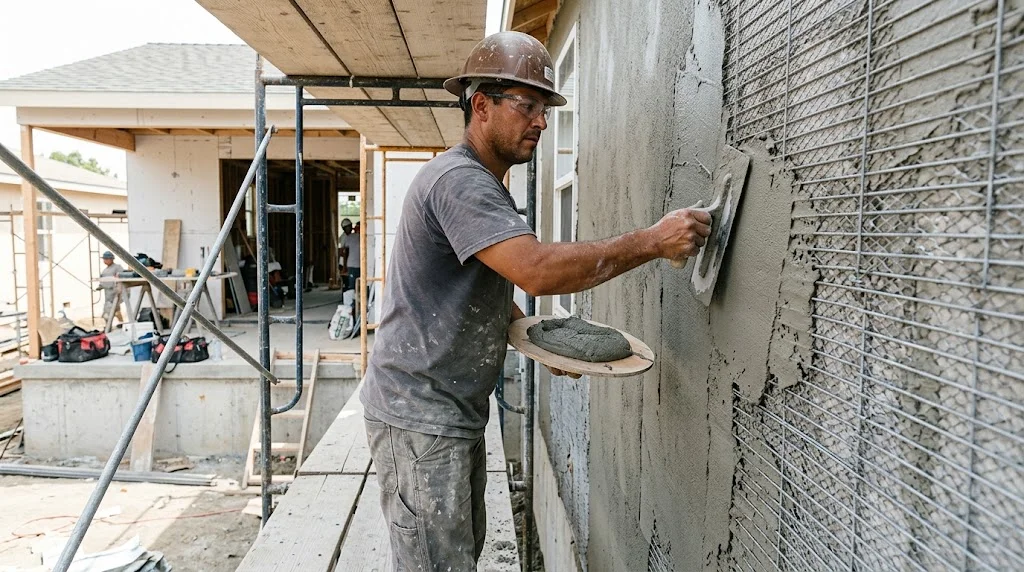
Most stucco problems come from steps two, three and four. Stucco itself is porous. Some water always gets through it in wet weather. A wall that is built to let that water drain and dry is fine for decades. A wall without proper barriers, flashing or a weep screed can quietly rot from the inside. The Department of Energy’s Building America Solution Center recommends a drainage gap behind stucco, and a drainage mat at least 1/4 inch thick in areas that get more than about 20 inches of rain a year.
Weather matters during installation too. This Old House notes that stucco should not be applied during freezing temperatures or heavy rain, because both can ruin the curing process.
How much does a stucco house exterior cost?
Costs vary by region, wall height, prep work and the system you choose. These are typical installed ranges published by This Old House in 2026:
| Item | Approximate cost |
|---|---|
| Traditional stucco, installed | $6.36 to $9.66 per sq ft |
| Synthetic stucco (EIFS), installed | $10 to $18 per sq ft |
| 2,000 sq ft home (traditional) | About $19,300 |
| 2,500 sq ft home (traditional) | About $24,150 |
| Minor crack and chip repair | $8 to $20 per sq ft |
| Filling a hole | $250 to $450 each |
| Extensive damage repair | Up to $120 per sq ft |
The “per sq ft” figures refer to wall area, not the floor area of the house. A two-story home has much more wall area than a single-story home with the same floor space.
Prep work is the big wildcard. If old siding has to be stripped, or if damaged sheathing and barriers need replacing, the bill climbs quickly. Color matching on repairs also adds cost, because new stucco rarely matches weathered stucco exactly. Many owners repaint or re-coat a whole wall after a patch.
Pros of a stucco house
- Long lifespan. With proper installation and maintenance, stucco can last 50 to 100 years. Vinyl siding usually lasts 20 to 40.
- Fire resistance. Cement stucco doesn’t burn. That’s a big reason it’s popular in wildfire-prone parts of California and the West.
- Low routine maintenance. No boards to replace, no regular staining. Most years, a rinse and a quick look for cracks is enough.
- Pest resistance. Termites and woodpeckers have nothing to eat or drill.
- Sound dampening. The dense, textured surface helps quiet outside noise.
- Insulation (EIFS). Synthetic stucco with foam board can noticeably improve a wall’s insulation and cut air leaks.
- Design flexibility. Stucco wraps around curves, arches and odd shapes that are hard to cover with siding, and it comes in almost any color and texture.
Cons of a stucco house
- Moisture risk. This is the big one. Poorly detailed stucco in a wet climate can trap water behind it, leading to rot and mold that is invisible until the damage is advanced.
- Cracking. Traditional stucco is rigid. Settling, temperature swings and small earthquakes all cause hairline cracks.
- Higher upfront cost. It costs more than vinyl siding and needs skilled labor.
- Repairs are tricky. Patches are hard to match in color and texture.
- Resale perception. In some markets, buyers are wary of stucco because of past moisture problems, and This Old House estimates stucco recoups about 70% of its cost at resale, versus about 80% for vinyl.
- Impact damage (EIFS). Synthetic stucco can dent or puncture if hit by a ball, ladder or lawnmower.
Which climates suit stucco?
Stucco is at its best in hot, dry climates. In Arizona, Nevada, New Mexico, Southern California and much of Texas, rain is infrequent and walls dry out quickly, so the small amount of water that gets through stucco is not a problem.
In wet climates with lots of driving rain, like the Pacific Northwest, parts of the Southeast and the mid-Atlantic, stucco can still work, but construction details matter far more. Two layers of barrier, careful flashing, a weep screed and ideally a drainage gap behind the stucco are essential. Some regions have a history of stucco moisture litigation for exactly this reason.
In very cold climates, freeze-thaw cycles can widen cracks over time. Regular sealing of cracks matters more there.
Popular stucco house styles and colors
Stucco works with a surprising range of architecture.
- Spanish Colonial and Mission Revival: white or cream walls, red clay tile roofs, arched doorways and windows.
- Mediterranean and Tuscan: warm earth tones, ochre, terracotta and sand, often with wrought iron details.
- Pueblo Revival: rounded edges, flat roofs, exposed wooden beams and earthy adobe colors, common in New Mexico.
- Modern and contemporary: smooth white or light gray stucco with clean lines, large windows and black window frames.
- Tudor Revival: stucco panels between dark half-timbering.
- Scandinavian-inspired modern: crisp white or soft gray smooth stucco, natural wood accents around the entry, minimal trim.
Popular stucco colors right now include warm whites, greige, soft sand, light gray and deep charcoal for modern homes. A light grey stucco house with black trim is a very common modern look. Lighter colors reflect more heat, which helps in sunny climates.
Texture changes the look as much as color. Smooth (or “Santa Barbara”) finishes look modern and refined; sand finishes are fine and even; lace and skip trowel finishes give an older, hand-made feel.
Buying a stucco house: what to check
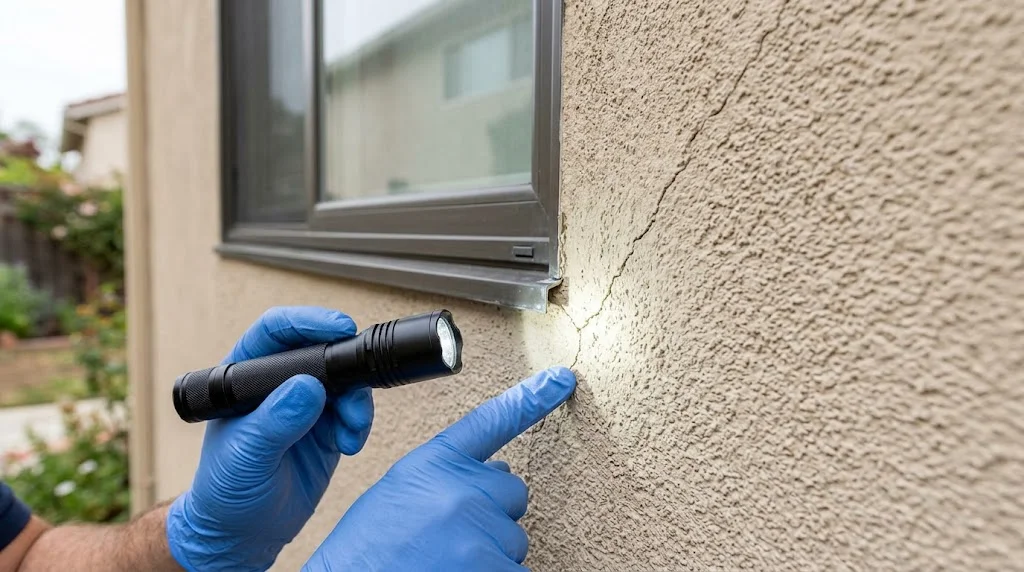
A stucco house can be a great buy. But a standard home inspection is not always enough, especially in wetter regions. If the house was built or re-sided in the last few decades, consider a dedicated stucco inspection, which may include moisture probes drilled into suspect areas.
Warning signs to look for:
- Cracks that are wider than a credit card, stepped, or growing. Hairline cracks are common and usually cosmetic.
- Stains or streaks running down from windows, roof lines or light fixtures.
- Bubbling, soft or crumbling spots. Push gently; healthy stucco is hard.
- Stucco running into soil or concrete at the bottom of the wall instead of ending at a weep screed a few inches above grade.
- Missing or poorly sealed flashing around windows, doors and roof-to-wall joints.
- Inside clues: musty smells, swollen window trim, stained drywall or soft floors along outside walls.
Stucco maintenance and repair
Stucco is low maintenance, not no maintenance. A simple yearly routine keeps it healthy:
- Walk around the house every spring. Look for new cracks, stains and loose areas, especially around windows and roof lines.
- Clean gently. Use a garden hose and a soft brush with mild detergent. Avoid high-pressure washing; it can force water into cracks and damage the finish.
- Seal small cracks. Hairline cracks can be filled with an elastomeric caulk or patch made for stucco, then painted to match.
- Keep sprinklers and soil away. Sprinklers should not hit the walls, and soil or mulch should stay several inches below the weep screed.
- Check the caulk around windows and doors and replace it when it cracks or pulls away.
- Repaint or re-coat when needed. Breathable masonry paint or an elastomeric coating every 10 years or so refreshes color and seals fine cracks.
Big cracks, soft areas or signs of moisture inside the walls are jobs for a stucco professional. This Old House suggests replacing the stucco on a wall if more than about 25% of it needs repair.
Stucco vs other siding options
| Material | Installed cost per sq ft (approx.) | Lifespan | Fire resistance | Maintenance |
|---|---|---|---|---|
| Traditional stucco | $6 to $10 | 50 to 100 years | Excellent | Low |
| EIFS | $10 to $18 | 30 to 50+ years | Moderate | Low |
| Vinyl siding | $3 to $6 | 20 to 40 years | Poor (melts) | Low |
| Fiber cement | Mid range | 30 to 50 years | Excellent | Low to moderate |
| Wood siding | Mid to high | 20 to 40 years with care | Poor unless treated | High |
Fiber cement is stucco’s closest competitor: it is also fire resistant and durable, but it handles wet climates more forgivingly because it is installed as boards with a natural drainage path.
Protecting a stucco home with smart tech
Because the biggest risk with stucco is hidden water, a few inexpensive smart home devices make a lot of sense.
- Leak and moisture sensors. Place them near exterior walls in basements, crawl spaces and under windows that have stained before. Our guide on where to place water leak sensors explains the best spots.
- A smart water shut-off valve. A burst pipe inside a stucco wall is a nightmare. A smart shut-off valve can close the main automatically when it detects a leak.
- Outdoor cameras and lights. Mounting cameras on stucco takes masonry anchors and a good sealant, but it’s very doable. See our guides to the best floodlight cameras and solar motion sensor lights, which avoid running wires through the wall.
- Whole-home monitoring. A home monitoring system ties sensors, cameras and alerts into one app.
When drilling into stucco for any device, use a masonry bit, drill slowly to avoid cracking, and seal the hole and the mount with exterior-grade sealant so water can’t get behind the finish. For more upgrade ideas, see our roundup of the best tech gadgets for home improvement.
FAQ
How long does a stucco house last?
Traditional stucco can last 50 to 100 years with good installation and maintenance. Many early 1900s stucco homes are still standing with their original walls.
Is a stucco house a bad investment?
Not by itself. Well-built stucco in a suitable climate is durable and attractive. The risk is poorly installed stucco in wet areas, which is why a specialist inspection is worth it before buying.
Is stucco cheaper than siding?
Traditional stucco usually costs more than vinyl siding but is in a similar range to fiber cement. Synthetic stucco (EIFS) costs more than both.
How can I tell if a house has real stucco or EIFS?
Tap the wall. Traditional stucco feels hard and sounds solid. EIFS feels slightly softer and sounds hollow because of the foam behind it. An inspector can confirm.
Do stucco houses have moisture problems?
Some do. Stucco lets a little water through, so the wall behind it needs a barrier, flashing and a way to drain. Homes built without those details, especially in rainy climates, are the ones that run into trouble.
Can you paint a stucco house?
Yes. Use a breathable masonry paint or an elastomeric coating designed for stucco, and fix cracks first. Avoid standard exterior latex that can trap moisture.
Are hairline cracks in stucco normal?
Yes, especially near window and door corners. Seal them to keep water out. Cracks wider than about 1/8 inch, or ones that keep growing, should be checked by a professional.
Bottom line
A stucco house can be one of the most durable, fire-resistant and low-maintenance homes you can own, especially in a dry, sunny climate. The material itself is not the problem. Installation is. A properly built wall with a good barrier, flashing and a weep screed will last for generations. A shortcut job can hide rot for years.
If you are buying, get a proper stucco inspection. If you are building or re-siding, choose an experienced installer and ask exactly how the wall will drain. And if you already live in a stucco house, a yearly walk-around, sealed cracks and a couple of leak sensors go a long way toward keeping it trouble-free.