
A portable air conditioner is the easiest way to cool a room when you can’t install a window unit or a split system. It rolls into place, vents through a window kit and plugs into a normal socket. That convenience comes with trade-offs, though: portable units are less efficient than window or mini-split air conditioners, and the BTU number on the box is often bigger than the real cooling you’ll get.
This guide explains how portable air conditioners work, what SACC ratings mean, and how single-hose and dual-hose models differ. We compare popular smart models from Midea, Whynter, LG, Dreo and Black+Decker, and show how app control, schedules and smart plugs can cut running costs. We also look at noise, drainage and how to make a portable unit look tidy in a calm Scandinavian-style room.
Table of Contents
- Quick Picks
- Portable Air Conditioner Comparison Table
- How Portable Air Conditioners Work
- BTU vs SACC: The Rating That Matters
- Single-Hose vs Dual-Hose
- The Best Portable Air Conditioners in Detail
- Smart Features and Automation
- What Size Portable AC Do You Need?
- Portable vs Window vs Mini-Split
- Installation and Venting Tips
- Running Costs and Energy Saving
- Maintenance and Drainage
- Making a Portable AC Look Tidy
- Portable AC Troubleshooting
- Frequently Asked Questions
- Final Verdict
Quick Picks
- Best overall smart portable AC: Midea Duo, a dual-hose inverter unit that’s quiet and efficient, with app and voice control.
- Best for larger rooms: Whynter NEX dual-hose inverter, strong cooling with smart app support.
- Best for LG ThinQ homes: LG dual inverter portable AC, quiet and efficient with ThinQ app control.
- Best mid-range smart pick: Dreo portable AC, a modern design with app and voice control.
- Best budget smart pick: Black+Decker Wi-Fi portable AC, app control at a lower price for smaller rooms.
- Best budget dual-hose: Whynter Elite dual-hose, efficient design without smart features.
Portable Air Conditioner Comparison Table
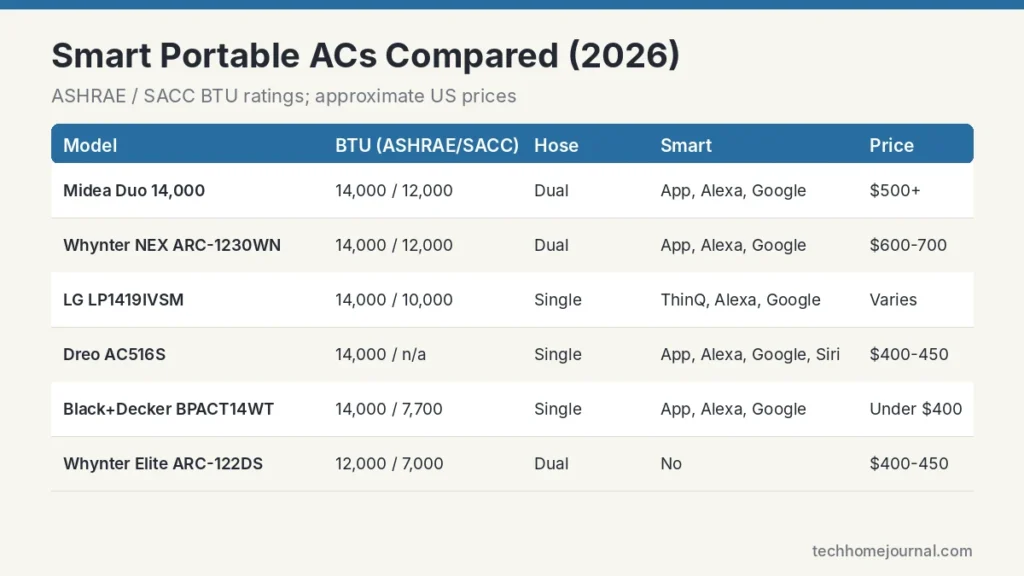
BTU figures show the older ASHRAE rating and the newer SACC rating (seasonally adjusted cooling capacity). Prices are approximate US street prices and change with the seasons.
| Model | BTU (ASHRAE / SACC) | Hose | Inverter | Smart | Approx. price |
|---|---|---|---|---|---|
| Midea Duo 14,000 | 14,000 / 12,000 | Dual (hose-in-hose) | Yes | App, Alexa, Google | $500+ |
| Whynter NEX ARC-1230WN | 14,000 / 12,000 | Dual | Yes | App, Alexa, Google | $600 to $700 |
| LG LP1419IVSM | 14,000 / 10,000 | Single | Yes | LG ThinQ, Alexa, Google | Varies |
| Dreo AC516S | 14,000 / not stated | Single | Not stated | App, Alexa, Google, Siri | $400 to $450 |
| Black+Decker BPACT14WT | 14,000 / 7,700 | Single | No | App, Alexa, Google | Under $400 |
| Whynter Elite ARC-122DS | 12,000 / 7,000 | Dual | No | No | $400 to $450 |
How Portable Air Conditioners Work
A portable air conditioner works like any other air conditioner, just in one box. A refrigerant cycle pulls heat and moisture out of the room air, and the unit pushes that heat outside through an exhaust hose fitted to a window kit. The cooled air blows back into the room.
Because the hot parts of the system sit inside your room, some heat leaks back from the unit and the hose. That’s the main reason portable units are less efficient than window or split systems with the same nominal BTU rating.
BTU vs SACC: The Rating That Matters
For years, portable ACs were sold by their ASHRAE BTU rating, measured in ideal lab conditions. Since 2017, U.S. Department of Energy rules require a second figure, SACC (seasonally adjusted cooling capacity), which accounts for heat leaking back into the room and real summer conditions.
SACC is almost always lower. A “14,000 BTU” unit might have a SACC of 7,700 on a single-hose budget model or 12,000 on a good dual-hose inverter model. When comparing, always look at SACC. The Energy Saver guide to room air conditioners explains how to size and run room units efficiently.
Single-Hose vs Dual-Hose
| Feature | Single-hose | Dual-hose |
|---|---|---|
| How it works | Uses room air to cool the unit, then vents it outside | Pulls outside air in through one hose and vents through the other |
| Efficiency | Lower; creates negative pressure that draws warm air in through gaps | Higher; less warm air drawn into the room |
| Cooling speed | Slower in hot weather | Faster |
| Setup | Simpler, one hose | Two hoses or a hose-in-hose design |
| Price | Lower | Higher |
If you live somewhere hot, or want to cool a living room rather than a small bedroom, a dual-hose or hose-in-hose model like the Midea Duo is worth the extra cost.
The Best Portable Air Conditioners in Detail
1. Midea Duo: best overall smart portable AC
Specs: 14,000 BTU ASHRAE / 12,000 BTU SACC, hose-in-hose dual-hose design, inverter compressor, about 42 dB on low, Midea app with Alexa and Google support.
The Midea Duo uses a clever hose-in-hose design that brings the efficiency of dual-hose cooling with the look of a single hose. The inverter compressor ramps up and down smoothly instead of switching on and off, so it’s quieter and uses less energy once the room is cool. Some versions also include a heat pump for winter heating. See Midea’s Duo product page for current versions.
- Pros: high SACC, quiet inverter, smart controls, efficient.
- Cons: higher price, heavy to move between rooms.
2. Whynter NEX ARC-1230WN: best for larger rooms
Specs: 14,000 BTU ASHRAE / 12,000 BTU SACC, dual hose, inverter, app with Alexa and Google, rated for spaces up to about 600 sq ft.
Whynter has made dual-hose portables for years, and the NEX adds an inverter and smart controls. It’s a strong choice for larger living rooms and open-plan spaces where a single-hose unit would struggle.
- Pros: strong real-world cooling, dual hose, inverter efficiency.
- Cons: expensive, two hoses to manage.
3. LG LP1419IVSM: best for LG ThinQ homes
Specs: 14,000 BTU ASHRAE / 10,000 BTU SACC, single hose, dual inverter compressor, LG ThinQ app, Alexa and Google support.
LG’s dual inverter model is quiet in sleep mode and efficient for a single-hose design. If you already use LG appliances, it fits neatly into the ThinQ app.
- Pros: quiet, efficient inverter, good app.
- Cons: single hose, lower SACC than the best dual-hose units.
4. Dreo AC516S: best mid-range smart pick
Specs: 14,000 BTU ASHRAE, single hose, Dreo app, Alexa, Google and Siri Shortcuts support, about 46 dB on low.
Dreo’s portable AC has a modern, clean design that looks less like an appliance than most. Smart controls and voice support are easy to set up. Check the SACC figure for the exact version you buy.
- Pros: modern design, broad voice assistant support, fair price.
- Cons: single hose, best for small to medium rooms.
5. Black+Decker BPACT14WT: best budget smart pick
Specs: 14,000 BTU ASHRAE / 7,700 BTU SACC, single hose, Wi-Fi app, Alexa and Google support.
It’s an affordable way to get app control and voice support, but the SACC rating shows it’s best for smaller rooms. Treat it as a bedroom or home office unit.
- Pros: low price, smart controls.
- Cons: louder, low SACC for its ASHRAE rating.
6. Whynter Elite ARC-122DS: best budget dual-hose
Specs: 12,000 BTU ASHRAE / 7,000 BTU SACC, dual hose, no Wi-Fi.
A good-value dual-hose option if you don’t need smart features. You can still add simple scheduling with a smart plug if the unit resumes after a power cut.
- Pros: dual hose at a moderate price, reliable brand.
- Cons: no app, lower SACC.
Smart Features and Automation
Smart portable air conditioners connect to Wi-Fi so you can control them from your phone or voice assistant. The most useful features:
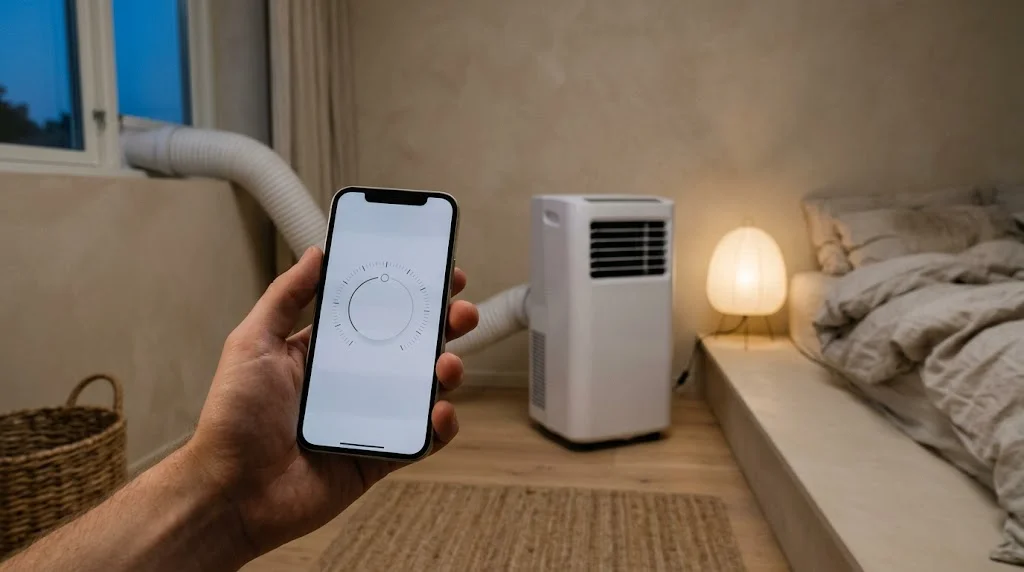
- Pre-cooling: start the unit 20 minutes before you get home instead of leaving it on all day.
- Schedules: cool the bedroom before bedtime and switch to sleep mode overnight.
- Voice control: “Alexa, set the bedroom AC to 22 degrees.” Our guide to the best smart speakers covers the main platforms.
- Energy tracking: some apps show runtime; an energy monitoring smart plug rated for the load gives exact numbers.
- Smart AC controllers: devices such as Sensibo can add app control to some non-smart units that use an infrared remote.
If your unit isn’t smart, a heavy-duty smart plug rated for at least 15 A can switch it on and off, but only if the AC resumes running when power returns. Many units come back in standby, so test yours first.
What Size Portable AC Do You Need?
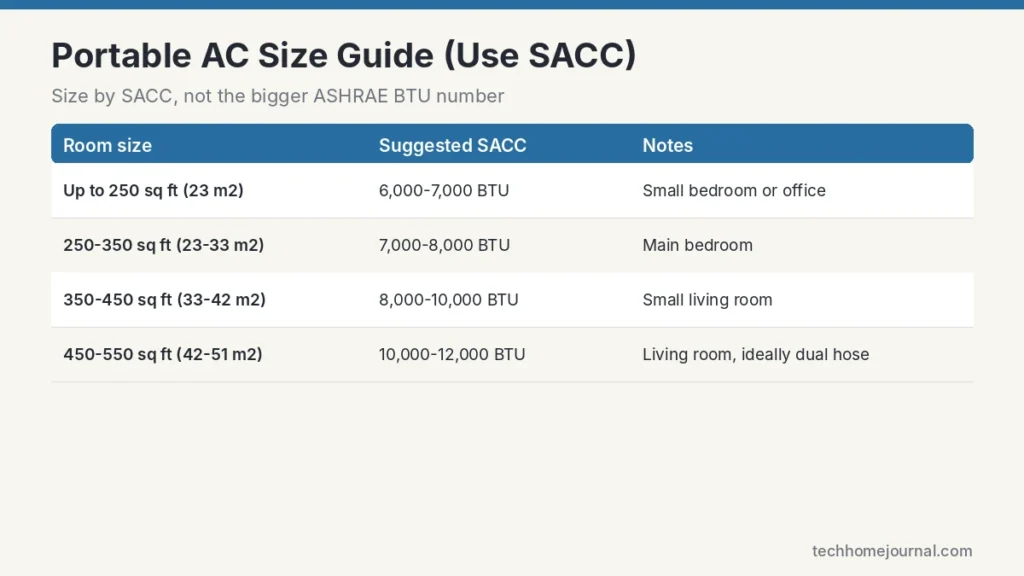
Use the SACC rating, not the ASHRAE number, when sizing.
| Room size | Suggested SACC | Notes |
|---|---|---|
| Up to 250 sq ft (23 m²) | 6,000 to 7,000 BTU | Small bedroom or office |
| 250 to 350 sq ft (23 to 33 m²) | 7,000 to 8,000 BTU | Main bedroom |
| 350 to 450 sq ft (33 to 42 m²) | 8,000 to 10,000 BTU | Small living room |
| 450 to 550 sq ft (42 to 51 m²) | 10,000 to 12,000 BTU | Living room, ideally dual hose |
Size up for sunny rooms, top-floor flats, kitchens or high ceilings. Size down slightly for shaded rooms. If you are between two sizes, choose the larger one and let the inverter or thermostat run it more gently.
Portable vs Window vs Mini-Split
| Type | Pros | Cons |
|---|---|---|
| Portable AC | No permanent installation, moves between rooms, renter-friendly | Least efficient, takes floor space, louder indoors |
| Window AC | More efficient, cheaper per BTU | Blocks part of the window, harder to install |
| Mini-split heat pump | Most efficient and quietest, heats and cools | Expensive, needs professional installation |
If you own your home and plan to cool the same room every summer, a window unit or mini-split usually costs less to run. A portable AC makes the most sense for renters, rooms with awkward windows, and short heatwaves.
Installation and Venting Tips
- Keep the hose short and straight. Long, bent hoses trap heat and reduce cooling.
- Seal the window kit well. Use foam strips around the panel so hot air doesn’t leak in.
- Insulate the hose with an insulating sleeve to cut heat radiating back into the room.
- Leave space around the unit, at least 50 cm (20 in) from walls and furniture.
- Close doors and curtains on sunny days to keep the cool air where you need it.
- Use a ceiling fan on low to spread cool air. Our guide to the best smart ceiling fans covers good options.
Running Costs and Energy Saving
Portable ACs typically draw around 900 to 1,500 W while the compressor runs. Inverter models use less once the room reaches the set temperature, because they slow down instead of cycling on and off.
- Set the temperature around 24 to 26°C (75 to 78°F) when you’re home.
- Use schedules or pre-cooling instead of running it all day.
- Close blinds on sunny windows. Smart blinds can do this automatically.
- Clean the filter every two weeks during heavy use.
- Use eco or sleep mode overnight.
For more ways to keep summer bills down, see our guide to lowering your electricity bill.
Maintenance and Drainage
Portable air conditioners remove moisture from the air as they cool. Many models evaporate most of this water and blow it out through the exhaust hose, but in humid weather you may need to drain a tray or connect a continuous drain hose.
- Filters: rinse the air filter every two weeks in summer.
- Drainage: empty the internal tank when the full-tank light comes on, or set up continuous drainage in humid climates.
- End of season: drain all water, run the fan for a few hours to dry the inside, and store the unit upright.
- Coils: vacuum dust from the vents and coils once a year.
Making a Portable AC Look Tidy
Portable units aren’t pretty, but you can keep a calm Scandinavian-style room looking uncluttered. Choose a white unit to match light walls, place it beside a curtain so the window kit is hidden behind fabric, and run the hose along the shortest path. In winter, store the unit and window kit in a cupboard so the room returns to its simple, open look. If you also want cleaner air, an air purifier and good ventilation help balance stuffy summer rooms.
Portable AC Troubleshooting
| Problem | Likely cause | Fix |
|---|---|---|
| Room won’t cool down | Unit too small, leaky window kit, long hose | Check SACC; seal gaps; shorten and insulate the hose |
| Unit shuts off with a light flashing | Water tank full | Drain the tank or set up continuous drainage |
| Hot air near the window | Hose or window panel leaking | Reseal the panel and check hose connections |
| Very loud | Uneven floor or high fan speed | Level the unit; use sleep or low mode |
| Musty smell | Dirty filter or standing water | Clean the filter; drain and dry the unit |
| App shows offline | Router change or weak Wi-Fi | Reconnect in the app; move the router closer |
Frequently Asked Questions
Are portable air conditioners worth it?
Yes, if you can’t install a window unit or mini-split. They’re less efficient, but they cool a room well when sized by SACC and vented properly.
What’s the difference between BTU and SACC?
BTU (ASHRAE) is measured in ideal lab conditions. SACC accounts for real summer conditions and heat leaking back into the room, so it gives a more realistic figure for comparison.
Is a dual-hose portable AC better?
Usually, yes. Dual-hose units draw less warm air into the room and cool faster, especially in hot weather and larger rooms.
Can I use a portable AC without a window?
It needs to vent hot air outside. Without a window, you can vent through a wall or a sliding door kit, but venting into another room doesn’t work.
Do portable air conditioners need to be drained?
Many evaporate most of the water, but in humid weather you’ll need to empty a tank or use a continuous drain hose.
How loud are portable air conditioners?
Most range from about 42 dB on low to 55 to 60 dB on high. Inverter models are noticeably quieter, which matters in bedrooms.
Can a portable AC heat a room too?
Some models include a heat pump or heater mode. Check the specs if you want year-round use.
Should I run a portable AC all day?
It’s usually cheaper to use schedules or pre-cooling so it runs before you get home and while you’re in the room. Inverter models are efficient at holding a temperature, but cooling an empty room still wastes energy.
Can I use an extension cord with a portable AC?
Most manufacturers advise plugging directly into a wall socket. If you must use one, choose a heavy-duty cord rated for the unit’s current, and never use a thin household extension lead.
Do portable air conditioners dehumidify?
Yes. Cooling removes moisture from the air, and many models also have a dedicated dry or dehumidify mode. That makes them useful on muggy days even when the temperature isn’t extreme, though a dedicated dehumidifier is better for damp basements.
How long do portable air conditioners last?
With regular filter cleaning, proper drainage and dry storage over winter, many portable units last around 8 to 10 years. Inverter models and well-known brands with available spare parts tend to last longest.
Final Verdict
For most people, the Midea Duo is the best portable air conditioner thanks to its high SACC rating, efficient inverter and quiet operation, plus app and voice control. The Whynter NEX is a strong alternative for larger rooms, and LG’s dual inverter model suits ThinQ homes. If budget matters most, the Black+Decker Wi-Fi model brings smart controls to small rooms.
Whatever you choose, size it by SACC, keep the hose short and sealed, and use schedules rather than running it all day. That way a portable AC keeps you cool without a shock on your summer electricity bill.