

Dry winter air can leave you with a scratchy throat, cracked lips, static shocks and a wooden floor that creaks more than it should. A humidifier fixes that by adding moisture back into the air. The trick is choosing the right type, sizing it for your room and keeping humidity in the healthy range, not too dry and not so damp that mould becomes a problem.
This guide explains how humidifiers work, compares popular models from Levoit, Dreo, Honeywell, Vornado, Pure Enrichment and others, and shows how smart humidifiers with built-in humidity sensors can run themselves. We also cover cleaning, water types and where to place a humidifier in a calm Scandinavian-style home full of wood and plants.
Table of Contents
- Quick Picks
- Humidifier Comparison Table
- Types of Humidifiers
- The Best Humidifiers in Detail
- What Is the Ideal Indoor Humidity?
- Smart Humidifiers and Automation
- How to Size a Humidifier
- How to Choose the Right Humidifier
- Where to Place a Humidifier
- Cleaning, Water and Maintenance
- Running Costs and Energy Use
- Humidifier vs Dehumidifier vs Air Purifier
- Humidifiers for Babies, Allergies and Colds
- Humidifier Troubleshooting
- Frequently Asked Questions
- Final Verdict
Quick Picks
- Best overall smart humidifier: Levoit Classic 300S, a 6-litre cool mist model with app control and a built-in humidity sensor.
- Best value smart pick: Dreo HM524S, a large tank, app control and voice assistant support at a lower price.
- Best warm and cool mist: Levoit LV600S, which can switch between warm and cool mist with auto mode.
- Best evaporative (no white dust): Honeywell HCM-350 or Vornado evaporative models.
- Best for large spaces: Levoit Superior 6000S or Aircare console models.
- Best budget bedroom pick: Pure Enrichment MistAire, small and simple.
- Best for a nursery: Crane Drop 4-in-1, with nightlight and sound machine built in.
Humidifier Comparison Table
Prices are approximate US street prices in October 2026. Coverage figures are the makers’ ratings and work best in well-sealed rooms.
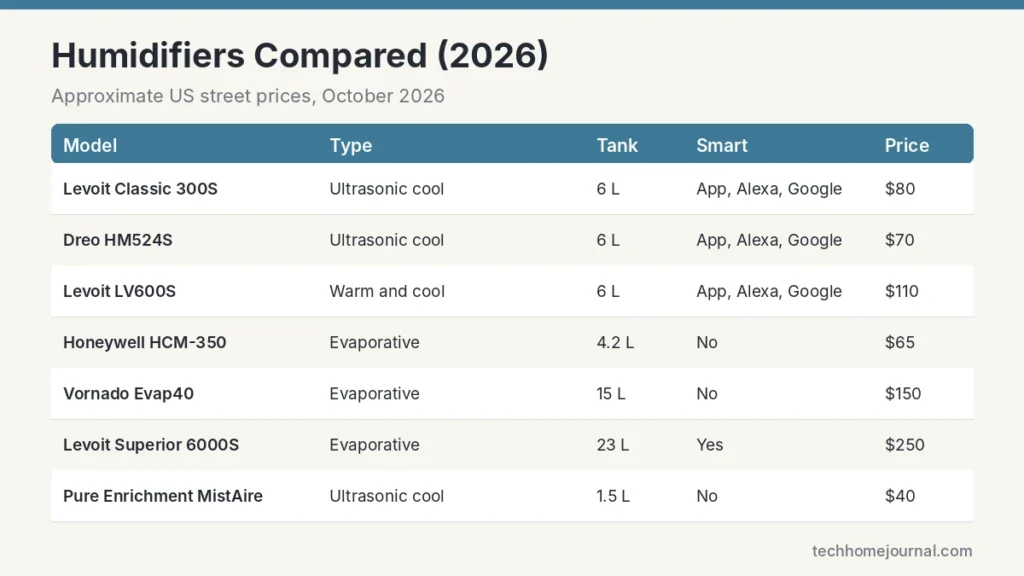
| Model | Type | Tank | Coverage | Smart | Approx. price |
|---|---|---|---|---|---|
| Levoit Classic 300S | Ultrasonic cool mist | 6 L | ~500 sq ft | App, Alexa, Google | $80 |
| Dreo HM524S | Ultrasonic cool mist | 6 L | ~550 sq ft | App, Alexa, Google | $70 |
| Levoit LV600S | Ultrasonic warm and cool | 6 L | ~750 sq ft | App, Alexa, Google | $110 |
| Honeywell HCM-350 | Evaporative | ~4.2 L | 500 to 800 sq ft | No | $65 |
| Vornado Evap40 | Evaporative | 15 L | ~1,000 sq ft | No | $150 |
| Levoit Superior 6000S | Evaporative | 23 L | ~3,000 sq ft | Yes | $250 |
| Pure Enrichment MistAire | Ultrasonic cool mist | 1.5 L | ~250 sq ft | No | $40 |
| Crane Drop 4-in-1 | Ultrasonic cool mist | 3.8 L | ~500 sq ft | No | $55 |
Types of Humidifiers
Ultrasonic cool mist
A vibrating plate turns water into a fine, cool mist. They’re quiet, efficient and popular. The downside is that minerals in tap water can come out as fine white dust on furniture, so distilled or demineralised water works best.
Evaporative
A fan blows air through a wet wick filter, and water evaporates naturally. Evaporative humidifiers can’t over-humidify easily, because evaporation slows as the air gets moister, and they don’t create white dust. They’re a little louder because of the fan, and wicks need replacing.
Warm mist
Water is heated before it’s released. Warm mist can feel comforting in winter and boiling helps reduce some germs, but these models use more electricity and the hot water is a burn risk around children and pets.
Whole-house humidifiers
These connect to your heating and ventilation system and humidify every room. They’re installed by an HVAC professional and controlled by a humidistat or a compatible smart thermostat.
The Best Humidifiers in Detail
1. Levoit Classic 300S: best overall smart humidifier
Specs: 6-litre tank, ultrasonic cool mist, about 500 sq ft coverage, built-in humidity sensor, VeSync app, Alexa and Google Home support.
The Levoit Classic 300S is easy to fill from the top, runs quietly and keeps humidity at your chosen level using its own sensor. The app shows the current humidity and lets you set schedules, so it can run overnight in the bedroom and switch off when you leave for work.
- Pros: large tank, top fill, auto mode, smart controls at a fair price.
- Cons: ultrasonic models can leave white dust with hard tap water.
2. Dreo HM524S: best value smart pick
Specs: 6-litre tank, ultrasonic cool mist, about 550 sq ft coverage, humidity sensor, app and voice control.
The HM524S offers similar features to the Levoit for a little less money. If you don’t need app control, Dreo also sells a non-smart version with the same tank.
- Pros: low price, big tank, smart features.
- Cons: app is less mature than Levoit’s VeSync.
3. Levoit LV600S: best warm and cool mist
Specs: 6-litre tank, warm or cool mist, about 750 sq ft coverage, auto mode, app and voice control.
The LV600S lets you choose warm mist on cold nights and cool mist the rest of the time. It’s a good fit for larger living rooms and open-plan spaces. Remember that warm mist uses more power and the steam outlet gets hot.
- Pros: warm or cool mist, large coverage, smart auto mode.
- Cons: warm mode uses more electricity, keep away from children.
4. Honeywell HCM-350: best evaporative pick
Specs: evaporative wick design, about 1.1-gallon tank, UV water treatment, quiet fan settings.
The HCM-350 is a long-time favourite because it’s simple and self-regulating. No white dust, no complicated app, just reliable humidity. Replace the wick filter regularly for the best performance.
- Pros: no white dust, hard to over-humidify, easy to clean.
- Cons: fan noise, ongoing wick cost, no smart features.
5. Vornado Evap40: best evaporative for larger rooms
Specs: evaporative, large tank around 4 gallons, about 1,000 sq ft coverage, automatic humidity control.
The Evap40 suits big living rooms and open-plan spaces where a small ultrasonic model struggles. The large tank means less refilling.
- Pros: big coverage, large tank, no white dust.
- Cons: bulky, louder on high, no app.
6. Levoit Superior 6000S: best for large homes
Specs: evaporative, around 6-gallon tank, coverage up to about 3,000 sq ft, smart controls.
This floor-standing model can humidify a whole floor of an open-plan home. It’s expensive and large, but cheaper and simpler than a whole-house system.
- Pros: huge coverage, smart controls, long runtime.
- Cons: large, higher price.
7. Pure Enrichment MistAire: best budget bedroom pick
Specs: 1.5-litre tank, ultrasonic cool mist, about 250 sq ft coverage, optional nightlight.
A small, quiet and cheap humidifier for a bedroom or home office. The tank needs refilling more often, but it’s ideal for one room.
- Pros: very affordable, compact, quiet.
- Cons: small tank, no humidity sensor.
What Is the Ideal Indoor Humidity?
The U.S. Environmental Protection Agency recommends keeping indoor relative humidity between about 30% and 50%. Below that, air feels dry and static builds up. Above about 60%, mould, dust mites and condensation become a problem. The EPA’s guide to mold and moisture explains why controlling humidity matters.
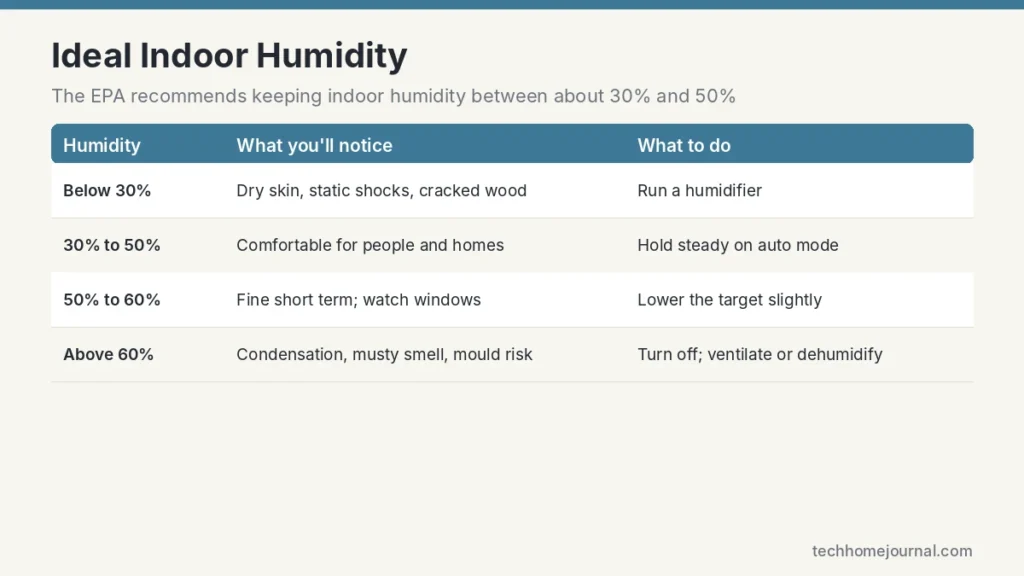
| Humidity | What you’ll notice |
|---|---|
| Below 30% | Dry skin and eyes, static shocks, cracked wood |
| 30% to 50% | Comfortable for most people and homes |
| 50% to 60% | Fine short term; watch for condensation |
| Above 60% | Condensation, musty smells, higher mould risk |
A cheap digital hygrometer, or a smart sensor, tells you where you are. Many smart thermostats also show indoor humidity.
Smart Humidifiers and Automation
A smart humidifier connects to Wi-Fi so you can control it from your phone and voice assistant. The useful features are:
- Built-in humidistat and auto mode: the humidifier holds a target, such as 45%, and turns itself up or down.
- Schedules: run in the bedroom overnight and in the living room during the evening.
- Low-water alerts: get a phone notification before the tank runs dry.
- Humidity history: see how humidity changes through the day and season.
- Voice control: “Alexa, set the humidifier to 45%”. Our guide to the best smart speakers covers the platforms.
You can also automate a basic humidifier. Pair a smart humidity sensor with a smart plug so the plug switches on below 35% and off above 45%. This works only with humidifiers that start running when power is restored, so check yours before relying on it.
A smart thermostat with a humidity reading, or one that controls a whole-house humidifier, ties humidity into your heating schedule.
How to Size a Humidifier
| Space | Coverage needed | Typical tank |
|---|---|---|
| Small bedroom or nursery | Up to 300 sq ft | 1.5 to 4 L |
| Main bedroom or office | 300 to 500 sq ft | 4 to 6 L |
| Living room | 500 to 800 sq ft | 6 L+ or evaporative |
| Open-plan floor | 1,000+ sq ft | Large evaporative console |
Ceiling height, how leaky your home is and outdoor weather all affect results. Older homes with draughts need a larger humidifier than modern, well-sealed ones. Keeping doors closed while the humidifier runs helps it reach your target faster and use less water.
How to Choose the Right Humidifier
- Pick the type. Ultrasonic for quiet and efficiency, evaporative for no white dust, warm mist for comfort in cold rooms.
- Match the room size using the table above.
- Look for a humidistat. Auto mode stops you over-humidifying.
- Check how easy it is to fill and clean. Top-fill tanks and wide openings make daily use easier.
- Consider noise. For bedrooms, choose a model with a quiet or sleep mode and a display that can be turned off.
- Decide on smart features. They’re worth it if you want schedules, alerts and voice control.
Where to Place a Humidifier
- Put it on a raised, water-safe surface, at least 60 cm (2 ft) off the floor where possible.
- Keep it at least 1 m (3 ft) from walls, beds and wooden furniture so mist doesn’t soak surfaces.
- Don’t place it next to electronics, books or houseplants that dislike wet leaves.
- Avoid windows in winter, where extra moisture leads to condensation.
- In a Scandinavian-style room with lots of solid wood, a humidifier in the 40% to 45% range helps protect floors and furniture from cracking, but don’t point the mist at them.
Houseplants also benefit from slightly higher humidity. Grouping plants near a humidifier, without pointing mist straight at them, keeps leaves healthier through winter.
Cleaning, Water and Maintenance
A dirty humidifier can spread bacteria and mould into the air, so cleaning matters more than with most appliances.
- Daily: empty and refill with fresh water. Don’t let water sit for days.
- Every few days: rinse the tank and dry it.
- Weekly: clean with white vinegar or the maker’s cleaning solution to remove scale, then rinse well.
- Water: use distilled or demineralised water in ultrasonic humidifiers to avoid white dust.
- Filters and wicks: replace evaporative wicks as recommended, usually every one to three months during heavy use.
- End of season: clean and dry completely before storing.
Regular cleaning prevents bacteria and mould from growing in the tank. Always follow the manual for your model, since some makers recommend their own cleaning solutions.
Running Costs and Energy Use
| Type | Typical power | Ongoing costs |
|---|---|---|
| Ultrasonic cool mist | About 20 to 40 W | Distilled water if needed |
| Evaporative | About 20 to 60 W | Replacement wicks |
| Warm mist | About 200 to 400 W | Higher electricity use |
Ultrasonic and evaporative humidifiers are cheap to run. Warm mist costs noticeably more if used all day. To check your own use, try an energy monitoring smart plug.
Humidifier vs Dehumidifier vs Air Purifier
These three are often confused. A humidifier adds moisture to dry air. A dehumidifier removes moisture from damp air, useful in basements and humid summers. An air purifier filters particles like dust and pollen but doesn’t change humidity. Some devices, such as Dyson’s humidifying purifiers, combine purification and humidification, but they cost more than buying a good purifier and humidifier separately.
Humidifiers for Babies, Allergies and Colds
Nurseries
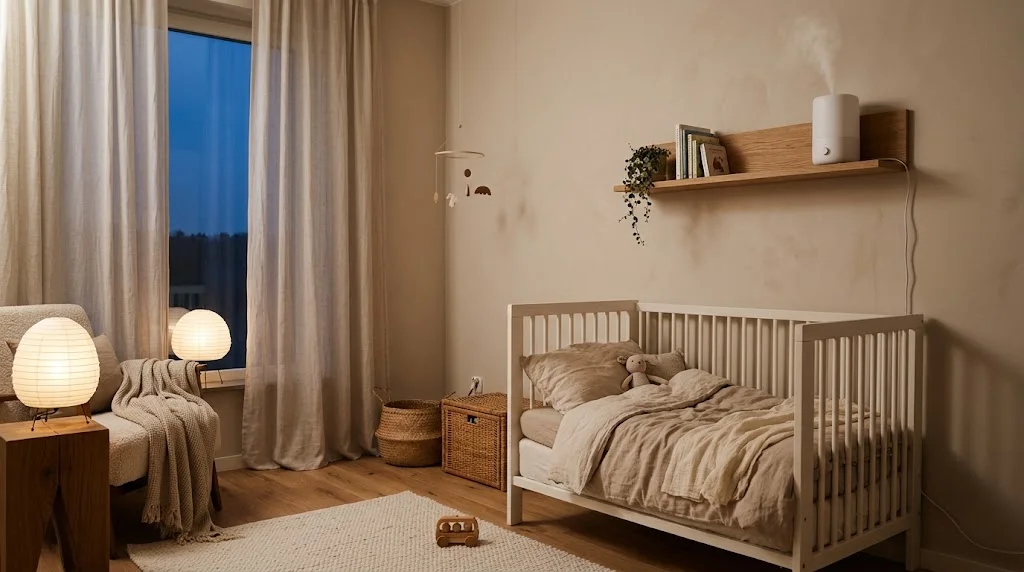
Cool mist is the safer choice in a baby’s room, because there’s no hot water or steam to cause burns. Choose a quiet model with a dimmable or switch-off light, place it out of reach, and keep humidity around 40% to 50%. Clean it more often than you would elsewhere in the home.
Allergies and asthma
Some moisture helps dry, irritated airways, but too much feeds dust mites and mould, two common allergy triggers. Use a humidifier with a humidistat, keep humidity below 50%, and pair it with an air purifier if dust or pollen are the main problem.
Colds and dry sinuses
A humidifier in the bedroom can make breathing feel easier during a cold. Run it overnight on auto mode, and empty and rinse the tank each morning.
Humidifier Troubleshooting
| Problem | Likely cause | Fix |
|---|---|---|
| White dust on furniture | Minerals in tap water (ultrasonic) | Use distilled water or an evaporative model |
| Windows dripping with condensation | Humidity too high | Lower the target to 40% or below in cold weather |
| Musty smell | Bacteria or mould in the tank | Clean with vinegar; replace wick if evaporative |
| Little or no mist | Scale on the transducer or a dry wick | Descale; replace the wick |
| Humidity never rises | Humidifier too small or room very draughty | Close doors; size up the humidifier |
Frequently Asked Questions
Is it OK to run a humidifier all night?
Yes, if it has a humidistat or auto mode so humidity doesn’t climb too high. Clean it regularly and keep it a safe distance from the bed.
Which is better, cool mist or warm mist?
Both add the same moisture. Cool mist uses less energy and is safer around children. Warm mist can feel cosier in cold rooms but uses more electricity.
Why is there white dust around my humidifier?
Minerals in tap water are being released by an ultrasonic humidifier. Use distilled or demineralised water, or switch to an evaporative model.
Can a humidifier cause mould?
Yes, if humidity stays above about 60% or the humidifier isn’t cleaned. Keep humidity between 30% and 50% and clean the tank weekly.
Are smart humidifiers worth it?
They’re worth it for auto mode, low-water alerts and schedules, especially in bedrooms and nurseries. A basic model with a built-in humidistat is a good budget alternative.
Where should I put a humidifier in the bedroom?
On a stable, raised surface about 1 m (3 ft) or more from the bed, away from walls, windows and electronics.
Can I use essential oils in my humidifier?
Only if the manual says so. Many humidifiers have a separate aroma tray. Oils in the main tank can damage plastic and parts.
How long does a humidifier tank last?
It depends on tank size and output. A 6-litre ultrasonic model on a medium setting often runs through a night and much of the next day, while a 1.5-litre model may need refilling every night. Auto mode stretches runtime because the humidifier slows down once the room reaches its target.
Do I need a humidifier if I have a smart thermostat?
A smart thermostat can show indoor humidity, but most can’t add moisture on their own. Some can control a whole-house humidifier if one is installed with your heating system.
Final Verdict
For most bedrooms and living rooms, the Levoit Classic 300S is the best all-round smart humidifier, with the Dreo HM524S a close, cheaper alternative. Choose the Levoit LV600S if you want warm mist on cold nights, or an evaporative model like the Honeywell HCM-350 or Vornado Evap40 if white dust and over-humidifying worry you.
Whatever you buy, keep humidity between 30% and 50%, clean the tank every week and use the right water. Do that and your home will feel more comfortable all winter, and your wooden floors and furniture will thank you.