

A smart thermostat is one of the few smart home upgrades that can pay for itself. The right model learns when you’re home, trims heating and cooling when you’re not, and lets you fix the temperature from your phone or with your voice. The wrong one sits on the wall unable to power itself, or doesn’t work with the assistant you already use.
This guide was updated for October 2026. We compared the current lineups from Google Nest, ecobee, Amazon and Sensi using manufacturer specs and list prices, then ranked each model on two things that matter most: how much energy it can help you save and how well it fits your HVAC system and smart home. Prices below are approximate list prices, so check current deals before buying.
Table of Contents
- Quick Picks: Best Smart Thermostats 2026
- Best Smart Thermostats Compared
- The 7 Best Smart Thermostats, Ranked
- How to Choose the Right Smart Thermostat
- How Much Can a Smart Thermostat Save?
- What’s Changed in 2026
- Frequently Asked Questions
- Final Verdict
Quick Picks: Best Smart Thermostats 2026
- Best overall: Google Nest Learning Thermostat (4th Gen). Auto-learning schedule, a room sensor in the box, Matter support and the highest savings claim (up to 31%).
- Best premium: ecobee Smart Thermostat Premium. Radar occupancy sensing, an air quality monitor, a SmartSensor and Alexa or Siri built in.
- Best mid-range: ecobee Smart Thermostat Enhanced. Most of the Premium’s savings tech for $60 less.
- Best value: ecobee Smart Thermostat Essential. Apple Home, Alexa and Google support at $139.99.
- Best budget for Google homes: Google Nest Thermostat. Simple, slim and often on sale under $100.
- Cheapest for Alexa users: Amazon Smart Thermostat at $79.99.
- Best touchscreen: Sensi Touch 2. A large color screen, no subscription and a 3-year warranty.
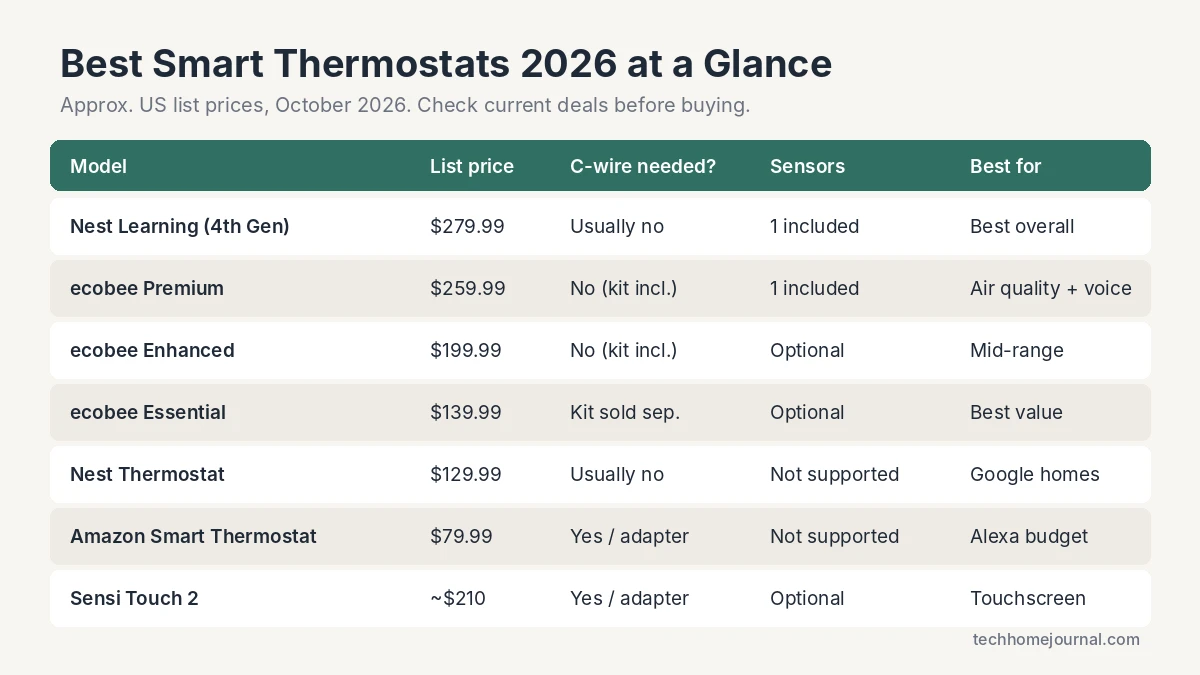
Best Smart Thermostats Compared
| Model | List price (approx.) | Savings claim | C-wire | Works with |
|---|---|---|---|---|
| Nest Learning Thermostat (4th Gen) | $279.99 | Up to 31% | Usually not needed | Google Home, Matter (Alexa, Apple Home, SmartThings) |
| ecobee Smart Thermostat Premium | $259.99 | Up to 26% | Power kit included | Apple Home, Alexa, Google, SmartThings |
| ecobee Smart Thermostat Enhanced | $199.99 | Up to 26% | Power kit included | Apple Home, Alexa, Google, SmartThings |
| ecobee Smart Thermostat Essential | $139.99 | Up to 23% | Kit sold separately | Apple Home, Alexa, Google, SmartThings |
| Google Nest Thermostat | $129.99 | Up to 31% (Nest claim) | Usually not needed | Google Home, Alexa |
| Amazon Smart Thermostat | $79.99 | ENERGY STAR certified | Required (adapter available) | Alexa |
| Sensi Touch 2 | $209.99 | About 23% | Required (adapter available) | Alexa, Google, SmartThings |
The 7 Best Smart Thermostats, Ranked
1. Google Nest Learning Thermostat (4th Gen): Best Overall
Specs: $279.99 list | 2.7-inch borderless display | Nest Temperature Sensor (2nd Gen) included, up to 6 more supported | Matter certified | Up to 31% savings claim | ENERGY STAR certified
The fourth-generation Nest Learning Thermostat is still the easiest way to get real savings without thinking about it. It builds a schedule from the adjustments you make in the first week, then keeps fine-tuning it with Smart Schedule and Adaptive Eco. Google claims savings of up to 31% on heating and cooling, the highest figure of any thermostat here.
Two upgrades make this generation worth the price. A temperature sensor now ships in the box, so you can balance a cold bedroom or a sunny living room without buying extras. And because it’s Matter certified, it works with Apple Home, Alexa and SmartThings, not just Google Home. Its Power Sharing feature means most homes don’t need a C-wire. Heat pumps and zoned systems may still need the Nest Power Connector.
Pros: true auto-learning, sensor included, Matter support, premium design in three finishes.
Cons: most expensive Nest, set-up and control now live in the Google Home app, which some longtime Nest users dislike.
2. ecobee Smart Thermostat Premium: Best Premium Pick
Specs: $259.99 list | Radar occupancy sensor | Indoor air quality monitor | SmartSensor included | Alexa or Siri built in | Up to 26% savings claim
The ecobee Smart Thermostat Premium is the most feature-packed thermostat you can buy in 2026. Built-in radar notices when someone walks into the room, and the included SmartSensor tells it which rooms are occupied, so it heats and cools where people actually are. It also monitors indoor air quality and can nudge you to ventilate when levels climb.
It doubles as a smart speaker with Alexa or Siri built in, and it streams Spotify or Bluetooth audio. If you use Apple devices, it’s one of the best choices available, with native Apple Home support and Apple Watch control. ecobee includes a Power Extender Kit for homes without a C-wire.
Pros: best room-by-room comfort, air quality monitoring, excellent Apple Home support.
Cons: pricey, and the speaker features duplicate what many homes already have.
3. ecobee Smart Thermostat Enhanced: Best Mid-Range Pick
Specs: $199.99 list | Radar occupancy sensor | SmartSensor compatible (sold separately) | Up to 26% savings claim | ENERGY STAR certified
The Enhanced keeps the Premium’s savings tech (radar occupancy and the same up-to-26% claim) but drops the air quality monitor, speaker and included sensor. For most people that’s the right trade. You still get Apple Home, Alexa, Google and SmartThings support, and you can add SmartSensors later for rooms that run hot or cold.
Pros: same savings claim as Premium for $60 less, broad compatibility.
Cons: no sensor in the box.
4. ecobee Smart Thermostat Essential: Best Value
Specs: $139.99 list | Color touchscreen | SmartSensor compatible | Up to 23% savings claim | Power Extender Kit sold separately
The Essential is ecobee’s entry model and the best value for anyone who wants Apple Home support without paying flagship prices. Scheduling, remote control and eco+ savings features are all here. It skips the radar occupancy sensor, so it relies more on your schedule and phone location. If you need a budget pick that also works with Apple, see our HomeKit thermostat guide.
Pros: low price, works with every major ecosystem.
Cons: no occupancy sensor, C-wire kit costs extra.
5. Google Nest Thermostat: Best Budget Pick for Google Homes
Specs: $129.99 list (often $99.99) | Mirrored display with touch strip | Works with about 85% of systems | No remote sensor support | Savings Finder and HVAC alerts
The Nest Thermostat is the simple, affordable Nest. It doesn’t auto-learn like the Learning model, but it does lower the temperature when everyone leaves, suggests schedule tweaks through Savings Finder and warns you about possible HVAC problems. It doesn’t support temperature sensors, so it’s best for smaller homes or apartments with even temperatures. Torn between brands? Our Nest vs ecobee comparison goes deeper.
Pros: frequently on sale, clean design, easy install.
Cons: no room sensors, heat pumps may need a C-wire or Power Connector.
6. Amazon Smart Thermostat: Cheapest for Alexa Users
Specs: $79.99 list | Built with Honeywell Home technology | Alexa app control | ENERGY STAR certified | C-wire required (adapter bundle available)
If your home runs on Echo speakers, the Amazon Smart Thermostat is the cheapest way to get a certified smart thermostat. Set-up and control happen in the Alexa app, and Alexa Hunches can adjust the temperature when you leave or go to bed. It’s basic, with no learning and no sensors, and it needs a C-wire. Still, at this price many utility rebates can cover most of the cost. Alexa homes with bigger budgets should check our best thermostats for Alexa.
Pros: very low price, simple Alexa integration.
Cons: Alexa only, C-wire required, no room sensors.
7. Sensi Touch 2: Best Touchscreen Thermostat
Specs: $209.99 list (often around $140) | 4.3-inch color touchscreen | Sensi room sensors optional | About 23% savings claim | 3-year warranty | C-wire required
The Sensi Touch 2 from Copeland suits people who still like to control the thermostat on the wall. The bright touchscreen is easy for every family member to use, and the slim design fits a standard thermostat footprint, so you usually don’t need to patch paint. It works with Alexa, Google Assistant and SmartThings, though not Apple Home or Matter. There’s no subscription, and HVAC alerts and runtime reports are free.
Pros: great on-wall screen, no subscription, long warranty.
Cons: needs a C-wire, no Apple Home support, sensors cost extra.
How to Choose the Right Smart Thermostat
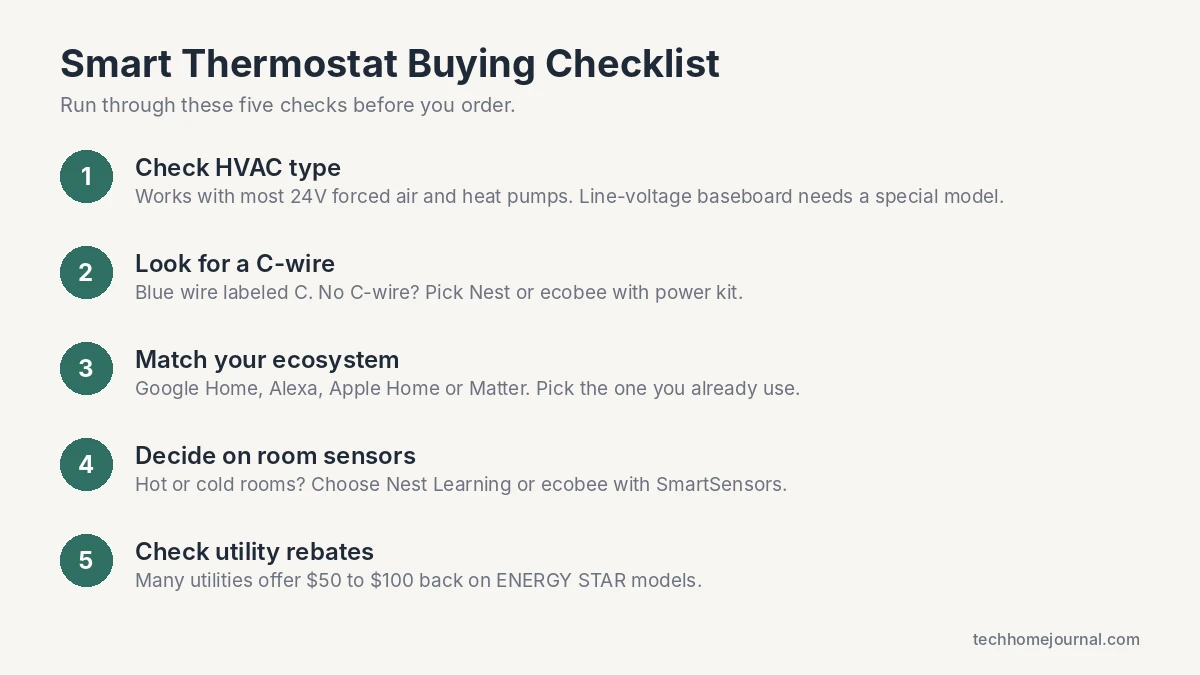
1. Check your HVAC system first
Every model here works with common 24-volt systems: gas or electric furnaces, central air and most heat pumps. Line-voltage systems such as electric baseboard heaters need a dedicated line-voltage thermostat. Before buying, take a photo of your current thermostat’s wiring and run it through the manufacturer’s compatibility checker.
2. Look for a C-wire
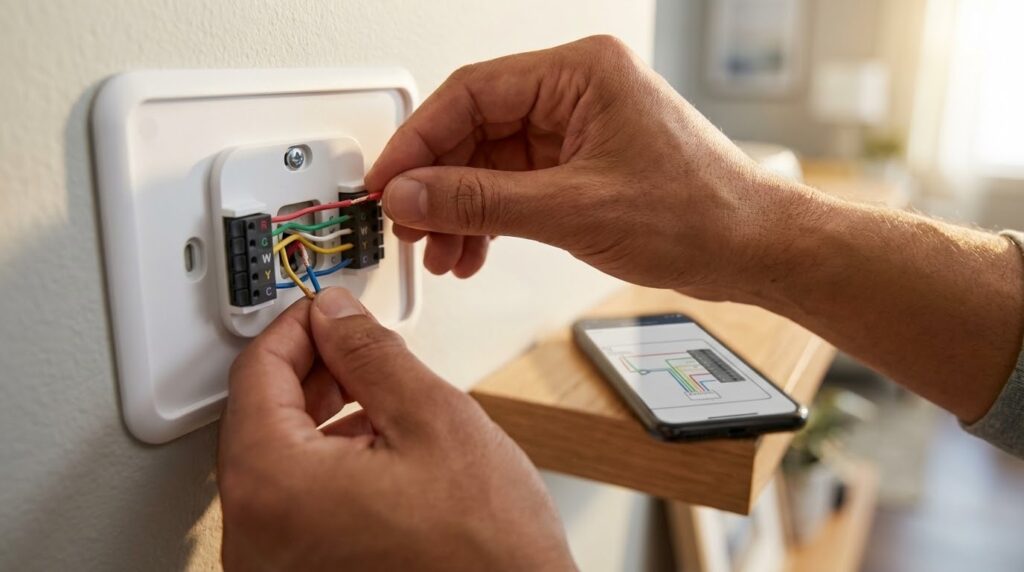
The C (common) wire gives a smart thermostat steady power. Nest models can usually run without one, and ecobee Premium and Enhanced include a Power Extender Kit. Amazon and Sensi need a C-wire or an adapter. If you don’t have one, our no C-wire thermostat guide covers your options.
3. Match your smart home platform
Pick a thermostat that works with the assistant you already use. Apple households should lean toward ecobee or the Matter-certified Nest Learning Thermostat. Alexa homes have the widest choice. Google homes get the smoothest experience with Nest.
4. Decide if you need room sensors
If your living room is warm while the bedrooms are cold, a sensor makes a bigger difference than any other feature. The Nest Learning Thermostat and ecobee Premium include one, and ecobee and Sensi let you add more later. In an open-plan Scandinavian-style home with even temperatures, you can usually skip them.
5. Check rebates and installation
Many utilities offer rebates on ENERGY STAR certified thermostats, and some will cover most of the cost of budget models. Most installs take 30 to 60 minutes with a screwdriver. Our smart thermostat installation guide walks you through it step by step. Shopping on a tight budget? See our best budget smart thermostats.
How Much Can a Smart Thermostat Save?
Brand claims are “up to” numbers. Google says Nest thermostats can save up to 31% on heating and cooling, ecobee claims up to 26% for its radar models and 23% for the Essential, and Sensi claims about 23%. Those figures compare against holding the temperature steady all day, so real savings depend on your climate, home and habits. The ENERGY STAR smart thermostat program only certifies models that show savings in real-world field data, and puts the typical household’s heating and cooling bill at more than $900 a year.
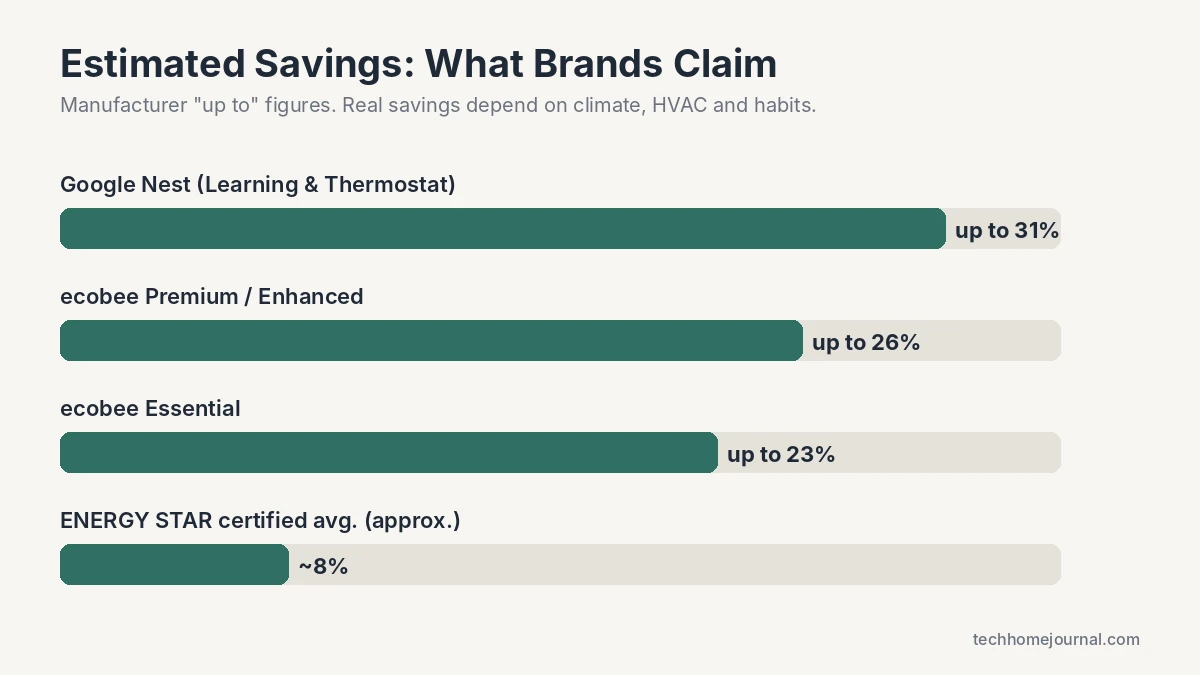
A realistic target for most homes is 8% to 15%, or roughly $70 to $140 a year on a $900 bill. You’ll save the most with features that cut runtime when nobody is home: auto-away, geofencing and occupancy sensing. For more ways to cut costs, read our guide to smart thermostat energy savings. To see exactly where your power goes, pair your thermostat with a home energy monitor.
What’s Changed in 2026
- Honeywell Home T9 with sensor is discontinued. Resideo lists the T9 with Sensor as no longer available, so we’ve dropped Honeywell from our top picks. Leftover stock can still be a good deal if you find it.
- Matter matters more. The Nest Learning Thermostat’s Matter certification means one thermostat can now work across Google, Apple, Amazon and Samsung platforms.
- Room sensing is becoming standard. Nest now includes a sensor with its flagship, and ecobee builds radar occupancy into its mid-range model.
- Prices are dropping. The Nest Learning Thermostat and Nest Thermostat are regularly $40 and $30 off, so check for deals before paying full price.
Want to know what a new thermostat could save you? Try our free smart thermostat savings calculator, or plan a bigger upgrade with the smart home cost calculator.
Frequently Asked Questions
What is the best smart thermostat in 2026?
For most homes, it’s the Google Nest Learning Thermostat (4th Gen). It learns your schedule, includes a room sensor and works with every major platform through Matter. Apple users who want room-by-room comfort should consider the ecobee Smart Thermostat Premium or Enhanced.
Which smart thermostat saves the most energy?
Google makes the highest claim (up to 31%), followed by ecobee’s radar models (up to 26%). In practice, any ENERGY STAR certified thermostat with auto-away or occupancy sensing will deliver similar savings if you actually use those features.
Do I need a C-wire for a smart thermostat?
Not always. Nest thermostats usually work without one, and ecobee includes a power kit with its Premium and Enhanced models. Amazon and Sensi thermostats need a C-wire or an adapter.
Which smart thermostat works with Apple HomeKit?
All three ecobee models support Apple Home natively, and the Nest Learning Thermostat (4th Gen) works with Apple Home through Matter. The Nest Thermostat, Amazon Smart Thermostat and Sensi Touch 2 do not support Apple Home.
Do smart thermostats need a subscription?
No. Every thermostat in this guide works without a monthly fee. Scheduling, remote control and energy reports are all free.
Is a smart thermostat worth it in 2026?
For most homes with central heating or cooling, yes. Prices start around $80, many utilities offer rebates, and typical savings of $70 to $140 a year mean most models pay for themselves in one to three years.
Final Verdict
The Google Nest Learning Thermostat (4th Gen) is the best smart thermostat for most homes in 2026. It has the strongest savings claim, a sensor in the box and Matter support. If you want room-by-room comfort and Apple Home support, pick the ecobee Smart Thermostat Enhanced, or step up to the Premium for air quality monitoring. On a budget, the ecobee Essential, Nest Thermostat and Amazon Smart Thermostat all deliver the basics for well under $150. Whichever you choose, check your wiring and your utility’s rebates first.



