
An espresso machine turns your kitchen into a small café, but the choice can be overwhelming. Some machines grind, dose and tamp for you. Others give you a steam wand and expect you to learn. A few now connect to an app, save recipes and even start brewing from your phone.
This guide explains the main types of espresso machine, compares popular models from Breville, De’Longhi, Gaggia and others, and helps you pick the right one for your budget, your counter space and how hands-on you want to be. Since Tech Home Journal is about the connected home, we also look at app-connected machines, smart plugs, energy use and how an espresso machine fits into a calm, uncluttered Scandinavian-style kitchen.
Table of Contents
- Quick Picks
- Espresso Machine Comparison Table
- Types of Espresso Machines
- The Best Espresso Machines in Detail
- Smart and App-Connected Espresso Machines
- Features That Actually Matter
- How to Choose the Right Espresso Machine
- Running Costs and Energy Use
- Cleaning and Maintenance
- Tips for Better Espresso at Home
- Espresso Machine vs Other Coffee Makers
- Frequently Asked Questions
- Final Verdict
Quick Picks
- Best for most beginners: Breville Bambino Plus: heats in seconds and textures milk automatically.
- Best all-in-one with grinder: Breville Barista Express Impress: built-in grinder and assisted tamping.
- Best budget pick: De’Longhi Dedica: slim, affordable and fine for milk drinks.
- Best for learning the craft: Gaggia Classic Pro: commercial-style 58 mm portafilter and a real steam wand.
- Best mid-range automatic: De’Longhi La Specialista Arte: built-in grinder and tamping station at a lower price.
- Best high-end automation: Breville Oracle range: grinds, doses, tamps and textures milk for you.
- Best for zero effort: Nespresso Vertuo: capsules, one button, no mess.
Espresso Machine Comparison Table
Prices are approximate US street prices in 2026 and change often, so check current deals before you buy.
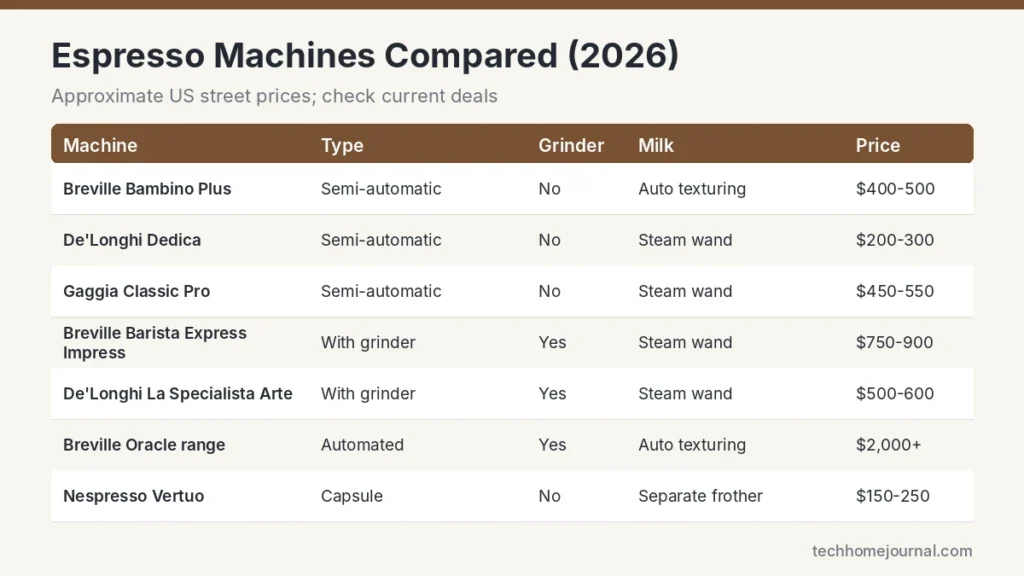
| Machine | Type | Grinder | Milk | Approx. price |
|---|---|---|---|---|
| Breville Bambino Plus | Semi-automatic | No | Automatic milk texturing | $400 to $500 |
| De’Longhi Dedica | Semi-automatic | No | Manual steam wand | $200 to $300 |
| Gaggia Classic Pro | Semi-automatic | No | Manual steam wand | $450 to $550 |
| Breville Barista Express Impress | Semi-automatic with grinder | Yes | Manual steam wand | $750 to $900 |
| De’Longhi La Specialista Arte | Semi-automatic with grinder | Yes | Manual steam wand | $500 to $600 |
| Breville Oracle range | Automated semi-automatic | Yes | Automatic milk texturing | $2,000+ |
| Nespresso Vertuo | Capsule | No | Separate frother | $150 to $250 |
Types of Espresso Machines
Semi-automatic machines
You grind, dose and tamp the coffee, then press a button to start and stop the shot. Most home machines fall here. They give you control and great coffee once you learn the basics.
Semi-automatic with a built-in grinder
These “all-in-one” machines include a grinder, so you only need one appliance on the counter. They’re popular with beginners because grinding fresh beans is the biggest single step towards good espresso.
Super-automatic (bean-to-cup) machines
Press a button and the machine grinds, brews and often froths milk for you. They’re convenient for busy households, but you trade some flavour control and they need regular internal cleaning.
Capsule machines
Nespresso and similar machines use pre-filled pods. They’re quick and tidy, but cost more per cup and offer less control. They’re a good fit if you mostly want a fast coffee on the way out the door.
Manual lever machines
Lever machines use your own arm to create pressure. They’re beautiful and rewarding, but they take practice and aren’t the best first machine for most people.
The Best Espresso Machines in Detail
1. Breville Bambino Plus: best for most beginners
Specs: 54 mm portafilter, ThermoJet heating (ready in about three seconds), automatic milk texturing with temperature and foam settings, about 7.7 inches wide.
The Breville Bambino Plus is small, fast and forgiving. It’s ready to brew almost as soon as you switch it on, and the automatic steam wand makes good latte milk without practice. You’ll need a separate grinder, but pairing it with a decent burr grinder gives café-quality drinks in a very small footprint.
- Pros: very quick heat-up, hands-free milk, compact, easy to clean.
- Cons: needs a separate grinder, smaller 54 mm basket, limited control for advanced users.
2. Breville Barista Express Impress: best all-in-one
Specs: built-in conical burr grinder with 25 settings, assisted tamping, PID temperature control, 54 mm portafilter, manual steam wand.
The Impress system takes the guesswork out of dosing and tamping. It weighs the dose by feel, tamps evenly, and suggests adjustments for the next shot. It’s an excellent first “serious” machine for people who want to grind fresh without buying separate gear.
- Pros: grinder included, assisted tamping, consistent results, good value for an all-in-one.
- Cons: larger footprint, manual steam wand takes practice, built-in grinder is less flexible than a standalone one.
3. De’Longhi Dedica: best budget pick
Specs: slim body about 6 inches wide, thermoblock heating, manual steam wand, pressurised and non-pressurised baskets depending on version.
The Dedica is a sensible starter for small kitchens and budgets. It makes decent espresso and milk drinks, especially with pre-ground or freshly ground coffee. It won’t match the Gaggia or Breville models in the cup, but it’s a big step up from a pod machine for the price.
- Pros: very slim, affordable, simple to use.
- Cons: basic steam wand, less consistent shots, smaller portafilter.
4. Gaggia Classic Pro: best for learning the craft
Specs: commercial-style 58 mm portafilter, single boiler, manual commercial steam wand, three-way solenoid valve.
The Gaggia Classic Pro has been a favourite for years because it’s simple, durable and easy to repair. The 58 mm portafilter accepts standard accessories, and the steam wand makes proper latte art milk once you learn the technique. There’s a short wait when switching from brewing to steaming, and you’ll need a good grinder.
- Pros: built to last, standard 58 mm parts, strong steam, huge user community.
- Cons: learning curve, no built-in temperature control, needs a separate grinder.
5. De’Longhi La Specialista Arte: best mid-range all-in-one
Specs: built-in grinder with 8 settings, tamping station, fixed brew temperature, manual steam wand, 51 mm portafilter.
The Arte gives you a grinder and tamping help at a lower price than most Breville all-in-ones. It’s a good choice for people who mainly drink milk-based coffees and want a simple, guided workflow.
- Pros: built-in grinder and tamper, easy workflow, good value.
- Cons: fewer grind settings, smaller portafilter, less control over temperature.
6. Breville Oracle range: best high-end automation
Specs: automatic grinding, dosing and tamping, dual boilers with PID control, 58 mm portafilter, automatic milk texturing.
The Oracle machines combine café-style hardware with automation. You get the flavour of a dual-boiler machine without the barista skills. Newer models in the range add touchscreens and connectivity. They’re expensive and large, but for coffee-loving households they replace both a grinder and a café habit.
- Pros: excellent espresso with minimal effort, brew and steam at the same time, automatic milk.
- Cons: high price, heavy, takes a lot of counter space.
7. Nespresso Vertuo: best for zero effort
Specs: capsule system with barcode-read brewing, several cup sizes, fast heat-up, no steam wand.
If you want coffee in under a minute with no cleaning, a capsule machine is hard to beat. The trade-off is cost per cup and less authentic espresso. Pair it with a separate milk frother if you like lattes.
- Pros: fast, tidy, consistent.
- Cons: expensive capsules, not true espresso for purists, capsule waste.
Smart and App-Connected Espresso Machines
A growing number of espresso machines connect to an app. Features vary by brand, but commonly include:
- Saved drink recipes for each person in the household.
- Remote start or scheduled heat-up so the machine is ready when you walk into the kitchen.
- Maintenance alerts for descaling, filter changes and cleaning cycles.
- Firmware updates that add drinks or improve performance.
- Bean subscriptions linked to the machine on some brands.
Examples include high-end Breville models with Wi-Fi features, app-enabled De’Longhi bean-to-cup machines, and newer brands such as Terra Kaffe that build the app into the core experience. Connectivity is useful, but it shouldn’t be the reason you buy a machine. Coffee quality, ease of cleaning and build quality matter more over the years you’ll own it.
Can you use a smart plug with an espresso machine?
Sometimes. A smart plug can turn on a machine with a simple physical switch so it’s warm when you wake up. Check three things first: the machine must turn on when power is restored (many electronic machines stay off), the plug must be rated for the machine’s wattage (often 1,200 to 1,600 W), and you should never leave a machine running unattended for long periods. Our guide to what a smart plug is explains ratings, and an energy monitoring smart plug can show exactly how much power your machine uses.
Features That Actually Matter
- Temperature stability: PID control keeps water temperature steady, which means more consistent shots.
- Portafilter size: 58 mm is the commercial standard and accepts the widest range of accessories. 54 mm and 51 mm are fine for home use.
- Heating system: thermoblocks and thermojets heat quickly; boilers give more stable temperature and stronger steam. Dual boilers let you brew and steam at the same time.
- Steam wand: automatic wands are easy; manual wands give better latte art once you learn.
- Grinder: fresh grinding matters more than almost anything else. Built-in grinders save space; separate grinders give more control.
- Pressure: good espresso is made at about 9 bar at the coffee. A “15-bar” or “20-bar” pump rating is mostly marketing.
- Water tank and access: a large, easy-to-fill tank saves daily hassle.
How to Choose the Right Espresso Machine
- Decide how hands-on you want to be. If you want to learn, choose a semi-automatic. If you just want coffee, go super-automatic or capsule.
- Count your milk drinks. If you drink lattes and cappuccinos daily, prioritise a good steam wand or automatic milk system.
- Budget for a grinder. Without a built-in grinder, set aside money for a quality burr grinder. It makes a bigger difference than the machine itself.
- Measure your counter. Check width, depth and height under your wall cabinets, especially for machines with top-filled bean hoppers.
- Think about cleaning time. Daily rinsing and weekly backflushing are part of owning a semi-automatic. Super-automatics need regular cleaning cycles.
- Check parts and support. Popular brands with good spare part availability last longer.
Running Costs and Energy Use
Espresso machines use a burst of power while heating, typically 1,200 to 1,600 W, then much less once warm. Fast-heating thermojet machines use very little energy overall because they don’t sit warm for long. Boiler machines left on all morning use more.
| Cost item | Typical range |
|---|---|
| Fresh beans (home espresso) | Often well under café prices per cup |
| Capsules | Usually higher per cup than fresh beans |
| Water filters | Every 2 to 3 months on machines that use them |
| Descaler | Every 1 to 3 months depending on water hardness |
| Electricity | Small per cup; higher if the machine stays on all day |
Use the machine’s auto-off timer, and avoid leaving boiler machines warm for hours. For more ways to trim kitchen energy use, see our guide to lowering your electricity bill.
Cleaning and Maintenance
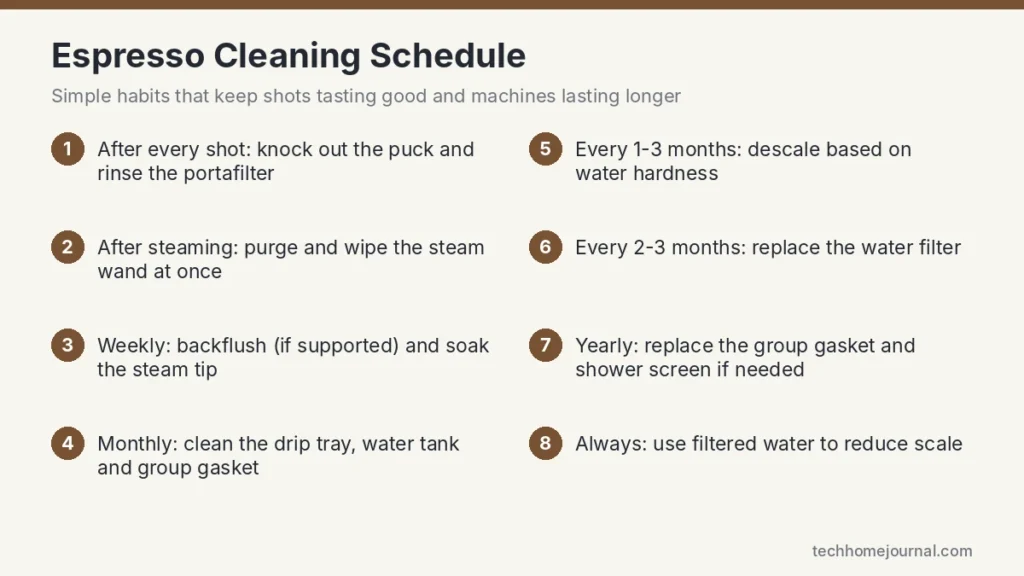
- After every use: knock out the puck, rinse the portafilter, purge and wipe the steam wand straight away.
- Weekly: backflush semi-automatic machines that support it, and soak the steam tip if milk has dried inside.
- Monthly: clean the drip tray and water tank, and wipe the group head gasket.
- Every 1 to 3 months: descale, depending on your water hardness. Breville also publishes model manuals on its support site. Our guide on how to descale a coffee maker explains safe methods.
- Yearly: replace the group head gasket and shower screen if shots start leaking or tasting uneven.
Hard water is the biggest enemy of espresso machines. Using a water filter or filtered water reduces scale and extends the machine’s life. The Specialty Coffee Association publishes coffee standards that home baristas can use as a reference.
Tips for Better Espresso at Home
- Use fresh beans roasted within the last few weeks.
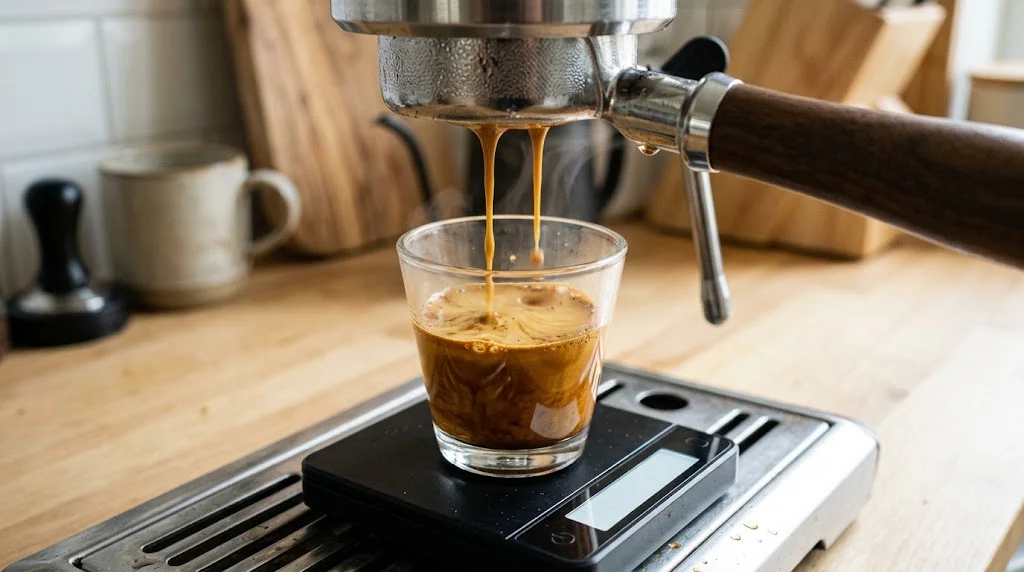
- Weigh your dose and your shot. A small scale makes results repeatable.
- Adjust grind first. If the shot runs too fast, grind finer; too slow, grind coarser.
- Aim for a starting ratio of about 1 part coffee to 2 parts liquid espresso in around 25 to 30 seconds, then adjust to taste.
- Preheat everything, including the cup and portafilter.
- Steam cold milk in a cold jug for better texture.
Fitting an espresso machine into a minimal kitchen
In a calm Scandinavian-style kitchen, the machine becomes a focal point. Brushed stainless steel or matte white finishes blend well with light wood and white worktops. Keep a small tray for the tamper, knock box and cups so the area stays tidy, and choose a spot near a socket and away from the hob so steam and heat don’t build up under the cabinets. If space is tight, our guide to small kitchen appliances for studio apartments has more compact ideas.
Espresso Machine vs Other Coffee Makers
| Option | Best for | Trade-off |
|---|---|---|
| Espresso machine | Lattes, cappuccinos, flat whites, strong short coffees | Higher cost and a learning curve |
| Drip coffee maker | Large mugs and pots for several people | No true espresso or steamed milk |
| Capsule machine | Speed and convenience | Higher cost per cup and capsule waste |
| Moka pot | Strong, espresso-style coffee on a budget | Not true espresso; no crema or milk steaming |
| AeroPress or French press | Simple manual brewing | Different flavour and body from espresso |
If you mostly drink black filter coffee, an espresso machine may be more than you need. If milk drinks are your daily habit, it usually pays for itself compared with café visits.
Frequently Asked Questions
What is the best espresso machine for beginners?
The Breville Bambino Plus is a strong choice because it heats quickly and textures milk automatically. If you want a grinder included, the Breville Barista Express Impress is easier to get right than most all-in-ones.
Do I need a separate grinder for espresso?
Yes, unless your machine has one built in. Espresso needs a fine, consistent grind that blade grinders and most pre-ground coffee can’t match.
Is a more expensive espresso machine worth it?
Up to a point. Moving from a budget machine to a mid-range one with stable temperature makes a clear difference. Beyond that, a better grinder often improves flavour more than a pricier machine.
How long do espresso machines last?
With regular descaling and cleaning, many semi-automatic machines last 5 to 10 years or more. Machines with easily available spare parts tend to last longest.
Can I use regular coffee in an espresso machine?
You can use any bean, but it must be ground fine for espresso. Medium to dark roasts are easier for beginners; light roasts need finer grinding and more care.
Are app-connected espresso machines worth it?
They’re convenient for saving recipes and maintenance reminders, but connectivity shouldn’t outweigh coffee quality, build and ease of cleaning.
How often should I descale my espresso machine?
Every one to three months for most homes, more often with hard water. Follow the maker’s instructions and use the recommended descaler.
Final Verdict
For most people starting out, the Breville Bambino Plus with a good grinder gives the best mix of speed, simplicity and coffee quality. If you’d rather have everything in one box, the Breville Barista Express Impress makes fresh-ground espresso easy to get right. Budget buyers will be happy with the De’Longhi Dedica, while those who want to learn the craft should look hard at the Gaggia Classic Pro.
Whichever you choose, invest in fresh beans, a proper grinder and a simple cleaning routine. Those three things matter more than any app or touchscreen, and they’ll turn your kitchen into the best coffee spot in the house.