The Best Fluffy Pancakes recipe you will fall in love with. Full of tips and tricks to help you make the best pancakes.

The average US household spends around $1,500 per year on electricity. What’s surprising is that roughly 35% of that goes to devices and lighting you could swap out in a single weekend. If you’re serious about how to lower electricity bill at home, the smartest move isn’t changing your habits – it’s changing your equipment.
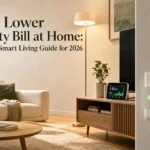
This guide focuses on the living room first, because it’s where most households burn the most standby and active energy. It’s also where Scandinavian design principles – clean lines, minimal clutter, intentional lighting – happen to align perfectly with energy efficiency. Less stuff running means less electricity wasted.
—
Table of Contents
- Know Where Your Living Room Energy Goes
- Smart Plugs and Power Strips: Your First Buy
- LED Lighting Upgrades That Actually Pay Off
- Smart Thermostats for Living Room Climate Control
- Energy-Efficient TVs and Entertainment Systems
- Scandinavian Decor Choices That Reduce Energy Use
- Making It All Work Together in 2026
- Frequently Asked Questions
—
Know Where Your Living Room Energy Goes
Before you buy anything, you need to know what’s actually costing you. In a typical living room, the energy breakdown looks like this: televisions and streaming devices account for roughly 20-25% of room usage, lighting takes another 15-20%, and standby power from idle electronics adds a sneaky 10% on top.
A device like the Sense Energy Monitor plugs into your electrical panel and maps every appliance in real time. Setup takes about 30 minutes. Within 48 hours, it shows you exactly which devices are drawing the most power – and the results are almost always surprising.
Most people assume heating and cooling dominate. But phantom load – the energy your TV, game console, and smart speaker draw when “off” – adds up to $100-$200 per year for a typical living room setup. That’s the first thing to fix.
—
Smart Plugs and Power Strips: Your First Buy
This is the lowest-cost, highest-impact starting point. A single smart plug costs $12-$25 and lets you cut power to any device on a schedule or via voice command. For a living room entertainment center, one smart power strip handles the whole setup.
The Kasa Smart Power Strip EP40 is worth naming here. It has 4 individually controlled outlets and 4 USB ports. Set it to cut power at midnight and you eliminate phantom load from your TV, soundbar, and streaming box in one move. Most users report saving $8-$15 per month from this change alone.
For Scandinavian-styled rooms, these plugs tuck behind furniture invisibly. No visual clutter, no compromises on the aesthetic. That matters when your design language is intentional and minimal.
> Pro tip: Put your router on a smart plug too, but set it to only cut power between 2 AM and 6 AM. You’ll save energy without noticing any disruption.
—
LED Lighting Upgrades That Actually Pay Off
Switching from incandescent to LED is old advice. The 2026 version of this upgrade is smarter. Tunable LED bulbs – ones that shift color temperature throughout the day – actually reduce how long you keep lights on, because they feel more natural and less fatiguing.
Philips Hue White Ambiance bulbs run $15-$20 each and use about 9 watts versus the 60-watt equivalent they replace. Over a year, a single bulb swap saves roughly $10-$12 in electricity. Replace 8 bulbs in a living room and you’re looking at $80-$100 saved annually.
The real efficiency gain comes from automation. Set bulbs to dim to 30% after 8 PM. Most people don’t notice the difference in brightness, but the energy draw drops by half. Pair them with a motion sensor – the Philips Hue Motion Sensor costs about $25 – and lights cut off automatically when the room is empty.
Scandinavian interiors already favor warm, low-level ambient lighting over harsh overhead floods. This design preference is genuinely energy-efficient. Lean into it.
—
Smart Thermostats for Living Room Climate Control
Heating and cooling account for about 48% of total home energy use according to the U.S. Department of Energy. The living room is often the hardest space to regulate because it’s the most-used room with the most variable occupancy.
A smart thermostat fixes this by learning your schedule and adjusting automatically. The Google Nest Learning Thermostat costs around $130 and typically cuts heating and cooling costs by 10-15% in the first year. That’s a payback period of 12-18 months for most homes.
The key feature to look for isn’t the thermostat itself – it’s room sensors. Nest and Ecobee both sell companion sensors for $30-$40 each that measure temperature in individual rooms. Place one in the living room and the system prioritizes that space during occupied hours. You stop heating empty bedrooms while you’re watching TV.
For a Scandinavian-designed home, the Nest and Ecobee both have minimal, wall-art-quality designs that don’t look out of place on a clean white wall.
—
Energy-Efficient TVs and Entertainment Systems
Your TV is probably the single biggest electricity draw in the living room. A 65-inch OLED TV from 2020 uses around 180 watts. A 2025-era equivalent uses closer to 110-130 watts, and the best models now carry ENERGY STAR certification with auto-brightness that drops consumption further in darker rooms.
The LG C4 OLED is a strong pick here. It uses roughly 120 watts at typical brightness, has a built-in energy dashboard, and auto-dims during credits or static scenes. Over 5 hours of daily use, that’s about $25-$35 per year less than an older equivalent.
Streaming devices matter too. A Google Chromecast with Google TV uses about 3 watts in active use. A PlayStation 5 uses 200 watts doing the same streaming task. If you’re watching Netflix, use the dedicated streaming stick. Save the console for gaming.
Soundbars are worth mentioning. A compact soundbar like the Sonos Ray uses 15-20 watts versus a full AV receiver setup pulling 80-100 watts. Same audio experience for casual listening, a fraction of the energy.
—
Scandinavian Decor Choices That Reduce Energy Use
This is the section most energy guides skip entirely. But design and energy use are directly connected, especially in the living room.
Scandinavian interiors use light-colored walls and furniture to maximize natural light. A room with white or soft gray walls reflects 80-90% of incoming daylight. A dark-walled room reflects 5-10%. That difference means you can keep artificial lighting off for 2-3 extra hours per day in winter. Over a year, that’s a measurable saving.
Natural materials like wool throws and wood flooring also play a role. Wool is a natural insulator. A 50×60 inch wool throw on a sofa doesn’t just look good – it keeps occupants warmer at lower thermostat settings. Dropping your thermostat by just 1°F saves about 1% on heating costs. Small shifts add up.
Large windows are a Scandinavian staple, and in 2026, pairing them with cellular shades is the smart move. Cellular shades – also called honeycomb blinds – trap air in their cells and reduce heat loss through glass by up to 40%. A set for a 6×4 foot window runs $80-$150 and pays back in one heating season.
> Pro tip: In winter, keep south-facing curtains open during daylight hours and close all window coverings after sunset. This passive solar gain can reduce heating load by 10-15% without any technology at all.
—
Making It All Work Together in 2026
Knowing how to lower electricity bill at home is one thing. Executing it without turning your living room into a tech lab is another. The best approach is layered: start with smart plugs and LED upgrades in week one (cost: $100-$200, savings: $15-$25 per month). Add a smart thermostat in month two. Upgrade your TV and entertainment setup when your current gear reaches end of life.
The Scandinavian angle here is actually a strategic advantage. A minimal, intentional room has fewer devices running, cleaner cable management, and less visual noise. It also has less phantom load. Design restraint and energy efficiency point in the same direction.
By the end of a full year with these changes, most living rooms see a $300-$500 reduction in annual electricity costs. That’s not a projection – it’s consistent with what Sense Energy Monitor users report after 12 months of optimized setups. The upfront investment across all these upgrades typically lands between $400-$700, meaning payback happens within 12-18 months.
If you want to go deeper, pairing these living room upgrades with a whole-home audit is the logical next step. Articles covering smart home energy dashboards and room-by-room insulation strategies can help you extend the same principles to every space in the house.
—
Frequently Asked Questions
What’s the single fastest way to reduce my electricity bill this week?
Install smart plugs on your entertainment center and set them to cut power overnight. This eliminates phantom load from your TV, streaming devices, and soundbar. Most households save $8-$15 per month from this one change, and the plugs cost $12-$25 each.
How much does a smart thermostat actually save?
Most users save 10-15% on heating and cooling costs in the first year. For a home spending $900 per year on climate control, that’s $90-$135 saved annually. Devices like the Google Nest Learning Thermostat pay for themselves within 12-18 months.
Do LED smart bulbs really make a difference compared to regular LEDs?
Regular LEDs already use 75-80% less energy than incandescent bulbs. Smart LEDs add automation – auto-dimming, scheduling, motion cutoff – which reduces run time by 30-40% on top of the base savings. The combination is meaningfully better than either upgrade alone.
Is a Scandinavian design style actually more energy-efficient?
Yes, in practical terms. Light-colored walls reflect more daylight, reducing artificial lighting needs. Minimal furniture means fewer devices and less standby power. Cellular shades on large windows cut heat loss by up to 40%. The aesthetic and the efficiency goals genuinely align.
How do I know which devices are costing me the most?
A whole-home energy monitor like the Sense Energy Monitor maps every appliance within 48 hours of installation. It costs around $299 but typically identifies savings that cover that cost within 6-9 months. It’s the most data-driven way to prioritize your upgrades.