
Most parents assume adding smart devices makes a home safer for kids. That assumption is worth questioning. A Z-Wave lock that auto-opens up on presence detection, a voice assistant that answers any question a six-year-old asks, or a smart plug without a PIN requirement can each introduce risks that a traditional home never had.
Knowing how to childproof smart home technology means going beyond outlet covers and cabinet latches. It means auditing every connected device, every automation, and every voice-enabled entry point your child can reach or trigger.
—
Table of Contents
- Why Smart Homes Create New Risks for Children
- Audit Your Devices Before You Configure Anything
- Securing Smart Locks and Access Control
- Voice Assistant Restrictions: Step-by-Step
- Smart Plugs, Outlets, and Electrical Safety
- Network Segmentation and Parental Controls
- Cameras, Privacy, and Child Safety
- Automations That Work Against You
- Building a Childproof Smart Home That Stays That Way
- Frequently Asked Questions
—
Why Smart Homes Create New Risks for Children
The average connected home in 2026 runs 22 smart devices. That number has nearly doubled since 2020, and the category of risk has shifted with it. A decade ago, childproofing was physical: cover the outlets, lock the cabinets, gate the stairs. Now the risks include digital access, unintended automations, and hardware that responds to any voice in the room.
Consider a scenario I have seen more than once: a parent sets up a smart speaker with a shopping feature enabled. A seven-year-old discovers that saying “add to cart” actually works. Within 20 minutes, $140 in toys are ordered and confirmed. That is not a hypothetical edge case. Amazon reported a spike in accidental child purchases every holiday season before rolling out voice purchase PINs in 2019 – and many households still have not enabled them.
The physical hazards are real too. Smart plugs without child lock modes allow kids to switch high-wattage devices on and off. Motorized blinds with accessible cords or controls pose entanglement risks. Robot vacuums can trap small objects or frighten toddlers. None of these risks are insurmountable. But you have to see them first.
—
Audit Your Devices Before You Configure Anything
Start here, not with a purchase. Pull up your router’s connected device list – in most Google Nest or Eero apps, this takes under 60 seconds – and count every device. Then ask three questions about each one:
Can a child physically interact with it? Can a child trigger it by voice? Does it control something dangerous (locks, heat, electricity, cameras)?
Any device that answers yes to two or more of those questions needs immediate attention. In my experience, a typical 4-bedroom home audit surfaces 6 to 9 devices that need reconfiguration before they are child-safe. That number surprises most parents.
Document what you find. A simple spreadsheet with device name, location, current settings, and risk level takes about 30 minutes to build and saves hours of troubleshooting later. This is the foundation of any serious smart home childproofing effort.
—
Securing Smart Locks and Access Control
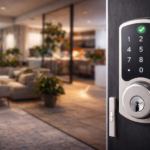
Smart locks are the highest-stakes device category in a child-accessible home. A Schlage Encode Plus or an August Wi-Fi Smart Lock both default to relatively open access settings out of the box. Without user codes assigned by age group or time window, any household member – including a curious eight-year-old – can open up a front door.
Here is what to configure on any smart lock immediately:
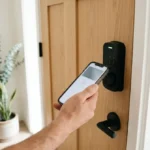
- Disable auto-open up based on phone proximity. Geofencing open up is convenient but it triggers whenever an adult’s phone approaches, and a child nearby can slip out behind them.
- Create a separate user code for each adult. Do not share a single household code. Individual codes let you see exactly who opened up the door and when.
- Set a curfew schedule. Most locks supporting Matter or Z-Wave allow time-restricted codes. A babysitter code that only works 3:00 PM to 9:00 PM is far safer than an always-active one.
- Enable lock activity notifications. A push alert within 5 seconds of any open up gives you real-time awareness.
- Cover or recess the keypad. At 36 to 42 inches off the ground, a standard keypad is reachable by most children over age 4. A recessed escutcheon or a keypad cover adds a physical barrier.
Set a 30-day reminder to review lock logs. Patterns in the data – repeated failed attempts, unusual open up times – show up faster than you expect.
—
Voice Assistant Restrictions: Step-by-Step
Voice assistants are the most underestimated childproofing gap in a smart home. An Amazon Echo or Google Nest Hub will respond to any voice, at any hour, with access to shopping, smart home controls, calendars, and sometimes door locks.
Follow these steps in order:
- Enable Voice Match (Google) or Voice Profiles (Alexa) so the assistant recognizes specific voices. Unrecognized voices get limited access.
- Turn on Kids Mode if your device supports it. Amazon’s Kids+ subscription ($4.99/month in 2026) restricts content, disables purchasing, and filters responses.
- Set a voice purchase PIN – a 4-digit code required before any order is placed. Do this even if you think your child would not try.
- Disable Drop-In and Announcements initiated by child-accessible devices. These features can let a child broadcast audio to every speaker in the house.
- Review routines that trigger on voice commands. A routine that says “Alexa, I’m leaving” and then opens up the door and disarms the alarm should not be triggerable by a 10-year-old.
- Set Do Not Disturb hours for devices in children’s bedrooms – typically 8:00 PM to 7:00 AM works well for school-age kids.
Run through this checklist every time you add a new voice-enabled device. Settings do not carry over automatically.
—
Smart Plugs, Outlets, and Electrical Safety
A smart plug without a child lock is just a regular outlet with an app. The app does not help if a child can push a physical button on the plug itself. Most TP-Link Kasa and Wemo plugs have a manual button on the body. That button bypasses every app restriction you have set.
> Pro tip: Look for smart plugs with recessed or lockable buttons, or place plugs behind furniture where the button is physically inaccessible. The Kasa EP25 has a button that requires a deliberate press-and-hold, which reduces accidental triggers.
For outlets themselves, use tamper-resistant (TR) receptacles. These are required by the National Electrical Code in new construction since 2008, but older homes often still have standard outlets. TR receptacles require simultaneous pressure on both slots to open – a child pressing a single object cannot insert it. Replacing 10 standard outlets costs roughly $60 in parts and an hour of work.
Smart plugs controlling high-wattage appliances – space heaters, blenders, coffee makers – should have automations that shut them off after 15 to 30 minutes of inactivity. That single rule prevents the most common appliance-related accidents.
—
Network Segmentation and Parental Controls
Putting your smart devices on a separate Wi-Fi network from your children’s tablets and laptops is one of the most effective and most overlooked childproofing moves available. A dedicated IoT VLAN (Virtual Local Area Network) means a compromised child device cannot communicate with your smart lock, thermostat, or security camera.
Most modern routers – Asus ROG and Netgear Orbi both support this natively – let you create a guest or IoT network in under 10 minutes. Assign all smart home devices to that network. Your kids’ devices stay on the primary network, which you then filter with a parental control DNS service like Circle or Bark.
Bark monitors for concerning content and sends parent alerts rather than blocking everything – a more nuanced approach that works better for children over 8. Circle offers per-device time limits down to 15-minute increments. Neither tool costs more than $99/year. Both are worth it.
—
Cameras, Privacy, and Child Safety
Indoor cameras are a double-edged category. They give parents visibility, but they also create a privacy record of every moment in your child’s life – footage that lives on a server you do not fully control.
Use cameras from manufacturers with strong encryption and clear data retention policies. Arlo stores footage locally or in an end-to-end encrypted cloud vault. Eufy keeps recordings on-device by default, with no mandatory cloud upload. Both are meaningfully better than cameras that push unencrypted streams to third-party servers.
Place cameras at adult eye level (5 to 6 feet) aimed at entry points, not aimed into bedrooms or bathrooms. That single placement rule eliminates 90% of the privacy concerns parents raise about indoor cameras. Disable remote viewing access for any household account that belongs to a minor.
—
Automations That Work Against You
The biggest childproofing failure I see in smart homes is not a device – it is an automation. Specifically, it is an automation built for adult convenience that a child can trigger accidentally or intentionally.
Review every automation in your hub – Home Assistant, SmartThings, or Apple Home – and flag any that do the following: open up a door, disarm a security system, shut off a smoke detector, or turn off a camera. These should require a PIN confirmation or be restricted to specific user accounts only. Most platforms added per-user automation permissions in 2023 or 2024; use them.
A motion-triggered automation that turns on lights is fine. A motion-triggered automation that opens up the back door “for convenience” is not. The 30 seconds you save is not worth the risk.
—
Building a Childproof Smart Home That Stays That Way
Childproofing a smart home is not a one-time project. Devices get firmware updates that reset settings. New devices join the network. Children grow older and become more capable of bypassing restrictions – a 5-year-old cannot operate a touchscreen lock, but a 9-year-old absolutely can.
Set a calendar reminder every 90 days to run a mini-audit: check lock logs, review voice assistant purchase history, verify camera placement, and confirm network segmentation is still intact. This takes about 20 minutes when done regularly. It takes 4 hours when done after something goes wrong.
The smartest move for 2026 and beyond is to treat childproofing as part of your device onboarding process, not as a separate task. Every new device gets a childproofing checklist before it goes live. That discipline – applied consistently from the start – is what separates a genuinely safe connected home from one that only feels safe.
—
When you implement how to childproof smart home, revisit the checklist above against your real constraints.
Frequently Asked Questions
At what age can children start using smart home devices safely?
Most child development experts suggest supervised interaction starting around age 7 to 8, with limited voice assistant access. Full unsupervised access to devices that control locks, thermostats, or cameras should wait until at least age 12, and even then with logging enabled. Every child is different, but those are reasonable baselines.
Can a child accidentally trigger a smart lock from inside the house?
Yes, and it happens more often than parents expect. Interior keypads, touchscreen panels, and voice commands can all open up a door from inside. Set interior controls to require a PIN even for opening up, and use the “vacation mode” or “away mode” on your lock to disable all codes when the home is empty.
Do parental control settings survive a factory reset or firmware update?
No. A factory reset wipes all settings, including child restrictions. Firmware updates occasionally reset individual settings too – particularly on voice assistants. After any major update, spend 5 minutes checking that your PIN requirements, Kids Mode, and purchase restrictions are still active.
Is it safe to use smart baby monitors over Wi-Fi?
It depends on the manufacturer’s security practices. Avoid monitors that use unencrypted RTSP streams or that have not received a firmware update in over 12 months. Nanit and Eufy both use AES-256 encryption and maintain active update schedules as of 2026. Avoid cheap, unbranded monitors sold on third-party marketplaces – their security track record is poor.
What is the single most important childproofing step for a smart home?
Enabling per-user access controls on your smart lock. Everything else – voice restrictions, network segmentation, camera placement – matters, but an unsecured smart lock is the one failure mode with immediate physical safety consequences. Do that first, then work through the rest of the audit.