

Your living room window faces the street. Your front door probably opens straight into it. That makes it the first room a burglar sees and often the first one they enter.
Good home security here isn’t about turning your living room into a surveillance bunker. It’s about picking devices that disappear into a clean, Scandinavian-style space while still catching trouble before it starts. This guide walks through exactly what to buy, where to put it, and what to skip.
Table of Contents
- Why the Living Room Matters Most for Home Security
- Smart Cameras That Don’t Look Like Cameras
- Window and Door Sensors for Ground-Floor Rooms
- Motion Sensors vs. Glass-Break Sensors
- Smart Locks and Video Doorbells Paired to Your Living Room Hub
- Choosing a Monitoring Plan: DIY vs. Professional
- Hiding Tech in a Scandinavian Interior
- Budgeting: What to Spend Room by Room
- Putting Your Living Room Security Plan Together
- FAQ
Why the Living Room Matters Most for Home Security
Most break-ins happen through the front of the house. A 2023 report from the National Council for Home Safety and Security found roughly 34% of burglars enter through the front door, and a huge share of those doors open directly into the living room.
That room usually has the biggest window, too. Wide glass means easy sightlines for a burglar checking if anyone’s home, and it’s the first pane they’ll test if a door won’t budge.
Your coverage plan should start here, not in the bedroom. A camera aimed at the front walk, a sensor on that big window, and a motion detector covering the open floor plan will stop more problems than five devices scattered around a house with a weak front room.
Smart Cameras That Don’t Look Like Cameras
Nobody wants a black plastic dome stuck to a wall above the sofa. Luckily, a few brands now make cameras that actually fit a Scandinavian palette of white oak, linen, and matte white finishes.
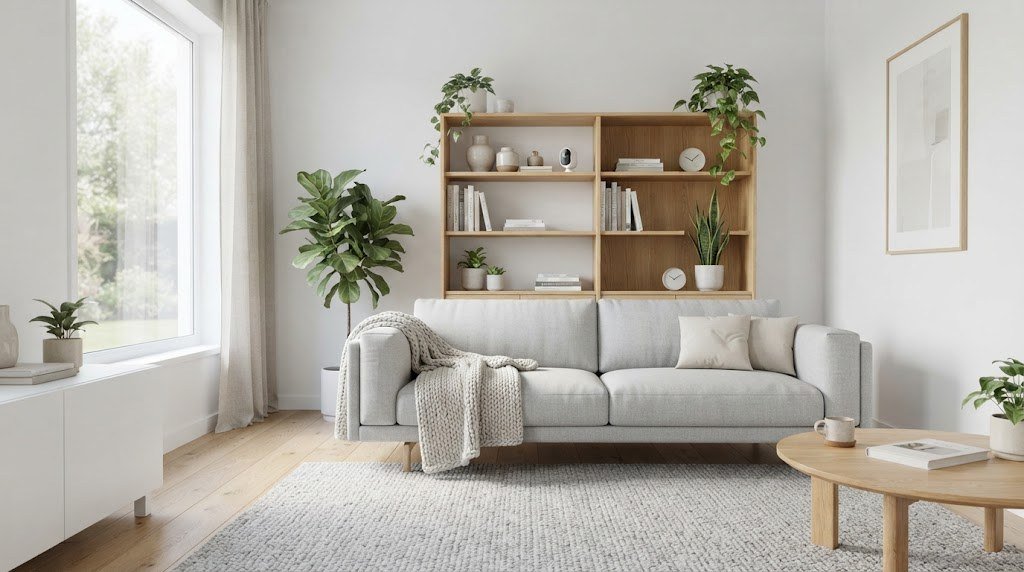
The Google Nest Cam (battery model) comes in snow and linen finishes that read more like a small speaker than a security device. It runs $179.99 alone, with subscription plans for cloud storage and person/package alerts starting around $8 a month.
Ring’s Indoor Cam is smaller and cheaper, usually under $60, and works well tucked onto a bookshelf facing the entry. Pro tip:
Pro tip: Mount cameras at 7-8 feet high, angled slightly down. This avoids the “up-the-nose” angle that makes footage useless for identifying a face.
- Field of view: look for 130-160 degrees to cover most living rooms without blind spots
- Night vision: infrared is standard; color night vision (like Nest’s) helps more with identification
- Storage: local microSD or free rolling storage beats a mandatory subscription if budget is tight
Window and Door Sensors for Ground-Floor Rooms
Sensors are the cheapest, least glamorous part of home security, and also the most reliable. A magnetic contact sensor on a window or door triggers the instant it’s opened, long before a burglar’s fully inside.
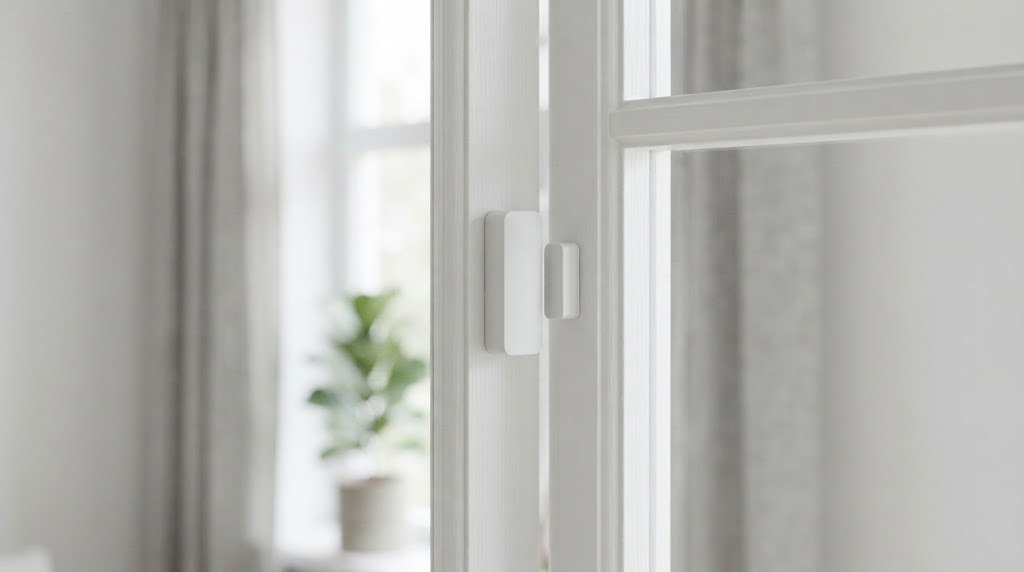
SimpliSafe and Ring Alarm both sell entry sensors for around $20-30 each, and they pair with matching white or gray finishes that vanish against most trim. Most living rooms need two to four of these: one per window, one per exterior door.
Battery life on these typically runs 3-5 years, so this isn’t a maintenance headache. Check the mounting depth before buying if your windows have deep sills or thick casement frames, since the two halves of the sensor need to sit close enough to detect contact.
Motion Sensors vs. Glass-Break Sensors
These two get confused constantly, but they solve different problems. A motion sensor, usually passive infrared (PIR), detects movement in a room after someone’s already inside.
A glass-break sensor listens for the specific acoustic signature of breaking glass and can trigger before anyone sets foot past the window. For a living room with a large picture window, a dedicated glass-break sensor is worth the extra $30-40 over relying on motion alone.
Here’s what changes the outcome:
- Motion-only setups mean the alarm doesn’t trip until someone’s already past the glass and standing in your room
- Glass-break sensors can catch the attempt itself, giving faster notification
- Combining both covers the room whether someone smashes the window or just walks through an opened up door
- Pet-immune PIR sensors (rated for pets under 40-55 lbs) avoid false alarms from dogs or cats on the sofa
Skip cheap ultrasonic-only sensors. They’re prone to false triggers from HVAC vents and ceiling fans, a common complaint on smart home forums.
Smart Locks and Video Doorbells Paired to Your Living Room Hub
If your living room opens onto the front entry, your smart lock and doorbell matter as much as anything inside the room. A video doorbell gives you the first look at who’s approaching, often 10-20 seconds before they reach the door.
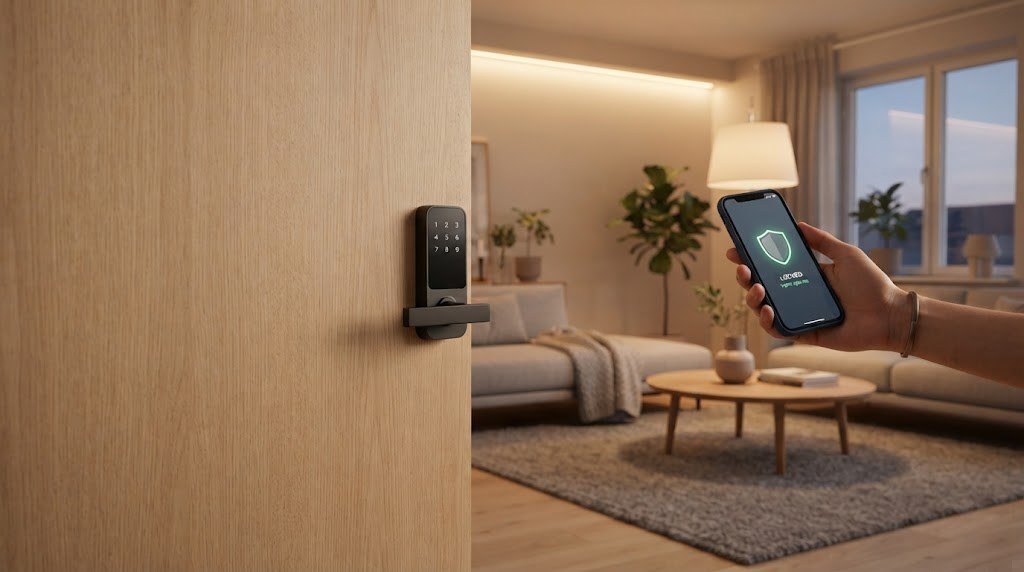
Pair it with a smart lock like the August Wi-Fi Smart Lock or Schlage Encode, both of which retrofit onto existing deadbolts without swapping the whole door hardware. Prices run roughly $230-280 depending on finish, and most support geofencing so the door auto-locks when your phone leaves the area.
The real win is integration. When the doorbell rings, a camera inside the living room can auto-record, and a smart display on the shelf can show the feed without you touching a phone. This only works if all three run on the same ecosystem, whether that’s Google Home, Amazon Alexa, or Apple Home.
Choosing a Monitoring Plan: DIY vs. Professional
This is where most buyers get stuck. DIY systems like SimpliSafe or Ring Alarm let you self-monitor for free (alerts to your phone only) or pay roughly $20-28 a month for professional 24/7 monitoring with police dispatch.
Professionally installed systems from companies like ADT cost more upfront, often with equipment bundles running $400-600, plus monthly monitoring that can run $45-60. You’re paying for install labor and a contract, not necessarily better hardware.
For a single living room setup, DIY self-monitoring usually makes more sense. You already get phone alerts instantly; the question is whether you want a third party calling police if you don’t respond within a set window, which matters more if the house sits empty during work hours.
Hiding Tech in a Scandinavian Interior
Scandinavian design leans on natural materials, muted tones, and visible restraint. Security gear tends to be the opposite: black boxes, red LEDs, visible screws.
The fix is picking finishes deliberately. Several brands now offer snow-white or sand-colored camera housings that sit naturally against light oak shelving or linen curtains.
- Route cables behind baseboards or inside cable raceways painted to match the wall
- Choose sensors in white or light gray, never black, for window frames and door trim
- Tuck hub units inside a console table or behind a plant rather than on open display
- Pick a doorbell with a slim brass or matte white faceplate instead of glossy black plastic
Pro tip: Test camera placement against your actual wall color before drilling. A white camera against a warm oak wall can look stark; sand or taupe finishes blend better with Scandi wood tones.
Budgeting: What to Spend Room by Room
A full living room setup doesn’t need to be expensive. Here’s a realistic range depending on how much coverage you want.
- Basic setup (1 camera, 2 door/window sensors): $150-220
- Mid-range setup (camera, 4 sensors, smart doorbell): $350-500
- Full setup (camera, glass-break sensor, smart lock, doorbell, monthly monitoring): $600-900 upfront, plus $20-28 a month
Most homeowners protecting a single living room and front entry land in the mid-range bracket. That’s enough to cover the window, the door, and general motion without over-buying gear for rooms you haven’t secured yet.
Putting Your Living Room Security Plan Together
Start with the front door and the biggest window. Those two points cover most of the actual risk in a living room, and a sensor plus a camera there does more than five gadgets scattered elsewhere.
From there, layer in a glass-break sensor if the window is large, and pick a monitoring plan that matches how often the house sits empty. If someone’s usually home, self-monitoring through your phone works fine. If the house is empty most weekdays, paid monitoring buys real peace of mind.
None of this has to clash with a Scandinavian look. White and sand-finish hardware, hidden cabling, and hub units tucked into furniture mean the room still reads as calm and uncluttered, even with real home security working quietly in the background.
Frequently asked questions
Do I need a professional installer for a living room security system?
No. Most modern systems like Ring Alarm and SimpliSafe are designed for self-install, usually taking under an hour for a living room’s worth of sensors and a camera. Professional install matters more for wired systems or if you’re adding glass-break sensors to unusual window shapes.
Will a visible camera actually deter burglars?
Yes, visible cameras are one of the strongest deterrents; research consistently shows burglars avoid homes with obvious security signage and cameras over ones without. A camera near the front entry, even a small one, works as a visual warning before it ever records anything useful.
How many sensors does a typical living room need?
Most living rooms need one sensor per window and one per exterior door, so two to four sensors covers a standard room. Add a motion sensor for the open floor area if the room connects to a hallway or stairwell.
Can I match security devices to my Scandinavian decor without buying custom gear?
Yes, several major brands now sell white, sand, or linen-finish cameras and sensors specifically because smart home buyers want them to blend in. Look at finish options before buying color, not just after, since swapping later usually means buying a second unit.
Is a video doorbell part of “living room” security or a separate category?
It’s part of the same system if your living room opens onto the front entry, which is the case in most homes. The doorbell feed often displays on a screen or speaker inside the living room, so treat it as one connected setup rather than a separate purchase.



