
Does home security have to cost a fortune to be effective? Not even close. Most homeowners dramatically overestimate the price of a solid deterrent setup – and underestimate how much free or near-free changes can accomplish.
The good news: burglars are opportunists. Research from the University of North Carolina found that 60% of convicted burglars said visible security measures caused them to abandon a target. You do not need a $200/month monitoring contract to trigger that effect.
—
Table of Contents
- The Real Cost of Home Security in 2026
- Free Deterrents That Outperform Their Price Tag
- DIY vs. Professional Installation: Which Wins on Value?
- The 6 Best Budget Security Upgrades (Ranked)
- Smart Locks and Doorbell Cameras Under $100
- Lighting as a Security Layer
- Neighborhood Watch and Digital Community Tools
- Building a Layered Security Plan on a Tight Budget
- Making Your Investment Last
- Frequently Asked Questions
—
The Real Cost of Home Security in 2026
The home security industry wants you to think in terms of monthly fees. The average professionally monitored system runs $30 to $60 per month, or $360 to $720 per year, before equipment costs. Over five years, that is easily $2,000 to $4,000 out of pocket – often for features most households never use.
The smarter framing is a one-time hardware budget paired with optional self-monitoring. A capable DIY setup from brands like SimpliSafe or Ring can be assembled for $150 to $350 upfront, with optional professional monitoring at $10 to $20/month if you want it. That is roughly 70% less than a traditional dealer-installed system.
The honest trade-off: professional monitoring provides a human response when you are unreachable. Self-monitoring means your phone is the alarm. For most low-to-medium risk neighborhoods, self-monitoring is entirely adequate.
—
Free Deterrents That Outperform Their Price Tag
Behavior change costs nothing. It also works. A locked door sounds obvious, but FBI Uniform Crime Reports consistently show that roughly 34% of burglars enter through the front door – often opened up or with a single-cylinder deadbolt that takes under 60 seconds to kick in.
Start here. Lock every entry point every time. Trim hedges below 3 feet near windows and doors – concealment is a burglar’s best friend. Vary your routine visibly: staggered porch lights, different parking spots, mail collected daily.
A “Protected by ADT” yard sign or window decal costs under $5 on its own and has genuine deterrent value even without the underlying system. Studies on deterrence consistently show signage alone reduces targeting probability by a measurable margin.
—
DIY vs. Professional Installation: Which Wins on Value?
This is the core financial decision in any home security plan. Here is a direct comparison.
Option A: DIY Self-Monitored System
DIY systems like the Ring Alarm or Wyze Home Monitoring kit install in under 2 hours with no tools beyond a screwdriver. Equipment costs run $100 to $250 for a starter kit covering one entry point, motion detection, and a siren. Monthly fees are optional – $0 for self-monitoring, or $10 to $20/month for professional backup.
The upside: no contracts, no cancellation fees, and hardware you own outright. The downside: if your phone is dead or you are in a no-signal area, alerts go unacknowledged.
Option B: Professional Installation with Monitoring
Dealer-installed systems (ADT, Vivint, Brinks) typically charge $99 to $299 for installation plus $40 to $60/month on a 24 to 36 month contract. Early termination fees average $75 to $300. You get 24/7 dispatch, cellular backup, and professional-grade sensors – but you are locked in financially.
| Feature | DIY Self-Monitored | Pro Installed |
|---|---|---|
| Upfront cost | $100 to $250 | $99 to $299 |
| Monthly fee | $0 to $20 | $40 to $60 |
| Contract required | No | Yes (24 to 36 months) |
| 5-year total cost | $100 to $1,450 | $2,499 to $4,099 |
| Cellular backup | Optional | Standard |
| Response time | Self / optional | 30 to 60 seconds |
For most budget-conscious households, Option A wins on pure value. Option B makes sense if you travel frequently or have a high-risk property.
—
The 6 Best Budget Security Upgrades (Ranked)
After testing dozens of setups, these six upgrades deliver the best deterrence-per-dollar. Listed from lowest to highest cost:
- Door reinforcement kit – A $25 to $40 strike plate upgrade (like the Door Armor MAX) raises kick-in resistance from under 1 minute to over 10 minutes, which exceeds most burglars’ patience threshold.
- Window and door sensors – Individual sensors from Wyze or Ring cost $10 to $20 each and trigger instant phone alerts.
- Motion-activated floodlights – A $35 to $60 LED floodlight (Blink, Mr. Beams) covers a full driveway and runs on batteries for 6 to 12 months per set.
- Video doorbell camera – The Blink Video Doorbell runs $49 to $59 and stores clips locally or on free cloud tier.
- Indoor security camera – A Wyze Cam v3 at $35 offers 1080p night vision and free 14-day cloud storage.
- Smart lock with keypad – Entry-level options from Schlage or Yale start at $79 to $99 and eliminate the risk of lost or copied keys.
—
Smart Locks and Doorbell Cameras Under $100
These two categories get the most attention – and for good reason. They cover the highest-risk entry point (the front door) with both deterrence and evidence collection.
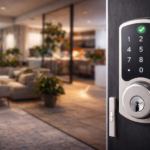
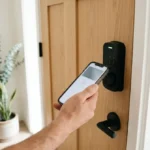
A smart lock with a keypad removes physical key vulnerability. The Schlage Encode Plus sits just above $100 at retail, but the Wyze Lock Bolt at $79 handles the basics cleanly: fingerprint open up, app alerts, and auto-lock after 30 seconds of door closure. Battery life runs 6 to 8 months on four AAs.
Doorbell cameras catch the face of every package thief and cold-call burglar. The Google Nest Doorbell (battery) is excellent but runs $179. For strict budget work, the Blink Video Doorbell at $49 covers 1080p video, two-way audio, and motion zones. Pair it with a free Amazon account for basic cloud history.
—
Lighting as a Security Layer
Darkness is infrastructure for crime. A well-lit exterior cuts the cover burglars rely on – and good lighting costs far less than cameras.
Motion-activated LEDs draw 8 to 15 watts versus the 65 to 100 watts of older halogen floods. Running a 10-watt LED floodlight for 6 hours nightly costs roughly $2 to $3 per year at average US electricity rates. That is genuine security at near-zero operating cost.
Place lights at all four corners of the house, over the garage, and along any side-yard path wider than 4 feet. Smart bulbs (Philips Hue, LIFX) can simulate occupancy by randomizing on/off schedules when you travel – a $15 to $25 per-bulb investment that outperforms a cheap timer.
—
Neighborhood Watch and Digital Community Tools
Technology is only part of the equation. Social infrastructure matters just as much for low-cost home security.
Apps like Neighbors by Ring and Nextdoor create real-time local alert networks. A neighbor who spots an unfamiliar car idling for 20+ minutes can post an alert that reaches 50 to 200 households in under 5 minutes. That kind of distributed awareness is impossible to replicate with hardware alone.
Formal neighborhood watch programs, coordinated through your local police department, reduce residential burglary rates by 16 to 26% according to National Institute of Justice data. They cost nothing to join and often come with free deterrent materials.
—
Building a Layered Security Plan on a Tight Budget
The most effective affordable home security approach is not one expensive device – it is 3 to 4 cheap layers that compound deterrence.
Layer one is behavioral: locked doors, trimmed landscaping, no hidden spare keys. Layer two is passive hardware: reinforced strike plates, window locks, and motion lighting. Layer three is detection: door sensors and at least one camera covering the primary entry. Layer four is response: a loud siren (the Wyze Home Monitoring siren hits 105 dB) and a neighbor or app alert chain.
Each layer adds friction. Most burglars abandon a target after 90 seconds of resistance. A four-layer setup, assembled for $150 to $300 total, creates more than enough friction to push an opportunist to an easier target down the street.
—
Making Your Investment Last
The best affordable home security strategy is not a one-time purchase – it is a system you maintain and expand incrementally.
Start with the highest-risk entry points: front door, back door, and any ground-floor window hidden from street view. Add one device every 1 to 2 months until coverage is complete. Most DIY ecosystems (Ring, Wyze, SimpliSafe) are modular, so a $150 starter kit today can grow into a $400 full-coverage system over 12 months without any single painful outlay.
Review your setup every 6 months. Check battery levels, test motion zones, and update app permissions. A sensor with a dead battery provides zero protection. Fifteen minutes of maintenance twice a year keeps the whole system honest.
The math is clear. A layered DIY approach built over one year costs roughly $25 to $35 per month amortized – less than a single professional monitoring contract, with no cancellation risk and hardware you own outright. For most households, that trade-off is straightforward.
> 📋 Disclaimer: This article is for informational purposes only and does not constitute financial or legal advice. Product prices and availability are subject to change. Consult a licensed security professional for high-risk properties or specific vulnerability assessments.
—
When you implement budget home security tips, revisit the checklist above against your real constraints.
Free tools: Planning a bigger setup? Our free smart home cost calculator estimates devices, installation and monthly fees for your whole home. How much storage will your cameras need? Our free security camera storage calculator shows how many days of footage your hard drive or microSD card will hold.
Frequently Asked Questions
What is the single most cost-effective home security upgrade?
A reinforced strike plate and deadbolt upgrade. At $25 to $50 total, it addresses the most common forced-entry method – door kick-ins – and raises resistance time from under 60 seconds to over 10 minutes. No subscription required, no app needed.
Do free self-monitored systems actually work as deterrents?
Yes. Visible cameras and sensors deter opportunistic burglars regardless of whether monitoring is active. The University of North Carolina study found that 60% of burglars chose a different target when security measures were visible – not when alarms were verified.
How much should a homeowner budget for a starter security setup in 2026?
A functional four-layer setup – strike plate, two door sensors, one outdoor camera, and motion lighting – can be assembled for $150 to $250. That covers the front door, back door, and driveway with no monthly fees if self-monitored.
Is professional monitoring worth the cost for a budget-focused household?
For most low-to-medium risk neighborhoods, no. Self-monitoring via app alerts handles the majority of scenarios. Professional monitoring adds value primarily when you travel frequently, have unreliable cell coverage, or own high-value assets that justify the $40 to $60/month premium.
Can renters implement these tips without violating lease terms?
Most of these upgrades are renter-friendly. Door sensors, cameras, smart locks with keypad adapters, and motion lights involve no permanent modification. Check your lease before installing anything that requires drilling – but strike plate replacements and adhesive sensors are almost universally permitted.