
Electricity prices keep climbing. The U.S. Energy Information Administration expects the average residential rate to reach about 18 cents per kWh in 2026, up from roughly 17 cents in 2025. That makes every wasted kilowatt-hour a little more expensive.
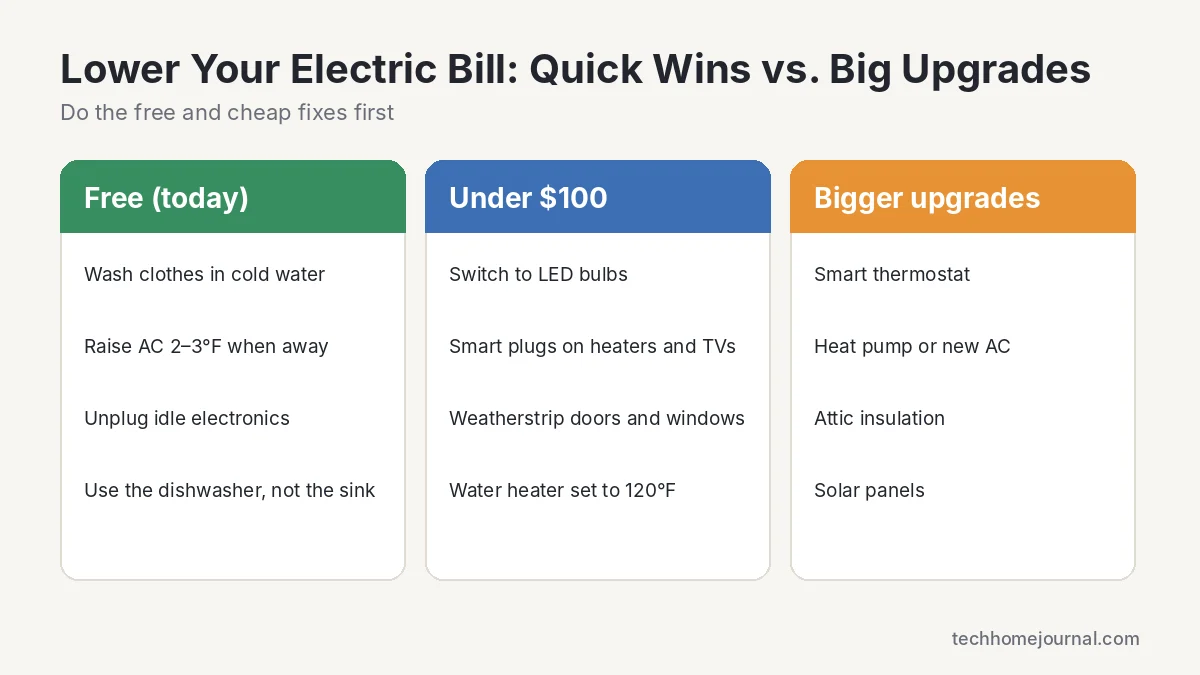
The good news is that most homes can cut their bill noticeably without spending much. This guide starts with free changes you can make today, then moves to cheap fixes and finally the upgrades that are actually worth the money.
Free tool: Find out what each device in your home costs to run with our Appliance Energy Cost Calculator.
Table of Contents
- Start With Your Bill
- Do a 30-Minute Energy Audit
- Heating and Cooling: The Biggest Savings
- Cut Hot Water Costs
- Kitchen and Laundry Habits
- Stop Paying for Standby Power
- Lighting
- Use Your Utility’s Programs
- Seasonal Tips
- Electricity Myths That Cost You Money
- Upgrades Worth Paying For
- Frequently Asked Questions
Start With Your Bill
Pull up your last few bills and find two numbers: your rate per kWh and how many kWh you use each month. Many bills also show a 12-month usage chart. If your usage jumps in summer, cooling is your biggest target. If it jumps in winter and you have electric heat, heating is.
Also check whether you’re on a flat rate or a time-of-use plan, and whether there’s a fixed monthly service charge. That charge doesn’t change no matter how much you save, so focus on the per-kWh part.
Do a 30-Minute Energy Audit
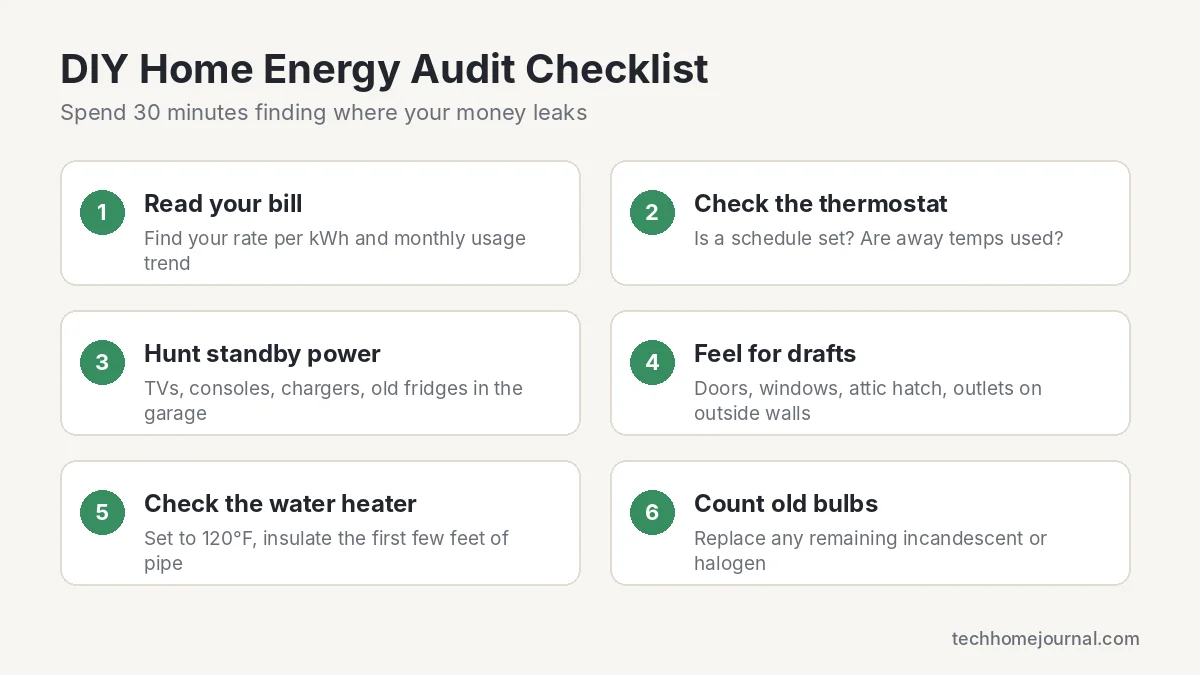
You don’t need special tools. Walk through your home with this checklist:
- Thermostat: Is a schedule set? Does it lower the temperature at night and when you’re out?
- Standby power: Look for TVs, consoles, cable boxes, old computers and chargers that stay plugged in all the time.
- Second fridge or freezer: Old units in garages and basements are often the biggest hidden cost.
- Drafts: Feel around doors, windows, the attic hatch and outlets on outside walls on a windy day.
- Water heater: Check the temperature setting and whether the first few feet of pipe are insulated.
- Lighting: Count any remaining incandescent or halogen bulbs.
Many utilities also offer free or low-cost professional home energy audits. Check your utility’s website, or see the Department of Energy’s guide to home energy assessments.
Heating and Cooling: The Biggest Savings
Heating and cooling make up almost half of a typical home’s energy bill, according to ENERGY STAR, so this is where small changes add up fastest.
- Adjust a few degrees. Set the thermostat a little higher in summer and lower in winter, and turn it back further when you’re asleep or away.
- Change the air filter. A clogged filter makes your system work harder. Check it monthly during heavy use.
- Use ceiling fans. A fan lets you feel cooler at a higher thermostat setting. Turn it off when you leave the room, since fans cool people, not rooms.
- Block the sun. Close blinds on sunny windows in summer and open them in winter.
- Get a tune-up. An annual service keeps heat pumps, furnaces and AC units running efficiently.
A smart thermostat does the adjusting for you. See how much it could save with our Smart Thermostat Savings Calculator, or compare models in our guide to the best smart thermostats.
Cut Hot Water Costs
Water heating accounts for about 18% of home energy use, according to the Department of Energy. Easy ways to cut it:
- Set the water heater to 120°F instead of 140°F.
- Take shorter showers and install a low-flow showerhead.
- Fix dripping hot water taps.
- Insulate the first few feet of hot water pipe coming out of the tank.
- When it’s time to replace your tank, look at a heat pump water heater.
Kitchen and Laundry Habits
- Wash clothes in cold water. Most of a washer’s energy goes into heating water.
- Run full loads in the washer and dishwasher, and skip the heated dry setting on the dishwasher.
- Clean the dryer lint filter every load, and air-dry when you can.
- Keep the fridge at 37 to 40°F and the freezer at 0°F. Colder than that just wastes energy.
- Use small appliances. A microwave, air fryer or slow cooker uses less energy than heating a full oven for a small meal.
Stop Paying for Standby Power
Devices that stay plugged in keep drawing power, even when they look off. The NRDC found that idle loads can account for about 23% of household electricity use. Use power strips or smart plugs to cut power to entertainment centers and home offices, and unplug the old garage fridge if you don’t really need it.
Lighting
LEDs use at least 75% less energy than incandescent bulbs and last up to 25 times longer, according to the Department of Energy. Replace any remaining old bulbs, starting with the lights you use most. Motion sensors in garages, closets and hallways stop lights from running when nobody is there.
Use Your Utility’s Programs
- Time-of-use plans: If you can run laundry, dishes and EV charging in the evening or overnight, a TOU plan may lower your bill. If you can’t shift usage, it may raise it, so compare carefully.
- Rebates: Many utilities offer rebates on smart thermostats, heat pumps, insulation and ENERGY STAR appliances.
- Free audits and weatherization: Some utilities and state programs offer free audits, and low-income households may qualify for weatherization help.
- Choose your supplier: In states with retail electricity choice, you may be able to pick a cheaper supply rate. Read the contract terms carefully.
- Budget billing: This spreads your costs evenly across the year. It doesn’t lower your total, but it can make big summer or winter bills easier to manage.
Seasonal Tips
Summer
- Set the AC a few degrees higher when you’re home and higher still when you’re away.
- Close blinds on south and west windows during the hottest part of the day.
- Avoid using the oven and dryer in the afternoon heat. Grill outside or cook in the microwave.
- Make sure the outdoor AC unit has clear airflow, with no plants or debris crowding it.
Winter
- Lower the thermostat at night and use warm bedding instead.
- Open curtains on sunny days to let the sun help heat your home, then close them at night.
- Seal drafts around doors and windows with weatherstripping or door sweeps.
- Use space heaters only in the room you’re in, never as a replacement for whole-home heat, and put them on a timer.
Electricity Myths That Cost You Money
- “Turning lights on and off uses more energy than leaving them on.” Not with modern LEDs. Turn them off when you leave a room.
- “Closing vents in unused rooms saves energy.” Closing too many vents can make your HVAC work harder and less efficiently. Use room sensors or zoning instead.
- “Cranking the thermostat heats or cools faster.” Most systems run at the same speed no matter the setting. You just overshoot and waste energy.
- “Screen savers save power.” They don’t. Let your computer and monitor go to sleep instead.
- “Budget billing lowers your bill.” It only spreads payments evenly. Your total usage is what matters.
Upgrades Worth Paying For
| Upgrade | Approx. cost | Best for |
|---|---|---|
| Weatherstripping and caulk | $20 to $50 | Drafty older homes |
| Smart plugs | $10 to $25 each | Standby loads, space heaters |
| Smart thermostat | $130 to $280 | Almost every home with central HVAC |
| Home energy monitor | $70 to $300 | Finding hidden waste |
| Attic insulation | Varies | Homes with thin or old insulation |
| Heat pump | Varies widely | Replacing an old AC or electric heat |
| Solar panels | $10,000+ | Sunny areas with high rates |
A home energy monitor is a smart first upgrade if you’re not sure where your power goes. For a step-by-step plan for smart devices, read our smart home energy saving tips.
Thinking about going further than smart plugs? Our solar panel calculator estimates the system size that would cover your monthly electricity use.
Frequently Asked Questions
What uses the most electricity in a home?
Heating and cooling, followed by water heating. Large appliances like dryers, electric ovens, refrigerators and EV chargers come next.
What is the fastest way to lower my electric bill?
Adjust your thermostat a few degrees, wash clothes in cold water, lower your water heater to 120°F and cut standby power with power strips or smart plugs. None of these cost anything.
Does unplugging appliances really save money?
Yes, for devices with standby power like TVs, consoles, cable boxes and old computers. It won’t make a big difference for things that use almost no power when off, like lamps and toasters.
Is it cheaper to leave the AC on all day?
In most cases, no. Raising the temperature while you’re away and cooling the house down shortly before you return uses less energy than cooling an empty house all day.
How much can I save on my electric bill?
It varies, but combining free habit changes with a smart thermostat and LED lighting commonly saves 10% or more on a typical bill.