The Best Fluffy Pancakes recipe you will fall in love with. Full of tips and tricks to help you make the best pancakes.

Intro
Your heating and cooling system runs whether you’re home or not — and if you’re still using a basic programmable thermostat, you’re almost certainly paying for comfort nobody’s enjoying.
The top smart thermostats available in 2026 go far beyond simple scheduling. They learn your routine, detect when you leave, adjust automatically for weather changes, and show you exactly how much you’re saving — all from your phone.
According to the U.S. Department of Energy, heating and cooling accounts for nearly 43% of the average American home’s energy bill. The best thermostats for home use can reduce that by 10–23% annually — a real, measurable return on a $130–$250 investment.
In this guide, you’ll find our six top-tested smart thermostat picks for 2026, a complete buying guide, honest pros and cons, and everything you need to choose the right best home thermostat for your specific HVAC system and budget.
Quick Answer The Google Nest Learning Thermostat (~$130) is the best smart thermostat for most US homeowners — it learns your schedule automatically, works with virtually every HVAC system, and saves an average of 10–12% on heating and 15% on cooling bills. For the most advanced features at any price, the Ecobee Smart Thermostat Premium (~$250) is unmatched.
Best For: Quick Reference
Best Overall: Google Nest Learning Thermostat (~$130) — most homeowners wanting auto-learning with minimal setup effort
Best Premium: Ecobee Smart Thermostat Premium (~$250) — homeowners wanting room sensors, built-in Alexa, and maximum energy data
Best Budget: Google Nest Thermostat (~$90) — first-time buyers wanting Google smart home integration at the lowest price
Best for Complex HVAC: Ecobee SmartThermostat Enhanced (~$190) — homes with multi-stage heating, cooling, or heat pumps
Best for Simple Control: Honeywell Home T6 Pro (~$70) — homeowners wanting reliable digital scheduling without smart home complexity
Best for Apple HomeKit: Ecobee Smart Thermostat Premium (~$250) — iPhone users wanting full HomeKit + Siri integration
Top Smart Thermostats Our 6 Best Picks for 2026
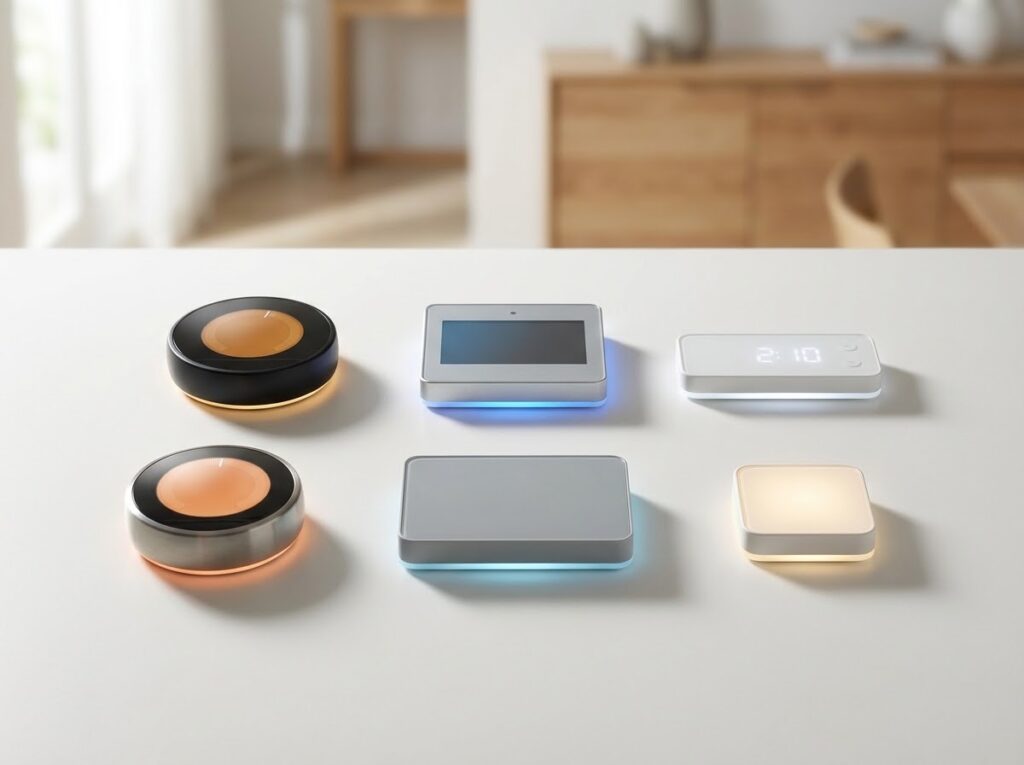
1. Google Nest Learning Thermostat — Best Overall
Price: ~$130 | Learning: Auto-learns schedule | Compatibility: 95% of US HVAC systems | Works With: Alexa, Google Home, Apple HomeKit | Subscription: $0
The Google Nest Learning Thermostat is our top pick for 2026 — and the most popular smart thermostat in the US for good reason. It watches your manual adjustments for the first week, builds a schedule automatically, then fine-tunes it using your home’s occupancy patterns. You genuinely don’t need to program anything.
Setup takes 30–45 minutes for most homeowners. The included app walks you through wiring step by step with real photos of actual wire configurations — the clearest installation guide in the category.
Imagine arriving home after a long day to find your house already at the perfect temperature — not because you remembered to adjust it from your phone, but because your thermostat learned that you’re always home by 6pm on weekdays. That’s the Nest in daily practice.
What our team loved:
- Fully automatic learning — no manual programming
- Home/Away Assist uses phone location for auto-adjustments
- Works with 95% of US 24V HVAC systems
- Alexa, Google Home, and Apple HomeKit compatible
- Proven average savings: 10–12% on heat, 15% on cooling
One limitation: Requires a C-wire for reliable operation — older homes without one may need the included Power Connector adapter.
2. Ecobee Smart Thermostat Premium — Best Premium Pick
Price: ~$250 | Learning: Yes + room sensors | Compatibility: Most multi-stage US systems | Works With: Alexa (built-in), Google Home, Apple HomeKit | Subscription: $0 basic / Premium app optional
The Ecobee Smart Thermostat Premium is the most feature-complete top smart thermostat available to US homeowners in 2026. It comes with a SmartSensor for remote room temperature monitoring, has Alexa built directly into the thermostat itself, and includes air quality and occupancy detection all in one device.
The Ecobee’s key advantage over Nest is room-level temperature control. If your bedroom runs 4°F warmer than your living room, the Ecobee uses its remote sensor data to make smarter decisions — heating and cooling based on where you actually are, not just where the thermostat is mounted.
What our team loved:
- Includes SmartSensor for room-level monitoring
- Built-in Alexa — no Echo device needed
- Air quality + occupancy detection built in
- Apple HomeKit, Google Home, Alexa, SmartThings compatible
- Best energy reporting dashboard of any thermostat tested
One limitation: Higher upfront cost and the most detailed energy analytics sit behind the optional premium subscription tier.
3. Google Nest Thermostat — Best Budget Smart Thermostat
Price: ~$90 | Learning: Schedule-based only | Compatibility: Most common US systems | Works With: Google Home, Alexa | Subscription: $0
The Google Nest Thermostat (not to be confused with the Learning Thermostat) is the most affordable entry point into the Google smart home ecosystem. It doesn’t auto-learn your schedule — you set it manually — but it does use Eco mode, phone-based Home/Away detection, and full Google Home integration at the lowest price point in the Nest lineup.
What our team loved:
- Most affordable Nest thermostat at ~$90
- Eco mode + Home/Away saves energy automatically
- Clean minimal display — blends into any room
- Google Home and Alexa compatible
- Easy DIY installation with app guidance
4. Ecobee SmartThermostat Enhanced — Best for Complex HVAC
Price: ~$190 | Learning: Yes | Compatibility: Multi-stage, heat pump, dual fuel | Works With: Alexa, Google Home, Apple HomeKit | Subscription: $0 basic
The Ecobee SmartThermostat Enhanced handles the HVAC configurations that frustrate most thermostats — multi-stage heating and cooling, heat pumps, dual-fuel systems, and up to 8 stages of control. If your system is anything more complex than a standard single-stage setup, this is your best home thermostat option.
What our team loved:
- Handles multi-stage, heat pump, and dual-fuel systems
- Compatible with up to 8 stages of control
- Full Alexa, Google Home, and HomeKit support
- SmartSensor compatible — add room sensors anytime
- Excellent energy usage reporting
5. Honeywell Home T6 Pro — Best Simple Digital Thermostat
Price: ~$70 | Learning: No | Compatibility: Most US systems | Works With: No smart platform | Subscription: $0
Not every homeowner wants voice control and app connectivity. The Honeywell Home T6 Pro is the best best digital thermostat for homeowners who want reliable 7-day programmable scheduling without WiFi, apps, or smart home complexity.
It’s the most reliable conventional digital thermostat available — 7-day flexible scheduling, clear backlit display, simple menu navigation, and rock-solid performance for 10+ years without any cloud dependency.
What our team loved:
- No WiFi or app required — completely standalone
- 7-day flexible scheduling
- Intuitive backlit display — easy for all ages
- Works with virtually all common US HVAC systems
- No subscription, no cloud, no connectivity issues
Home Energy Monitor: Best Systems to Track Every Watt
6. Emerson Sensi Touch 2 — Best Mid-Range Wireless Thermostat
Price: ~$120 | Learning: Schedule-based | Compatibility: Most US systems including heat pumps | Works With: Alexa, Google Home, Apple HomeKit | Subscription: $0
The Emerson Sensi Touch 2 is the best mid-range best wireless thermostat for homeowners wanting smart scheduling, full voice assistant support, and Apple HomeKit compatibility without paying Ecobee or Nest Premium prices.
It offers a vivid color touchscreen, flexible 7-day scheduling, geofencing for automatic Home/Away detection, and utility flex rate programs — all for $120 with no subscription required.
What our team loved:
- Full Apple HomeKit, Alexa, and Google Home support
- Geofencing for automatic Home/Away detection
- Utility flex programs — earn bill credits in some states
- Clean color touchscreen interface
- No subscription for any core features
Best Thermostats for Home: Full Comparison Table
| Thermostat | Price | Auto-Learning | Room Sensors | Voice Assistants | Best For |
| Nest Learning | ~$130 | Yes | No | Alexa, Google, HomeKit | Best overall |
| Ecobee Premium | ~$250 | Yes | Included | Alexa built-in, Google, HomeKit | Premium pick |
| Nest Thermostat | ~$90 | No | No | Google, Alexa | Budget Google |
| Ecobee Enhanced | ~$190 | Yes | Optional | Alexa, Google, HomeKit | Complex HVAC |
| Honeywell T6 Pro | ~$70 | No | No | None | No-WiFi option |
| Sensi Touch 2 | ~$120 | No | No | Alexa, Google, HomeKit | Mid-range value |
What to Look For When Buying a Smart Thermostat
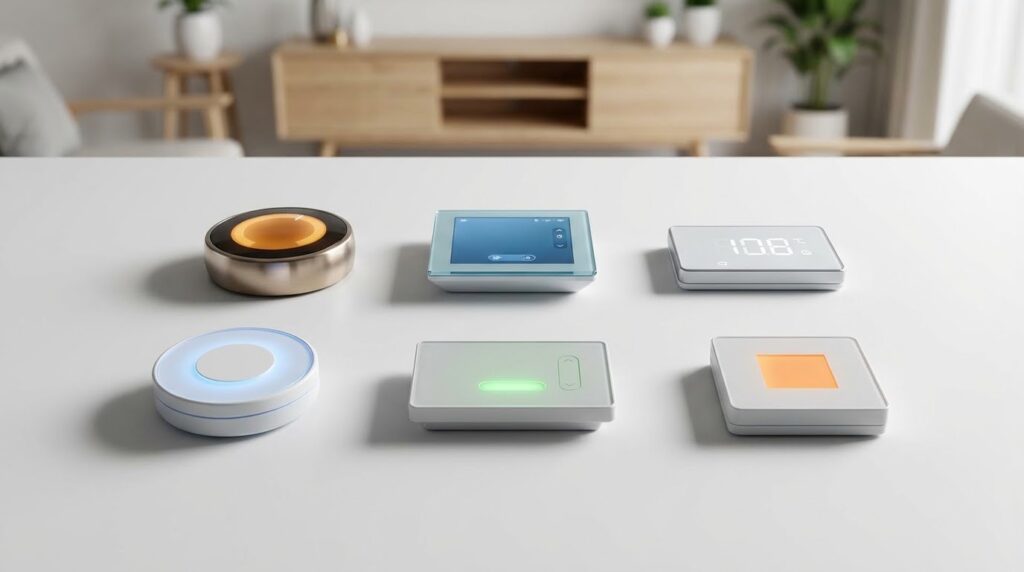
Before purchasing any of the top smart thermostats, run through these five checks. Getting them wrong means returning a thermostat you spent an hour installing.
1. HVAC System Compatibility
This is the most important check — and the one most buyers skip. Before purchasing any smart thermostat, identify your system type:
| System Type | Compatible Thermostats |
| Standard single-stage heat/cool | All 6 picks on this list |
| Heat pump | Ecobee Enhanced, Sensi Touch 2, Nest Learning |
| Multi-stage system | Ecobee Enhanced, Ecobee Premium |
| Dual fuel | Ecobee Enhanced |
| Boiler/radiant heat | Check compatibility carefully — most smart thermostats don’t support |
Use each manufacturer’s compatibility checker online before purchasing. Both Nest and Ecobee have free tools that confirm compatibility based on your existing wiring.
2. C-Wire Availability
Most modern smart thermostats require a C-wire (common wire) for continuous power. Check your current thermostat’s wiring:
- Have a C-wire: All smart thermostats install straightforwardly
- No C-wire: Nest Learning includes a Power Connector adapter; Ecobee includes a PEK adapter; Sensi Touch 2 works without one on most systems
3. Smart Home Platform
| Your Platform | Best Choice |
| Google Home primary | Nest Learning or Nest Thermostat |
| Apple HomeKit primary | Ecobee Premium or Sensi Touch 2 |
| Amazon Alexa primary | Ecobee Premium (built-in Alexa) |
| No smart home | Honeywell T6 Pro |
| Home Assistant | Ecobee (local API available) |
4. Auto-Learning vs Manual Scheduling
Auto-learning thermostats (Nest Learning, Ecobee) require zero manual programming — they observe your behavior and build a schedule automatically. Manual scheduling thermostats (Nest Thermostat, Sensi Touch 2, Honeywell T6 Pro) require you to set your own schedule — more control, less automatic optimization.
5. Room Sensors — Do You Need Them?
If your home has rooms that run significantly hotter or colder than where the thermostat is mounted, remote room sensors make a meaningful difference. The Ecobee Premium includes one SmartSensor — additional sensors cost ~$79 for a 2-pack.
Smart Outlet Plugs: Best Picks for Every Device & Budget
Best Wireless Thermostat Options: Do You Need Remote Sensors?
A best wireless thermostat does more than control temperature from your phone — the best ones use remote sensors to monitor temperature across multiple rooms simultaneously, making smarter heating and cooling decisions based on where people actually are.
When remote sensors genuinely help:
- Your thermostat is in a hallway that runs 5°F colder than your bedroom
- Your upstairs runs significantly warmer than your downstairs
- You have a home office you want to prioritize during work hours
- You have a guest room you want to exclude from heating when unoccupied
Ecobee’s SmartSensor system handles this best. Each sensor detects both temperature and occupancy — the thermostat automatically weights occupied rooms more heavily when making temperature decisions.
The result: your bedroom is at the right temperature when you’re sleeping, your home office is comfortable during work hours, and your HVAC system doesn’t waste energy conditioning rooms nobody is using.
Imagine working from your home office on a cold February morning. The hallway thermostat reads 71°F. Your office sensor reads 66°F. Without room sensors, your system thinks the house is comfortable. With Ecobee’s SmartSensor, it knows your office needs attention — and heats accordingly.
Room Sensor Quick Reference:
| Thermostat | Remote Sensors | Sensor Cost |
| Ecobee Premium | 1 included | ~$79 for 2-pack add-ons |
| Ecobee Enhanced | Not included | ~$79 for 2-pack |
| Nest Learning | Not supported | N/A |
| Nest Thermostat | Not supported | N/A |
| Sensi Touch 2 | Not supported | N/A |
Pros and Cons of Top Smart Thermostats
Pros:
- Proven energy savings — 10–23% reduction in heating and cooling costs annually for most US homes
- Automatic optimization — learning models and geofencing adjust temperature without any daily input from you
- Remote control — adjust from anywhere via smartphone, even mid-vacation
- Utility rebates available — many US utility companies offer $50–$100 rebates on qualifying smart thermostats
- Fast payback — most homeowners recover the purchase price within 12–18 months through energy savings
- Voice control — works with Alexa, Google Home, or Siri depending on model
Cons:
- Installation complexity — multi-stage and heat pump systems require careful wiring; some older homes lack a C-wire
- WiFi dependency — smart features stop working if your internet goes down
Learning curve — auto-learning thermostats take 1–2 weeks to fully optimize your schedule
- App quality varies — Google’s Nest app is excellent; some competitors lag behind
- Not compatible with all systems — boilers, radiant heat, and high-voltage systems often require specific models or aren’t supported
Frequently Asked Questions
What are the top smart thermostats available in 2026? The top smart thermostats in 2026 are the Google Nest Learning Thermostat (~$130) for most homeowners, the Ecobee Smart Thermostat Premium (~$250) for maximum features, the Google Nest Thermostat (~$90) for budget buyers, and the Emerson Sensi Touch 2 (~$120) for mid-range value with full HomeKit support.
How much can the best thermostats for home use actually save? According to the U.S. Department of Energy, smart thermostats save most homeowners 10–23% on heating and cooling annually. On a $200/month energy bill with 43% going to HVAC, that’s $103–$237 saved per year — meaning most smart thermostats pay for themselves within 12–18 months.
Is a smart thermostat worth buying for a rental property? Yes — with conditions. Check with your landlord first. Smart thermostats are reversible installations and most landlords approve them. The Honeywell T6 Pro is the best option for renters who want better scheduling without smart home features. For smart options, the Google Nest Thermostat at ~$90 offers the easiest reinstallation when you move.
Does the best wireless thermostat work without a C-wire? Most modern smart thermostats require a C-wire, but all top picks include workarounds. The Nest Learning Thermostat includes a Power Connector adapter. The Ecobee includes a Power Extender Kit (PEK). The Sensi Touch 2 works without a C-wire on most common systems. Always check your specific wiring before purchasing.
Which smart thermostat works best with Apple HomeKit? The Ecobee Smart Thermostat Premium is the best Apple HomeKit smart thermostat — it offers full native HomeKit integration, Siri voice control, and Thread support for faster local response times. The Emerson Sensi Touch 2 (~$120) is the best mid-range HomeKit option if the Ecobee’s price is too high.
Are smart thermostats difficult to install? Most smart thermostats take 30–60 minutes to install for a typical homeowner comfortable with basic DIY tasks. The hardest part is matching your existing wiring to the new thermostat’s terminals. Both Nest and Ecobee offer excellent in-app wiring guides with real photos. Complex HVAC systems — multi-stage, heat pumps — may warrant hiring an HVAC technician.
Can a best digital thermostat save as much as a smart thermostat? A quality programmable digital thermostat like the Honeywell T6 Pro saves energy when programmed correctly — typically 5–10% with a good 7-day schedule. Smart thermostats save more (10–23%) because they auto-optimize based on actual behavior, geofencing, and weather data rather than relying on a fixed schedule you set once and never update.
Bottom Line
The top smart thermostats in 2026 deliver real, measurable savings — not theoretical ones. Heating and cooling is the single largest energy expense in most US homes, and a smart thermostat is the highest-return upgrade available at any price point.
Our clear recommendation: Google Nest Learning Thermostat at ~$130 for most homeowners — automatic learning, proven savings, and compatibility with 95% of US systems. Want room sensors and built-in Alexa? The Ecobee Premium at ~$250 justifies every extra dollar.
Check your utility company’s website before buying — many offer $50–$100 rebates that make these thermostats nearly free.